If you buy through our links, Amazon pays us a small commission at no extra cost to you. That’s how we keep the site running. How we choose.
Contents
Overview
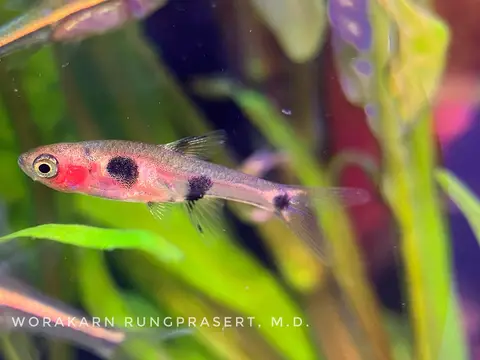
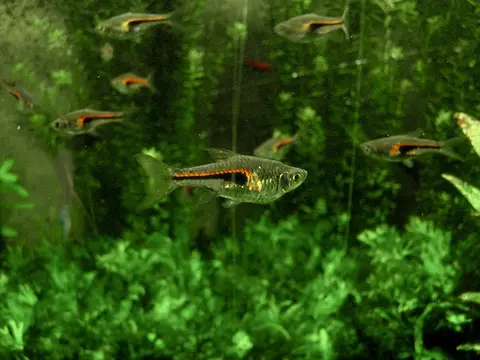
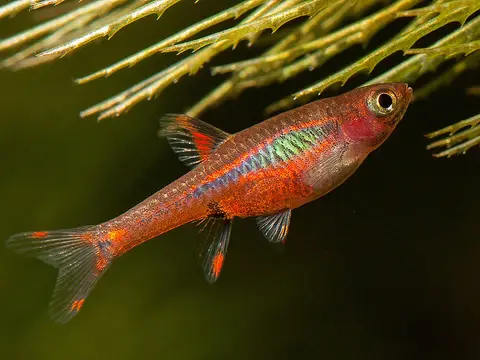
The chili rasbora, also sold as mosquito rasbora, is one of the smallest fish in the hobby: about 0.8 in (2 cm) as an adult, with a coral-red body and a dark lateral stripe that deepens when the fish feels secure. It comes from the peat swamps of southwestern Borneo, where the water is tea-colored, very soft, acidic and shaded by vegetation.
People love it because a well-colored school against green plants looks stunning, and because it turns an 8-10 gallon nano into a living biotope. It is not a fish for a brand-new setup, since it needs stable, mature water. For keepers who already understand the nitrogen cycle and want a quiet planted nano, shrimp included, it is an excellent pick.
Care and tank setup
A cycled tank of 8 gallons (30 L) or more works for a school of 10-15, though in 13-15 gallons (50-60 L) the group behaves more naturally. Stability matters more than size: add them to a tank that has been running for at least two or three months.
- Water: soft and slightly acidic, around 72-82 °F (22-28 °C). Moderate tap water is tolerated if stable, but color improves with remineralized RO water.
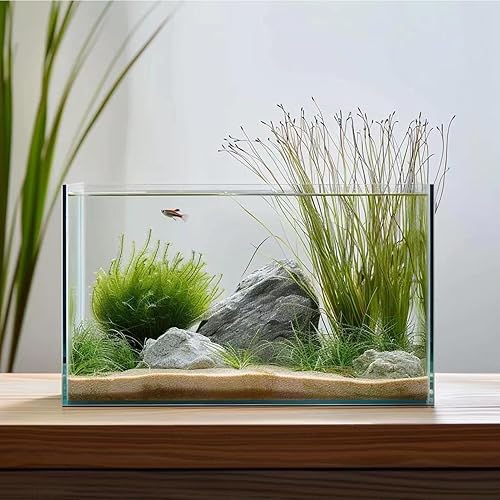
- Decor: dense plants, mosses, floaters to dim the light, catappa leaves and a dark substrate.
- Filtration: gentle, with a diffused outflow; they dislike strong current.
- Tank mates: dwarf shrimp, snails, otocinclus, pygmy corydoras or other Boraras. Avoid fast or large fish that will bully or eat them.
The classic mistake is buying them for a new tank or keeping only four or five: they hide, lose color and get sick easily. Do small, regular water changes and avoid sudden swings in temperature or pH.
Feeding
It is a micropredator that feeds on zooplankton, larvae and tiny insects in the wild. In the aquarium it takes crushed flakes and very fine micro pellets, but offer small live or frozen foods often: baby brine shrimp, daphnia, cyclops or chopped bloodworms. Feed tiny portions twice a day; its mouth is very small and leftovers quickly foul a nano tank.
Breeding
It scatters a few eggs among mosses and fine-leaved plants almost continuously and gives no parental care. In a heavily planted species-only nano, some fry survive on their own in the moss. To raise more, move a small group to a little tank with Java moss and soft water, remove the adults after a few days and feed the fry infusoria, then newly hatched brine shrimp.
Compatible tank mates
Species from our database that share water parameters, size and temperament with the Chili rasbora. Calculated from the data in each profile.
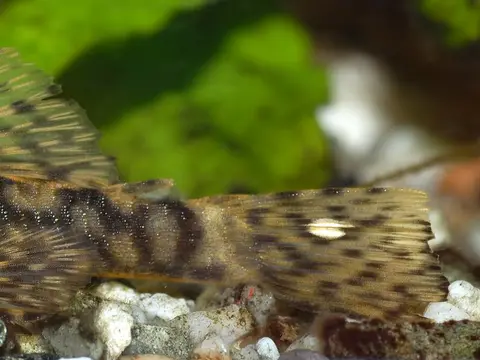 Bristlenose pleco Ancistrus sp. 26 gal (100 L) · 72–81 °F (22–27 °C)
 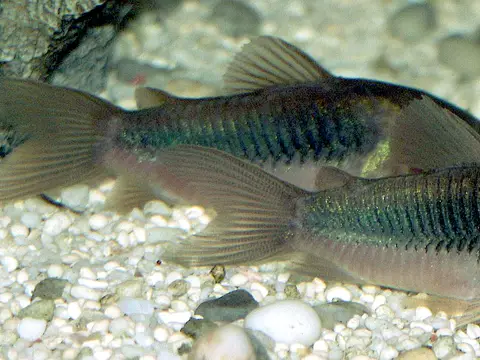 Bronze cory Corydoras aeneus 21 gal (80 L) · 72–81 °F (22–27 °C)
 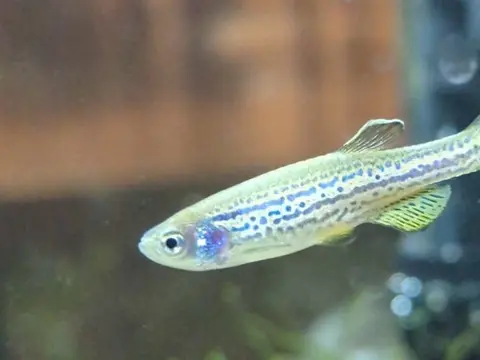 Zebra danio Danio rerio 16 gal (60 L) · 64–77 °F (18–25 °C)
 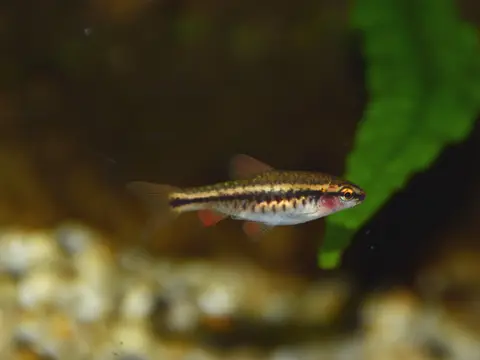 Cherry barb Puntius titteya 16 gal (60 L) · 73–81 °F (23–27 °C)
 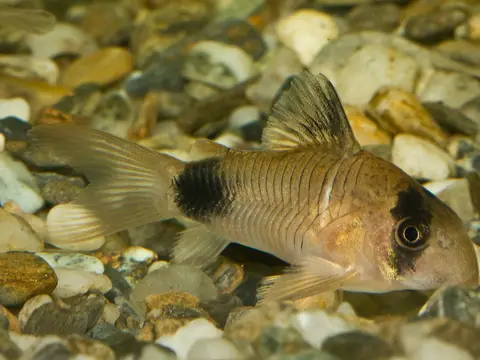 Panda cory Corydoras panda 16 gal (60 L) · 68–77 °F (20–25 °C)
 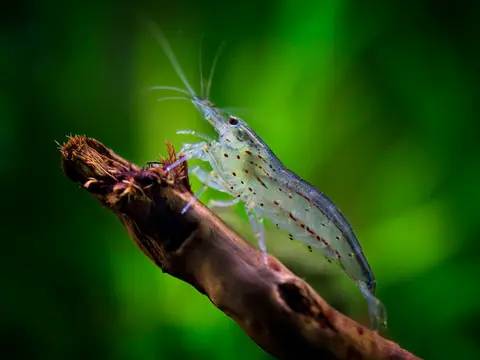 Amano shrimp Caridina multidentata 11 gal (40 L) · 64–82 °F (18–28 °C)
 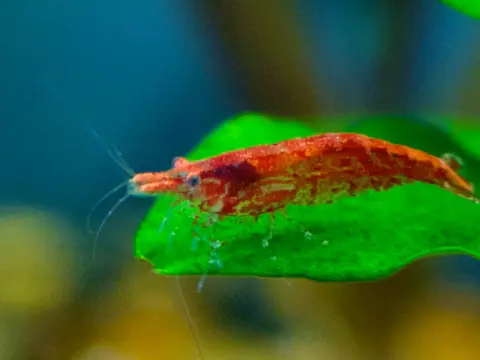 Cherry shrimp Neocaridina davidi 5 gal (20 L) · 64–81 °F (18–27 °C)
 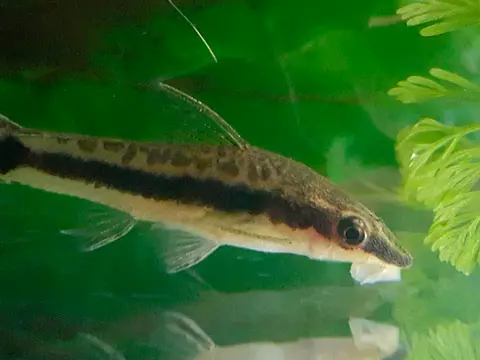 Otocinclus catfish Otocinclus vestitus 16 gal (60 L) · 70–79 °F (21–26 °C)
 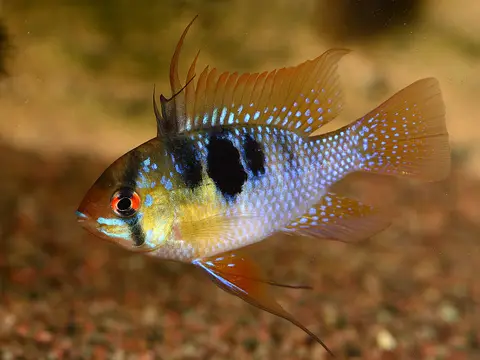 Ram cichlid Mikrogeophagus ramirezi 16 gal (60 L) · 79–86 °F (26–30 °C)
 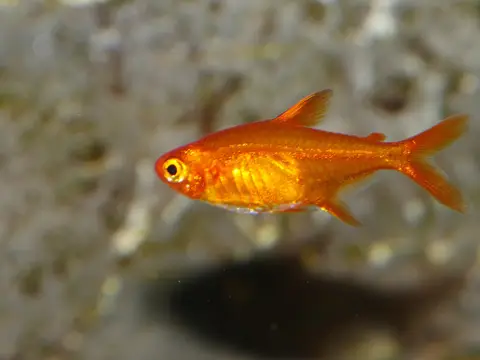 Ember tetra Hyphessobrycon amandae 11 gal (40 L) · 73–82 °F (23–28 °C)
 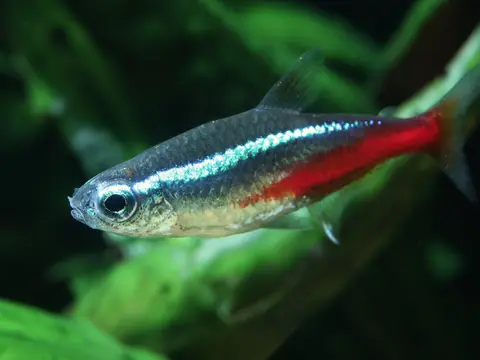 Neon tetra Paracheirodon innesi 16 gal (60 L) · 68–79 °F (20–26 °C)
 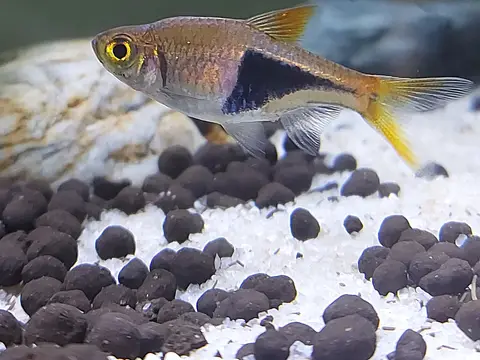 Harlequin rasbora Trigonostigma heteromorpha 16 gal (60 L) · 72–81 °F (22–27 °C)
 Check the compatibility of your whole tank →
What not to keep it with
Popular species you shouldn’t house with the Chili rasbora, and why.
- Tiger barb: one may eat the other due to size
- Betta fish: one may eat the other due to size
- Common goldfish: one may eat the other due to size
- Discus: incompatible temperatures, one may eat the other due to size
- Angelfish: one may eat the other due to size
- Dwarf gourami: one may eat the other due to size
- Yellow lab cichlid: incompatible pH, incompatible water hardness, one may eat the other due to size
- Clown loach: one may eat the other due to size
Recommended equipment
What you need to keep the Chili rasbora healthy, checked against Amazon stock.




Frequently asked questions
How many liters does a Chili rasbora need?
At least about 30 liters for a group of at least 10 fish. More space always helps keep the water stable.
What water temperature does the Chili rasbora need?
Between 22 and 28 °C, with a pH of 5 to 7.
What fish can live with the Chili rasbora?
Based on water, size and temperament, it fits with species such as Bristlenose pleco, Bronze cory, Zebra danio, Cherry barb and Panda cory. Use our compatibility calculator to check your whole tank.
Can the Chili rasbora be kept with shrimp?
Yes: it usually won’t eat adult shrimp, though some shrimplets may get picked off. A tank with plenty of moss gives the babies cover.