If you buy through our links, Amazon pays us a small commission at no extra cost to you. That’s how we keep the site running. How we choose.
Contents
Overview
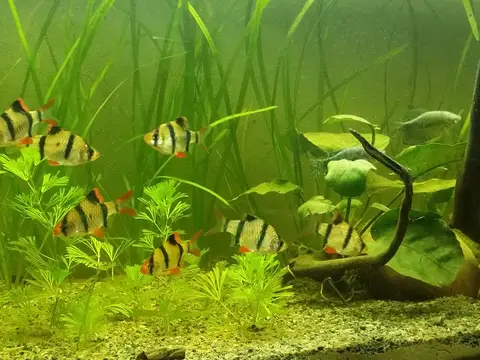
The tiger barb, also called the Sumatra barb, is one of the most recognizable aquarium fish: a tall golden body with four bold black vertical bands and a reddish snout and fins. Besides the classic form, captive-bred varieties such as the green (moss) tiger barb, albino and GloFish versions are widely sold.
It comes from Sumatra and Borneo, though every fish in the trade is captive-bred. It is tough, colorful and constantly on the move, perfect if you want a lively tank. But it has a well-earned reputation as a fin nipper: in small groups it harasses other fish. Kept properly, in a large school with suitable tank mates, it is a fantastic, easy fish.
Care and tank setup
For a school of eight or more, plan on at least 26 gallons (100 L), ideally a 30-gallon or larger tank about 36 inches (90 cm) long. Use a cycled tank, a filter with good flow and oxygenation, and a heater.
- Decor: sturdy plants, driftwood and rocks to break up sight lines, plus plenty of open swimming room. They usually leave plants alone.
- Water: undemanding; they handle most tap water as long as it stays clean with weekly 25-30% changes.
- Tank mates: fast, robust fish: danios, other barbs, mid-sized tetras such as red eye or black skirt tetras, corydoras, loaches and plecos. Never with angelfish, bettas, guppies, long-finned gouramis or shrimp.
The classic mistake is buying three or four: they spend all day chasing everything else. With eight to ten, they sort out their pecking order among themselves and leave tank mates far more alone.
Feeding
A greedy omnivore. Feed quality flakes and pellets as a staple, supplemented with frozen or live foods (mosquito larvae, brine shrimp, daphnia) and some greens such as spirulina or blanched peas. Offer two small meals a day; they will happily overeat, and excess food fouls the water and makes the fish fat.
Breeding
An egg scatterer that breeds fairly readily. Move a well-conditioned pair (the female is rounder, the male has a redder snout) into a tank with fairly soft water, moss or fine-leaved plants and mesh over the bottom. They scatter hundreds of eggs at dawn and provide no care, eating the eggs instead, so remove the parents. Fry hatch in about 36 hours.
Compatible tank mates
Species from our database that share water parameters, size and temperament with the Tiger barb. Calculated from the data in each profile.
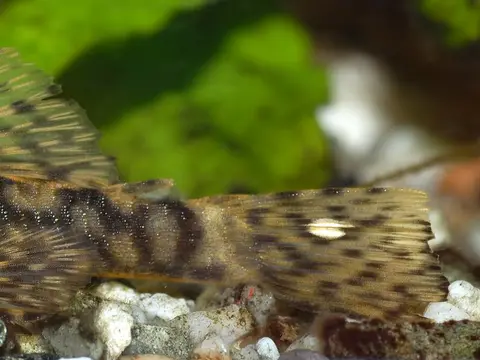 Bristlenose pleco Ancistrus sp. 26 gal (100 L) · 72–81 °F (22–27 °C)
 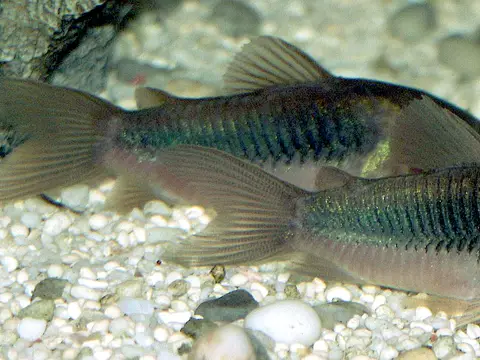 Bronze cory Corydoras aeneus 21 gal (80 L) · 72–81 °F (22–27 °C)
 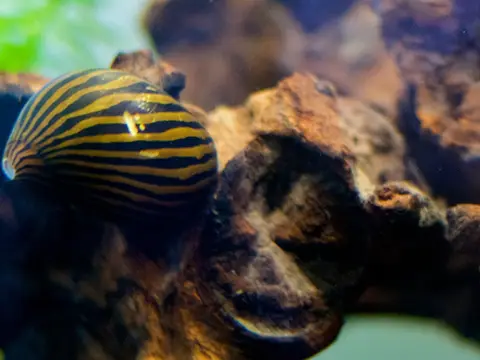 Nerite snail Neritina natalensis 5 gal (20 L) · 72–82 °F (22–28 °C)
 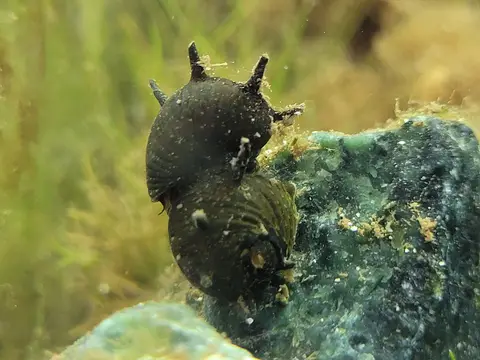 Horned nerite snail Clithon corona 5 gal (20 L) · 72–82 °F (22–28 °C)
 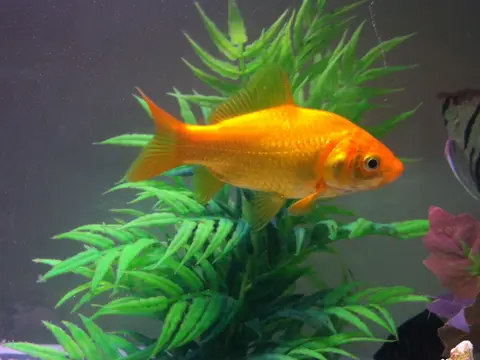 Common goldfish Carassius auratus 79 gal (300 L) · 50–75 °F (10–24 °C)
 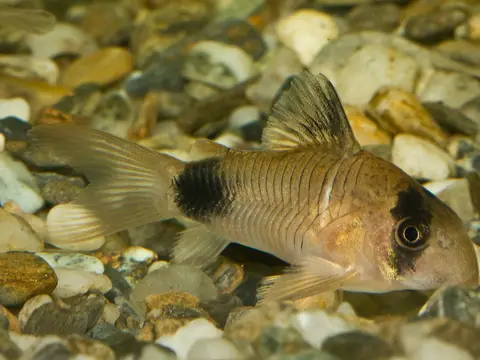 Panda cory Corydoras panda 16 gal (60 L) · 68–77 °F (20–25 °C)
 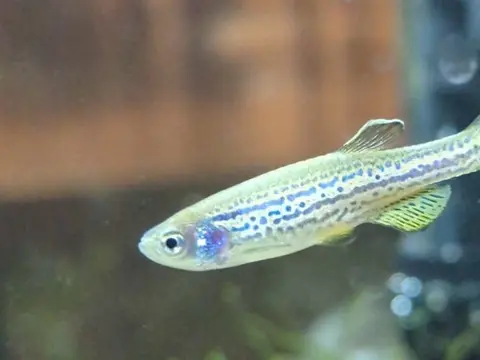 Zebra danio Danio rerio 16 gal (60 L) · 64–77 °F (18–25 °C)
 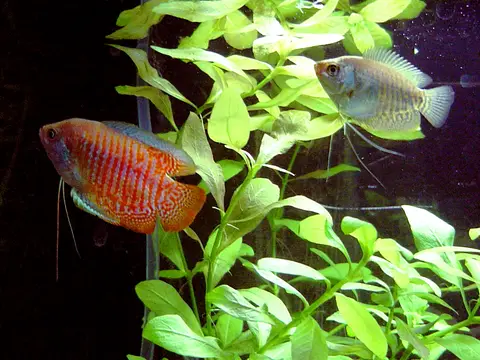 Dwarf gourami Trichogaster lalius 16 gal (60 L) · 75–82 °F (24–28 °C)
 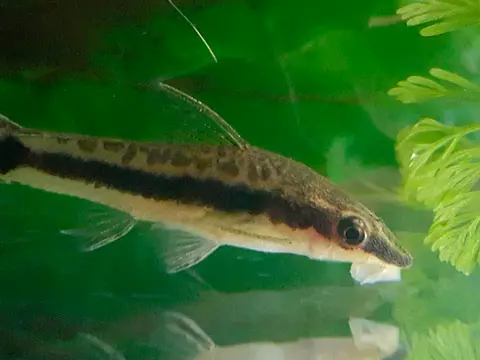 Otocinclus catfish Otocinclus vestitus 16 gal (60 L) · 70–79 °F (21–26 °C)
 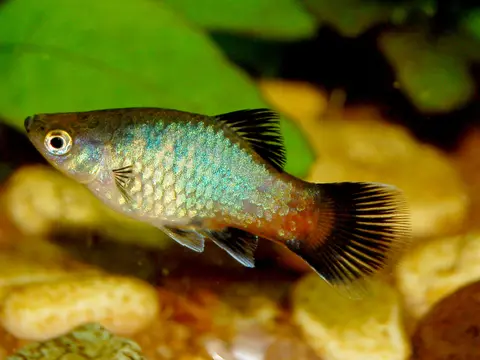 Platy Xiphophorus maculatus 16 gal (60 L) · 68–79 °F (20–26 °C)
 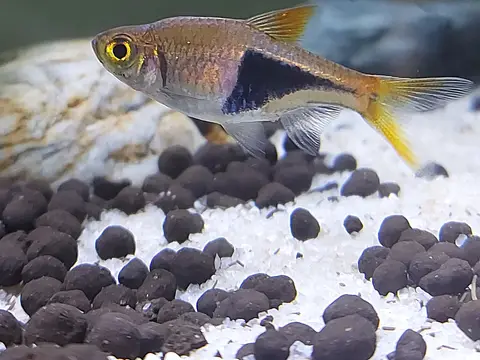 Harlequin rasbora Trigonostigma heteromorpha 16 gal (60 L) · 72–81 °F (22–27 °C)
 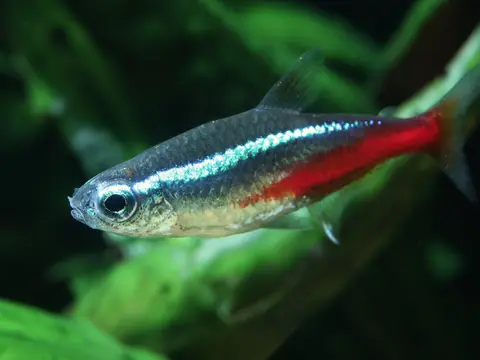 Neon tetra Paracheirodon innesi 16 gal (60 L) · 68–79 °F (20–26 °C)
 Check the compatibility of your whole tank →
What not to keep it with
Popular species you shouldn’t house with the Tiger barb, and why.
- Betta fish: nips long fins
- Discus: incompatible temperatures
- Angelfish: one may eat the other due to size, nips long fins
- Guppy: nips long fins
- Clown loach: incompatible temperatures, one may eat the other due to size
- Oranda goldfish: nips long fins
- Oscar: one may eat the other due to size, incompatible temperaments
- Ember tetra: one may eat the other due to size
Recommended equipment
What you need to keep the Tiger barb healthy, checked against Amazon stock.




Frequently asked questions
How many liters does a Tiger barb need?
At least about 100 liters for a group of at least 8 fish. More space always helps keep the water stable.
What water temperature does the Tiger barb need?
Between 22 and 26 °C, with a pH of 6 to 7.5.
What fish can live with the Tiger barb?
Based on water, size and temperament, it fits with species such as Bristlenose pleco, Bronze cory, Nerite snail, Horned nerite snail and Common goldfish. Use our compatibility calculator to check your whole tank.
Can the Tiger barb be kept with shrimp?
Not recommended: because of its size or instinct, it will eat shrimp.
You may also like
Barbs and danios → Freshwater fish → Complete aquarium guide →