If you buy through our links, Amazon pays us a small commission at no extra cost to you. That’s how we keep the site running. How we choose.
Contents
Aquascaping is the art of designing an underwater landscape with rock, wood and plants so the tank looks like a slice of nature rather than a glass box with ornaments. Japanese aquarist Takashi Amano popularized it in the 1990s and today there are international contests, but the principles work in any tank, from an 8-gallon (30 L) nano to a 55-gallon (200 L) display. This guide covers the main styles, basic composition rules, how to choose and place hardscape, which plants go in each zone, the tools you actually need and how to keep a layout looking good over the months.
The short version: pick a style, decide where the focal point goes (never dead center), build the hardscape dry first, create depth by sloping the substrate up toward the back and plant densely from day one. A good layout is built on stone and wood; plants finish it.
What aquascaping is and why it works
An aquascape isn't just a tank with lots of plants. The difference is intent: every rock, branch and plant group is placed to create a sense of scale, depth and balance. A good layout makes a 24-inch (60 cm) tank look like a valley, a hillside or a corner of forest. A well-planted aquascape is usually a very healthy tank, too: the plant mass uses up nutrients and outcompetes algae. The technical foundation is the same as any planted tank: light, substrate, fertilizer and, in most styles, CO2.
The main styles
Nature Aquarium
Amano's style recreates land scenes (forests, mountains, riverbanks) in miniature. It combines rock and wood with many plant species, mosses and carpets, aiming for asymmetry and a natural look, as if untouched by human hands. It's the most versatile style and where most people start.
Iwagumi
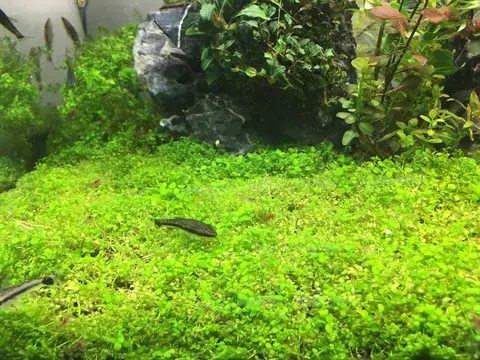
Minimalist and Japanese in origin: rocks only, in odd numbers (usually 3, 5 or 7), with one dominant main stone (oyaishi) and smaller supporting stones. It's usually planted with a single carpeting species such as Hemianthus callitrichoides "Cuba", dwarf hairgrass or Monte Carlo, and stocked with a school of small fish. It looks simple but is one of the hardest: there are no plants to hide mistakes, and it demands CO2, strong light and a lot of discipline.
Dutch
The Dutch style drops hardscape almost entirely. It's an underwater garden of dense plant groups in different colors, heights and textures, arranged in terraces and separated by "streets". It takes many stem plants, precise weekly trimming and, usually, CO2.
Jungle
Wild and lush: plants left to grow freely, big leaves, wood poking through and often floating plants that dapple the light. It's the most forgiving style for a low-tech tank because it accepts slow growers and doesn't need surgical trimming.
Biotope
A biotope recreates a specific habitat: an Amazon blackwater stream with leaf litter and roots, a Southeast Asian river with crypts, or a rocky African lake. Fish, plants, substrate and water parameters all have to match that place. Accuracy matters more than looks, although good biotopes are stunning.
| Style | Hardscape | Plants | CO2 | Difficulty |
|---|---|---|---|---|
| Nature Aquarium | Rock and wood | Varied, mosses and carpets | Recommended | Medium |
| Iwagumi | Rocks only, odd numbers | One or two carpeting species | Essential | High |
| Dutch | Almost none | Many stem species | Almost always | High |
| Jungle | Wood, some rock | Large, epiphytes, floaters | Optional | Low |
| Biotope | Matches the habitat | Native species only (or none) | Depends | Medium |
Composition: thirds, focal point and depth
Aquascaping composition rules come from painting and photography:
- Rule of thirds: mentally divide the front view into three horizontal and three vertical sections. The focal point should sit near one of the intersections, not in the middle. Many aquascapers use the golden ratio (about 1:1.6), which gives a similar result.
- Focal point: the element the eye lands on first: the main stone, the base of a branch or a clearing in the plants. Just one; two focal points fight each other.
- Layout types: concave (high sides, valley in the middle, very natural), convex (a taller central island) and triangular (a high mass on one side sloping to the other, the easiest to balance).
- Depth: slope the substrate up toward the back (about 1.5 inches in front, 3-4 inches at the back, or 3-4 cm and 8-10 cm), put smaller rocks toward the rear and use fine-leaved plants in the background: the eye reads all of that as distance.
- Negative space: leave open areas of sand or carpet. Empty space lets the layout breathe and gives fish room to swim.
Hardscape: rock and wood
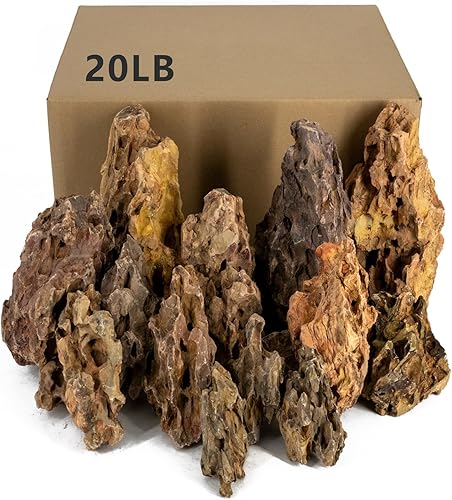
Hardscape is the skeleton of the aquascape, and it's best built dry, moving pieces around until you like it. Stick to one type of rock and one type of wood: mixing materials kills the natural look. Popular rocks include dragon stone (Ohko), lava rock, pagoda stone and Seiryu; popular woods include spiderwood, redmoor, manzanita and mopani. Our guides to aquarium rocks and driftwood explain what to look for.
- Test your rocks: a few drops of vinegar or acid; if they fizz, they contain lime and will raise KH and pH.
- Prep your wood: soak it for days or weeks so it sinks and releases tannins. The white fuzz that often appears at first is a harmless fungus that goes away on its own (and shrimp eat it).
- Stability: rest rocks on the glass or a solid base, not on a pile of substrate that can shift. If needed, fix pieces with cyanoacrylate glue or aquarium-safe putty.
Watch out: Seiryu and other limestone-based rocks harden the water. For Caridina shrimp or softwater fish, choose inert rocks such as dragon stone or lava. And never collect rocks or wood from rivers or beaches without cleaning them and checking where they came from: they may carry contaminants, and collecting may be illegal.
Which plants go in each zone
Plants are arranged by height to reinforce the sense of depth:
| Zone | Role | Examples |
|---|---|---|
| Foreground | Carpet the floor, frame the scene | HC "Cuba", Monte Carlo, dwarf hairgrass, Cryptocoryne parva, Staurogyne repens |
| Midground | Transition, hide the base of the hardscape | Crypts, Bucephalandra, anubias, Pogostemon helferi |
| Background | Height, color, hide equipment | Rotala, Ludwigia, Hygrophila, vallisneria, Limnophila |
| On rock and wood | Make the hardscape look aged | Java moss, flame moss, Java fern, Bolbitis |
A useful rule: use few species in large groups. Three or four well-chosen species look far more natural than fifteen scattered plants. Play with texture contrast (fine leaves next to broad ones), and if you use red plants, make them the accent, not the whole picture.
Tools and step-by-step setup
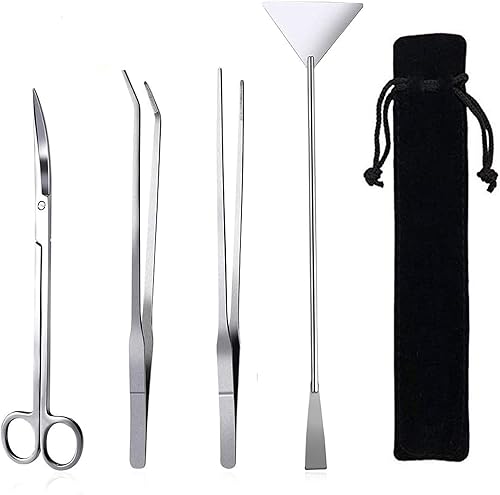
You don't need an arsenal, but these tools make the job much easier (we compare them in aquascaping tools):
- Long tweezers (10-12 inches / 25-30 cm), straight or curved, for planting without tearing things up.
- Curved scissors for trimming carpets and straight scissors for stems; wave scissors are handy for shaping moss.
- Substrate spatula for leveling and shaping.
- Spray bottle to keep plants moist while you work.
- Sketch the layout and choose a style and composition type.
- Add the substrate with a slope and build the hardscape dry.
- Add an inch or two of water or mist the scape, then plant from front to back.
- Fill slowly onto a plate or a plastic bag so you don't stir up the substrate.
- Start the filter, cycle the tank and begin with a 6-hour photoperiod.
Some aquascapers use the dry start method: they plant the carpet in damp substrate, cover the tank with plastic wrap and let it grow emersed for several weeks before flooding. Roots take hold and there's very little algae at the start.
Maintaining an aquascape
An aquascape changes every week; keeping it in shape is part of the art. In the first weeks with aqua soil, do more frequent water changes (two or three a week) because the soil leaches ammonia; after that, 20-30% weekly is normal. Trim stem plants before they shade the plants below, cut carpets back so they don't lift and rot underneath, remove dead leaves and clean the glass. A cleanup crew of Amano shrimp, otocinclus and nerite snails helps with algae. If your style uses CO2, check the bubble counter and drop checker daily; we explain how in CO2 in the aquarium.
Common mistakes
- Putting the focal point in the center: the layout looks stiff and symmetrical.
- Mixing lots of rock and wood types: it looks less natural.
- Rocks that are too small: in a 24-inch tank the main stone needs to be big; small scattered stones just look like loose gravel.
- Flat substrate: without a slope there's no sense of depth.
- Too many plant species: fewer species in groups works better.
- Iwagumi without CO2: carpets struggle and algae win.
- Adding fish before cycling: even if the scape looks finished, fish suffer without an established bacterial colony.
Recommended gear for this guide

Frequently asked questions
What is the easiest aquascaping style for beginners?
A jungle style or a simple Nature Aquarium with driftwood, epiphytes and crypts. They accept slow-growing plants, work without CO2 and forgive mistakes. Iwagumi and Dutch look simple but demand CO2, strong light and constant trimming.
Can you aquascape without CO2?
Yes, by choosing plants that don't need it: anubias, Java fern, Bucephalandra, mosses and crypts. What doesn't do well without CO2 are fine carpeting plants such as HC Cuba or Monte Carlo and intense red plants.
What is the rule of thirds in aquascaping?
You divide the front of the tank into three horizontal and three vertical sections and place the focal point near one of the four intersections rather than in the center. It makes the layout look more natural and dynamic.
Do rocks change water parameters?
Some do. Limestone-based rocks such as Seiryu release carbonates and raise KH and pH. Dragon stone, lava rock and quartz are inert. If you keep shrimp or softwater fish, test rocks with vinegar before using them.
How long does an aquascape take to grow in?
Usually two to three months. Plants need time to grow, carpet and cover the base of the hardscape, and mosses spread slowly. The first weeks are the most delicate for algae, so plant densely and stay consistent with lighting and water changes.
You may also like
- GuideFirst Aquarium for Beginners: Tank Size, Equipment and Easy Fish
- GuideHow Much Does an Aquarium Cost? Setup Budget and Real Monthly Costs
- GuideHow to Set Up a Fish Tank Step by Step: From Stand to First Fish
- GuidePlanted Tank for Beginners: Light, Substrate, Fertilizer and CO2
 ProfileDwarf baby tears
- Gear reviewAquarium rocks
- Gear reviewAquascaping tools
- Gear reviewAquarium driftwood
Substrate & decor → See all guides → Complete aquarium guide →