If you buy through our links, Amazon pays us a small commission at no extra cost to you. That’s how we keep the site running. How we choose.
Contents
Our top 3 picks
Stock checked on October 7, 2026
aquarium led lights comparison, in stock
Linda's Essentials Fake Fish Tank Frutiger Aero Fish Lamp - Fake Aquarium Decorative Lamp, Artificial Fish Tank with…

hygger Advanced LED Aquarium Light with Timer, 24/7 Lighting Cycle & DIY Mode, Full Spectrum Fish Tank Light for 36-42…
hygger Advanced LED Aquarium Light with Timer, 24/7 Lighting Cycle & DIY Mode, Full Spectrum Fish Tank Light for 30-36…
hygger Advanced LED Aquarium Light with Timer, 24/7 Lighting Cycle & DIY Mode, Full Spectrum Fish Tank Light for 18-24…
hygger Advanced LED Aquarium Light with Timer, 24/7 Lighting Cycle & DIY Mode, Full Spectrum Fish Tank Light for 24-30…
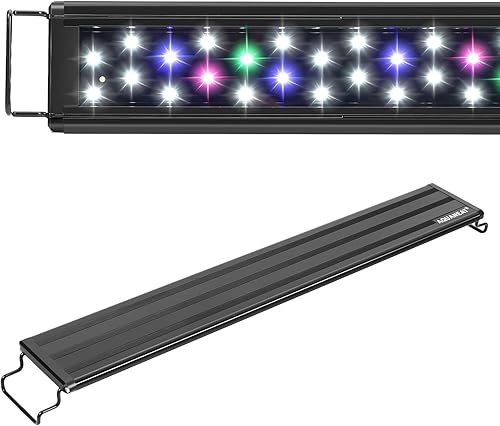
AQUANEAT LED Aquarium Light Full Spectrum for 30 Inch to 38 Inch Fish Tank Light Fresh Water
AQUANEAT LED Aquarium Light Full Spectrum for 36 Inch to 44 Inch Fish Tank Light Fresh Water
AQUANEAT LED Aquarium Light Full Spectrum for 24 Inch to 30 Inch Fish Tank Light Fresh Water
AcuarioSano rating: combines the average rating and the number of buyer reviews on Amazon. No brand pays to be featured.
What aquarium lighting does
Light does three jobs: it lets you see your fish, sets the day-night rhythm they need to rest, and feeds plants through photosynthesis. In a community tank with slow-growing plants such as Anubias nana or Java fern, you don't need a powerful light; a well-sized mid-range LED is enough. If you're aiming for a demanding planted tank with carpeting plants and CO2, see our comparison of LED lights for planted tanks.
LED fixtures have almost completely replaced fluorescent tubes: they use less power, barely warm the water, last for years without dimming and let you adjust color and intensity. Brands such as Fluval, Aqueon, Hygger, Nicrew, Finnex, Current USA and Chihiros offer models for every tank size.
What size to choose for your tank length
The basic rule is to pick a light that is the same length as the tank or slightly shorter. Many come with extendable brackets that rest on the glass and cover a range (for example 24-30 inches). Too short and you'll get dark corners; too long and it won't sit properly. Also check whether your tank has a hood or glass lid: some lights sit on top of a lid, others need an open-top tank.
| Tank length | Approx. volume | Typical LED wattage (fish and easy plants) |
|---|---|---|
| 12 in (30 cm) | 3-6 gal (15-25 L) | 6-10 W |
| 20 in (50 cm) | 10 gal (38 L) | 10-15 W |
| 24 in (60 cm) | 15-20 gal (55-75 L) | 14-20 W |
| 30 in (76 cm) | 29 gal (110 L) | 20-30 W |
| 36 in (91 cm) | 40-50 gal (150-190 L) | 25-40 W |
| 48 in (122 cm) | 55-75 gal (210-285 L) | 30-50 W |
Wattage is only a guide: two fixtures with the same wattage can deliver very different light depending on LED efficiency and optics. If the maker lists lumens, about 55-95 lumens per gallon (15-25 per liter) is usually enough for fish and easy plants.
Color temperature and spectrum
- Cool white (6,500-8,000 K): the most natural look for freshwater; brings out the green in plants.
- White plus red and blue (RGB or "full spectrum"): makes fish like neon tetras pop and gives plants a little extra.
- Blue or "moonlight" mode: decorative for evening viewing; keep it short, because fish need real darkness too.
Timers and photoperiod
Lights should run 6-8 hours a day, at the same time every day. Many fixtures have a built-in timer or app control with gradual sunrise and sunset; if yours doesn't, a plug-in outlet timer works just as well. Start with 6 hours in a newly set-up tank and increase slowly. Our guide on how many hours of light an aquarium needs walks you through it.
Tip: choose a dimmable light even for a simple tank. Being able to drop the intensity to 60-70% is the easiest way to slow algae without changing equipment.
Warning: don't leave the light on 10-12 hours "so the fish can see," and don't place the tank next to a window with direct sun. Too much light is the number one cause of algae in the aquarium.
Common mistakes
- Buying a light that's too short and leaving shady zones.
- Choosing by wattage without checking whether the light suits plants.
- Skipping the timer and switching lights on and off at random times.
- Running a very strong light without CO2 or fertilizer: more algae, not more plants.
- Forgetting to check whether the fixture works with your tank's lid.
We compare spec sheets, verified reviews and real-world use criteria, but we don't physically test the products.
Frequently asked questions
What size LED light do I need for my tank?
One that matches the tank length or is slightly shorter. Many have extendable brackets that cover a range, for example 24 to 30 inches.
How many hours should aquarium lights be on?
Between 6 and 8 hours a day, on a timer so it's always at the same time. In a new tank, start with 6 hours.
Will a standard LED light grow plants?
For easy plants like anubias, Java fern, mosses and cryptocorynes, yes. Carpeting plants and demanding planted tanks need a stronger full-spectrum light.
Can I leave the blue moonlight on all night?
It's not recommended. Fish need several hours of real darkness; if you like moonlight mode, run it for only an hour or two after the main light goes off.
You may also like
 Gear reviewPlanted aquarium LED lights
 Gear reviewAquarium kits
 Gear reviewAquarium algae control products
 ProfileAnubias nana
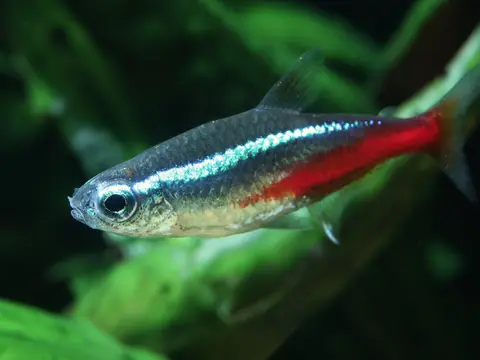 ProfileNeon tetra
- GuideHow Many Hours of Light Does an Aquarium Need? Photoperiod Guide
- GuideAquarium Without a Filter or Heater: Can You Do It Safely?
- GuideAquarium Temperature: Ideal Range, Heaters, Summer and Outages