If you buy through our links, Amazon pays us a small commission at no extra cost to you. That’s how we keep the site running. How we choose.
Contents
Overview
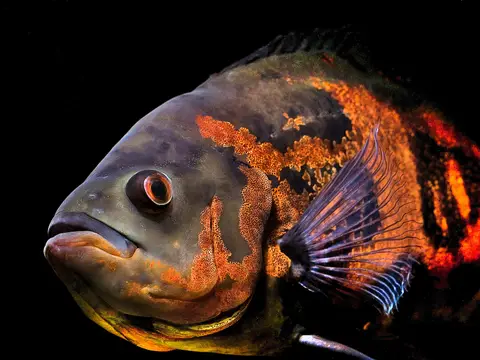
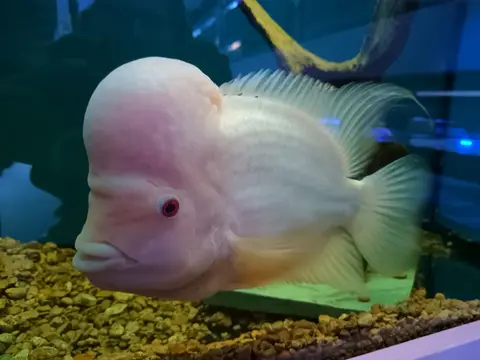
The oscar (Astronotus ocellatus) is a large Amazonian cichlid famous for its intelligence and personality. It recognizes its owner, begs at the glass and rearranges the tank to its liking. The wild form is dark with orange blotches and an eyespot at the base of the tail, while stores mostly carry tiger, red, albino and lemon strains.
The catch is that oscars are sold at 1.5-2 inches and grow very fast: they can pass 8 inches (20 cm) in their first year and reach 12-14 inches (30-35 cm) and over 2 pounds as adults. This is a fish for people willing to set up a genuinely large aquarium and keep it running for 15 years or more. Well cared for, it is a true pet.
Care and tank setup
Let's be clear: an adult oscar needs at least 105 gallons (400 L), roughly 5 feet (150 cm) long and 20-24 inches (50-60 cm) front to back so it can turn around comfortably. For a pair, plan on 160 gallons (600 L) or more. A 30- or 55-gallon tank only works for a few months.
- Filtration: heavy-duty (one or two large canister filters), because oscars are messy. Change 30-50% of the water every week.
- Décor: sand or smooth gravel, large stable rocks and driftwood. They uproot plants, so use anubias tied to wood or artificial plants.
- Equipment: a secure lid (they jump) and a guarded heater, which they can break.
- Tankmates: only large, robust fish of similar size, such as big plecos, and only in very large tanks. Anything that fits in its mouth is food.
Oscars are sensitive to poor water quality: pits on the head (HLLE) usually point to high nitrate and a poor diet. Never release one into the wild.
Feeding
Oscars are greedy opportunistic predators. Use a large, high-quality cichlid pellet as the staple and add shrimp, mussel, white fish fillet or insects. Skip live feeder fish: they spread disease and offer nothing a good diet doesn't. Avoid mammal meat too. Adults do well on one or two meals a day, no matter how hard they beg.
Breeding
Oscars are hard to sex, so most people raise a group of juveniles until a pair forms. The pair cleans a flat rock and the female lays a thousand or more eggs, which both parents defend fiercely. Breeding at home is possible, but you need a huge tank and homes for hundreds of fry that will grow to a foot long.
What not to keep it with
Popular species you shouldn’t house with the Oscar, and why.
- Bristlenose pleco: incompatible temperaments
- Cherry barb: one may eat the other due to size, incompatible temperaments
- Tiger barb: one may eat the other due to size, incompatible temperaments
- Betta fish: one may eat the other due to size, incompatible temperaments
- Common goldfish: incompatible temperatures, incompatible temperaments
- Bronze cory: one may eat the other due to size, incompatible temperaments
- Panda cory: one may eat the other due to size, incompatible temperaments
- Zebra danio: one may eat the other due to size, incompatible temperaments
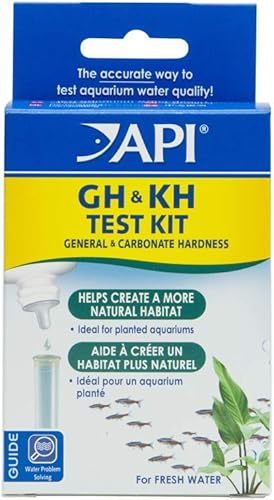
Recommended equipment
What you need to keep the Oscar healthy, checked against Amazon stock.


Frequently asked questions
How many liters does a Oscar need?
At least about 400 liters. More space always helps keep the water stable.
What water temperature does the Oscar need?
Between 23 and 28 °C, with a pH of 6 to 7.5.
What fish can live with the Oscar?
This species is best kept alone or with very few carefully chosen tank mates.
Can the Oscar be kept with shrimp?
Not recommended: because of its size or instinct, it will eat shrimp.
You may also like
American cichlids → Freshwater fish → Complete aquarium guide →