If you buy through our links, Amazon pays us a small commission at no extra cost to you. That’s how we keep the site running. How we choose.
Contents
Our top 3 picks
Stock checked on October 7, 2026


internal aquarium filters comparison, in stock
Aquarium Internal Filter, Quiet Fish Tank Filter Pump, Medium-15W
fishkeeper Aquarium Filter for 25-45 Gallon, 4-Stage in-Tank Filter
Submersible Aquarium Internal Filter, Adjustable Fish Tank Filter with Water Pump for Fish Tank (400GPH, 15W)

Oase BioPlus 50 Compact Internal Filter for Clean & Clear Aquarium Water – Easy Maintenance, Discreet Corner Mount, for…
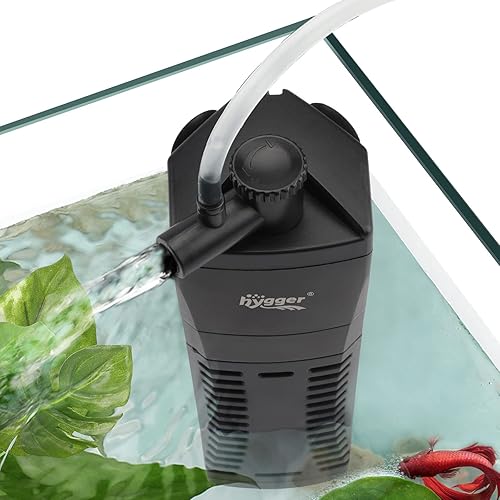
hygger Aquarium Internal Filter, 170GPH Silent Power Filter for 15-30 Gallon Corner Installation, Triple Filtration…
hygger 120GPH Silent Aquarium Internal Filter for 10-20 Gallon Fish Tanks

hygger 25W Aquarium U-V Internal Filter with Timer for 30–130 Gal Tanks
hygger 8W Aquarium U-V Internal Filter with Timer for 10–20 Gal Tanks
AcuarioSano rating: combines the average rating and the number of buyer reviews on Amazon. No brand pays to be featured.
What an internal filter is and when to choose one
An internal (submersible) filter is a pump with a sponge or basket body that sits underwater inside the aquarium, attached to the glass with suction cups. It draws water in at the bottom or side, pushes it through the filter media and returns it at the top, usually through an adjustable outlet. No hoses, no priming: you position it, plug it in and it runs.
It is the most common choice for tanks of roughly 10 to 40 gallons (40-150 l). Below that it can be oversized or too strong; above it, the small media volume falls short and it makes sense to move up to a canister filter. Many all-in-one aquariums, especially European brands like Juwel, come with a built-in internal filter compartment in one corner that works the same way.
Flow rate and size by tank volume
As with any filter, aim to turn over 3 to 5 times the tank volume per hour. Internal filters usually print a tank-size range on the box, but that figure is optimistic: pay more attention to the flow rate and, above all, to how much media fits inside.
| Tank | Approx. flow | Media | Good for |
|---|---|---|---|
| 10-15 gal (40-60 l) | 50-80 GPH (200-300 l/h) | one sponge or small basket | small tetras, shrimp, betta (flow turned down) |
| 15-25 gal (60-100 l) | 80-130 GPH (300-500 l/h) | two modules or sponge + ceramic | community tanks |
| 25-40 gal (100-150 l) | 130-200 GPH (500-750 l/h) | several modules or corner compartment | busier community tanks |
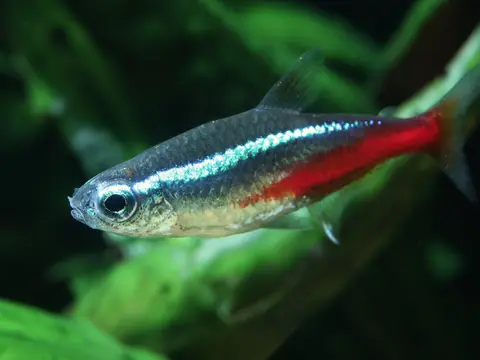
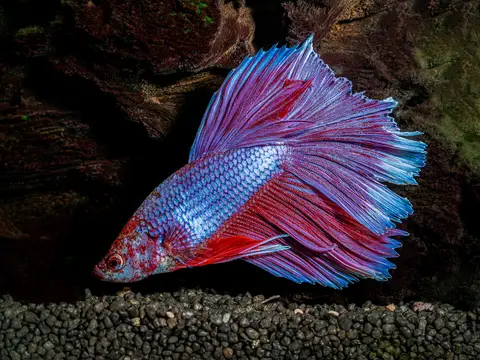
In a peaceful community tank with neon tetras and corydoras, the middle range is ideal. For poor swimmers such as the betta, choose a model with adjustable flow or aim the outlet at the glass.
What to check before buying
- Media capacity: a modular or basket body lets you add ceramic media alongside the sponge, which greatly improves biological filtration.
- Flow control: essential if you keep long-finned fish, fry or shrimp.
- Adjustable outlet and venturi: pointing the outlet at the surface moves water and adds oxygen; some models include an air intake (venturi) you can close.
- Easy opening: the body should come apart from the motor without tools or rearranging the whole tank.
- Good suction cups: old cups harden over time, so replacements should be easy to find.
Tip: when it is time to clean the sponge, slip a bag or cup under the filter before lifting it out of the water. That way the trapped gunk does not end up back in the tank.
Maintenance without losing bacteria
An internal filter clogs sooner than a canister because it holds less media: rinsing it every 2-4 weeks during your water changes is typical. Squeeze the sponge in a bucket of tank water until most of the dirt comes out, without making it look new. Clean the impeller now and then, too, because tangled debris cuts flow and causes noise.
A freshly installed filter does not provide biological filtration on day one: bacteria take weeks to colonize it. Follow the steps for cycling your aquarium before adding fish, and if you are swapping filters, run the old one alongside the new one for a few weeks.
Warning: do not rinse the sponge under the tap or replace all of it with a new one. If it is falling apart, cut the old one in half and replace it in two stages, a few weeks apart. The filter media is where the bacteria live: more on that in our guide to filter media.
Common mistakes
- Choosing by the gallon range on the box without checking flow rate and media volume.
- Mounting it so high that the intake sucks in air and the filter rattles.
- Leaving the current on full in tanks with bettas, fry or delicate plants.
- Switching it off at night because of noise: bacteria need constant flow.
- Using a small internal filter in a goldfish tank, where waste output is huge.
We compare spec sheets, verified reviews and real-world use criteria, but we do not physically test the products: treat the models above as a starting point and confirm flow rate and media capacity on each listing.
Frequently asked questions
What tank size is an internal filter good for?
It is the most practical choice for about 10 to 40 gallons. Beyond that it usually lacks media volume and a canister filter makes more sense, although some large modular internal filters handle around 50 gallons.
How often should you clean an internal filter?
Every 2 to 4 weeks, ideally during a water change. Just squeeze the sponge in tank water and clear debris from the impeller, without making it spotless, so you keep the beneficial bacteria.
Can I turn off an internal filter at night?
No. The filter needs to run 24 hours a day: without water flow, the bacteria that remove ammonia run out of oxygen and start dying within hours. If it is noisy, check the impeller or the air intake instead.
Is an internal filter better than a hang-on-back filter?
Both suit small and mid-size tanks. An internal filter is usually quieter and needs no space behind the tank; a hang-on-back frees up room inside the tank and can be serviced without putting your hands in the water.
You may also like
 Gear reviewCanister filters
 Gear reviewHang-on-back filters
 Gear reviewAquarium filter media
 ProfileNeon tetra
 ProfileBetta fish
- GuideAquarium Water Changes: How Much, How Often and How To
- GuideAquarium Without a Filter or Heater: Can You Do It Safely?
- GuideAquarium Temperature: Ideal Range, Heaters, Summer and Outages