If you buy through our links, Amazon pays us a small commission at no extra cost to you. That’s how we keep the site running. How we choose.
Contents
Overview
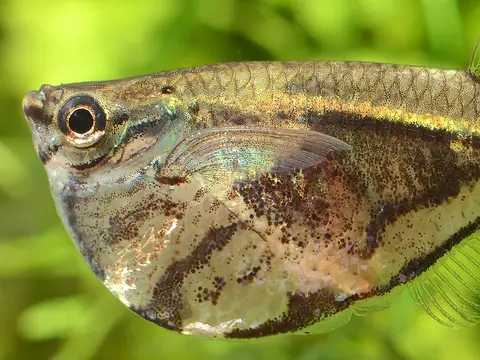
The marbled hatchetfish has one of the oddest shapes in the hobby: its flattened body with a deep, keel-like belly resembles the blade of a hatchet. It reaches about 1.4 inches (3.5 cm) and shows a marbled pattern of dark bands on a silver background. It comes from streams and flooded forest in the Amazon basin, where it lives just below the surface hunting insects that fall into the water.
That keel houses powerful pectoral muscles that let it leap out of the water and glide several feet to escape predators. It is peaceful, a little skittish and striking in a group, occupying a zone that almost no other fish uses. It suits hobbyists with some experience and a stable, mature tank.
Care and tank setup
Keep a group of 6 or more in at least 20 gallons (80 L) with plenty of open surface. The one non-negotiable is a gap-free lid: without one, sooner or later you will find a hatchetfish on the floor.
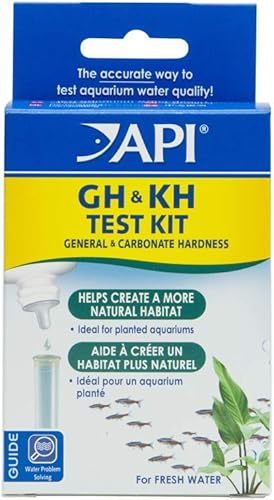
- Water: soft and slightly acidic at 75-82 °F (24-28 °C). Catappa leaves or peat help recreate its native water. The tank must be fully cycled and stable, as it is sensitive to sudden changes and nitrite.
- Surface: floating plants over part of the surface (they make it feel secure) and gentle flow without strong turbulence.
- Acclimation: newly imported fish are delicate and prone to ich; quarantine them and acclimate slowly.
Good tankmates are small, peaceful midwater or bottom dwellers: small tetras, corydoras, calm dwarf cichlids or small loaches. Avoid surface-feeding bullies and fast fish that steal all the food. It startles at taps on the glass and sudden movement above the tank.
Feeding
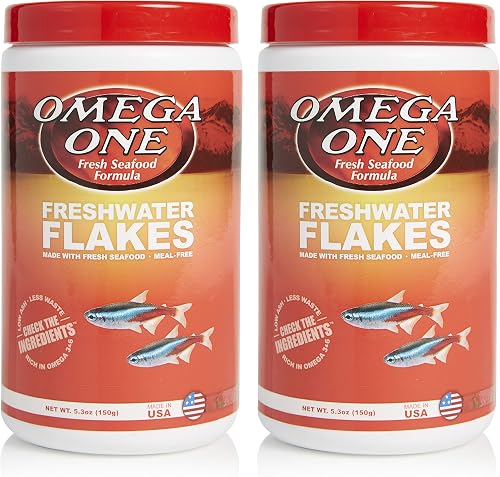
An insectivore that feeds almost entirely at the surface. Offer quality fine flakes and floating micro pellets, plus frequent live or frozen foods such as mosquito larvae, daphnia, brine shrimp or flightless fruit flies, which trigger its hunting instinct. It ignores food that sinks, so choose floating foods and feed small portions twice a day.
Breeding
Breeding in aquariums is rare and poorly documented. It has been achieved in very soft, acidic water with lots of live food and dim lighting: after long courtship displays at the surface, pairs scatter eggs among floating-plant roots or fine-leaved plants. Parents provide no care. Fry are tiny and need infusoria. Nearly all fish in the trade are wild-caught.
Compatible tank mates
Species from our database that share water parameters, size and temperament with the Marbled hatchetfish. Calculated from the data in each profile.
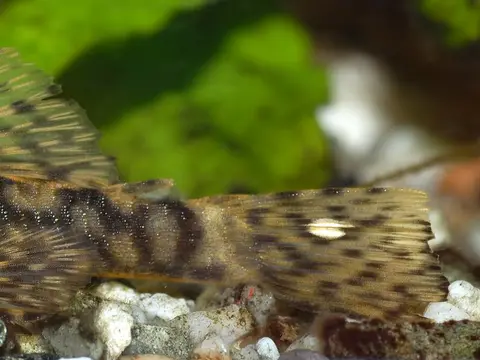 Bristlenose pleco Ancistrus sp. 26 gal (100 L) · 72–81 °F (22–27 °C)
 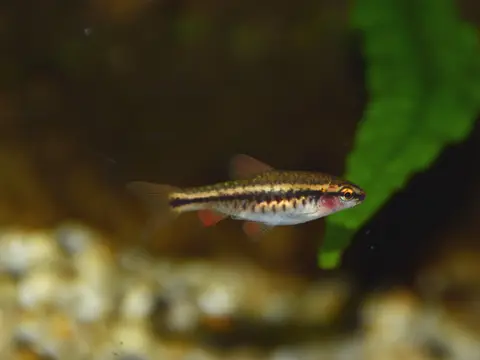 Cherry barb Puntius titteya 16 gal (60 L) · 73–81 °F (23–27 °C)
 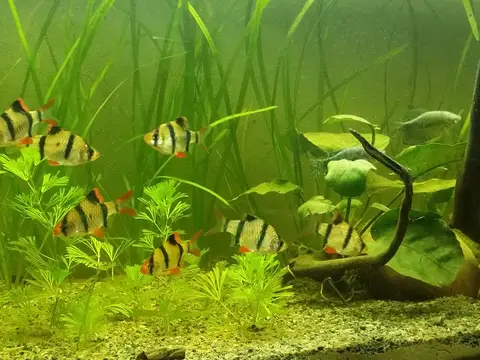 Tiger barb Puntigrus tetrazona 26 gal (100 L) · 72–79 °F (22–26 °C)
 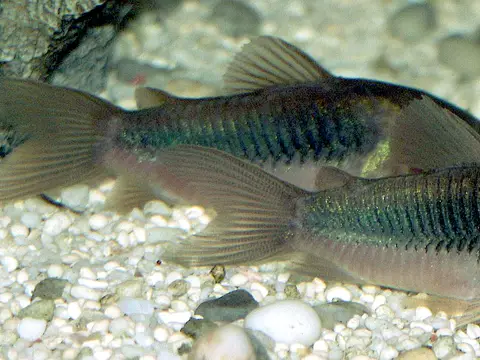 Bronze cory Corydoras aeneus 21 gal (80 L) · 72–81 °F (22–27 °C)
 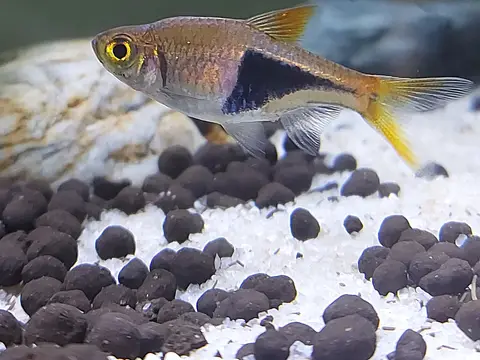 Harlequin rasbora Trigonostigma heteromorpha 16 gal (60 L) · 72–81 °F (22–27 °C)
 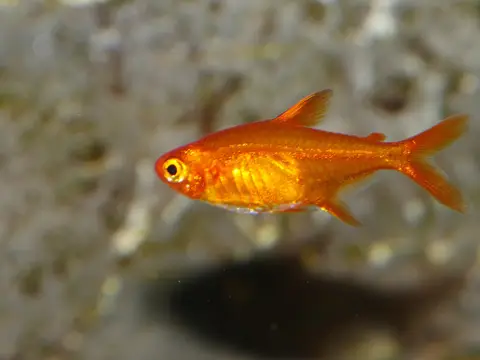 Ember tetra Hyphessobrycon amandae 11 gal (40 L) · 73–82 °F (23–28 °C)
 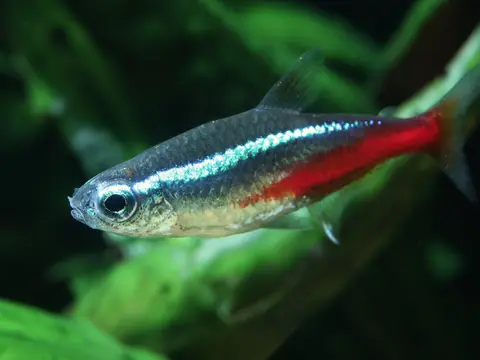 Neon tetra Paracheirodon innesi 16 gal (60 L) · 68–79 °F (20–26 °C)
 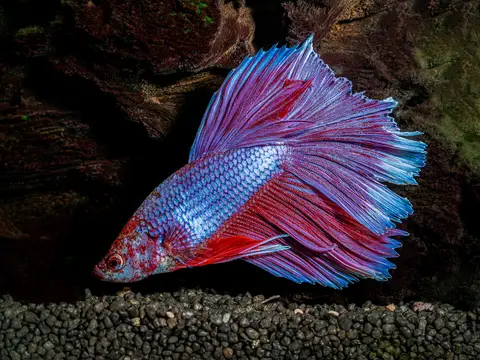 Betta fish Betta splendens 7 gal (25 L) · 75–82 °F (24–28 °C)
 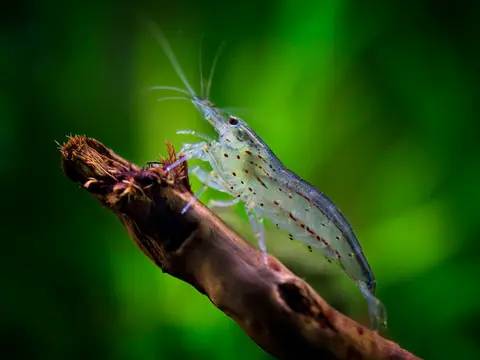 Amano shrimp Caridina multidentata 11 gal (40 L) · 64–82 °F (18–28 °C)
 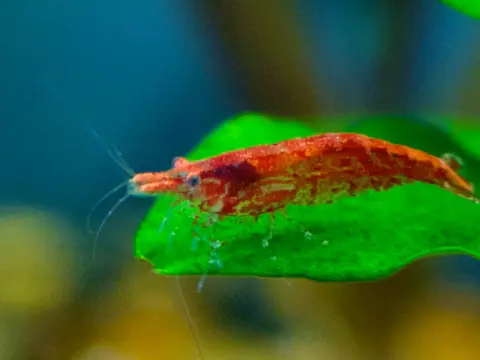 Cherry shrimp Neocaridina davidi 5 gal (20 L) · 64–81 °F (18–27 °C)
 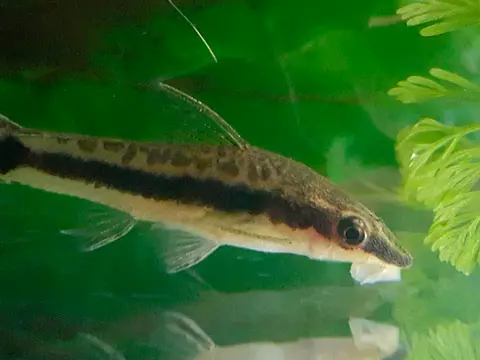 Otocinclus catfish Otocinclus vestitus 16 gal (60 L) · 70–79 °F (21–26 °C)
 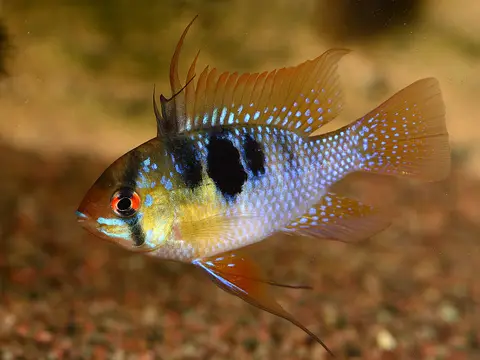 Ram cichlid Mikrogeophagus ramirezi 16 gal (60 L) · 79–86 °F (26–30 °C)
 Check the compatibility of your whole tank →
What not to keep it with
Popular species you shouldn’t house with the Marbled hatchetfish, and why.
- Common goldfish: incompatible temperatures, one may eat the other due to size
- Discus: incompatible temperatures, one may eat the other due to size
- Angelfish: one may eat the other due to size
- Yellow lab cichlid: incompatible pH, one may eat the other due to size
- Clown loach: one may eat the other due to size
- Molly: incompatible pH
- Oranda goldfish: incompatible temperatures, one may eat the other due to size
- Oscar: one may eat the other due to size, incompatible temperaments
Recommended equipment
What you need to keep the Marbled hatchetfish healthy, checked against Amazon stock.


Frequently asked questions
How many liters does a Marbled hatchetfish need?
At least about 80 liters for a group of at least 6 fish. More space always helps keep the water stable.
What water temperature does the Marbled hatchetfish need?
Between 24 and 28 °C, with a pH of 5.5 to 7.
What fish can live with the Marbled hatchetfish?
Based on water, size and temperament, it fits with species such as Bristlenose pleco, Cherry barb, Tiger barb, Bronze cory and Harlequin rasbora. Use our compatibility calculator to check your whole tank.
Can the Marbled hatchetfish be kept with shrimp?
Yes: it usually won’t eat adult shrimp, though some shrimplets may get picked off. A tank with plenty of moss gives the babies cover.