If you buy through our links, Amazon pays us a small commission at no extra cost to you. That’s how we keep the site running. How we choose.
Contents
Overview
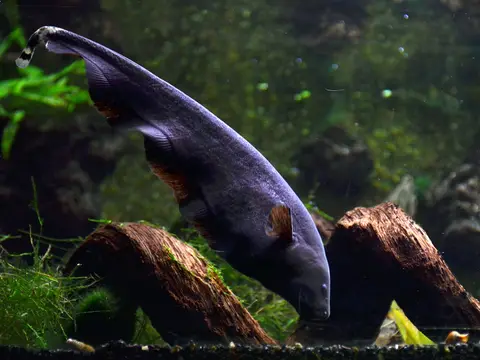
The black ghost knifefish is one of the most striking fish in the hobby: a velvety black body with no dorsal fin that glides forward and backward by rippling a long anal fin. Two white bands circle the tail and a pale blaze marks the snout. It comes from rivers of the Amazon and Orinoco basins, where it lives in dark water and finds its way with a weak electric field it generates itself.
It is shy and nocturnal, yet over the years it often becomes remarkably tame with its keeper. The catch is that it is sold small and cheap, and few stores mention it grows past 16 inches (40 cm). This is not a beginner fish or a community fish for average tanks. It is a long-term commitment for someone who can provide a genuinely large aquarium.
Care and tank setup
An adult needs roughly a 130-gallon (500-liter) tank or larger, ideally 6 ft (180 cm) long and wide enough to turn around. Juveniles grow quickly, so starting in a small tank just postpones the problem. It is sensitive to nitrate and sudden swings: keep the tank fully cycled, run strong filtration and do generous weekly water changes at 73-82°F (23-28°C).
- A hiding tube is a must: a PVC or ceramic tube sized to its body where it spends the day. Without one it stays stressed and stops eating.
- Dim lighting, sturdy or floating plants and driftwood; fine sand prevents scrapes.
- A tight lid: it explores at night and can jump.
- Tankmates: medium, calm fish such as adult angelfish, peaceful cichlids of similar size or plecos. Small tetras and shrimp will be eaten.
Avoid keeping two unless the tank is huge, since they are territorial with each other. Knifefish lack protective scales and handle copper and malachite green poorly, so use half doses or gentler treatments.
Feeding
It is a carnivore that feeds mostly at dusk. It readily takes frozen bloodworms, brine shrimp, mysis and chopped earthworms, and with patience learns to accept sinking carnivore pellets. Feed right after lights-out and close to its hideout, because faster tankmates tend to steal the food. A thin juvenile is a warning sign, so make sure the food is actually reaching it.
Breeding
Breeding in a home aquarium is practically unheard of. Fish in stores are wild-caught or come from commercial farms in Southeast Asia that use large facilities and hormone induction. Sexing is difficult and adults often fight, so attempting to breed them at home makes little sense. Focus instead on a long life: with good care they live well over ten years.
Compatible tank mates
Species from our database that share water parameters, size and temperament with the Black ghost knifefish. Calculated from the data in each profile.
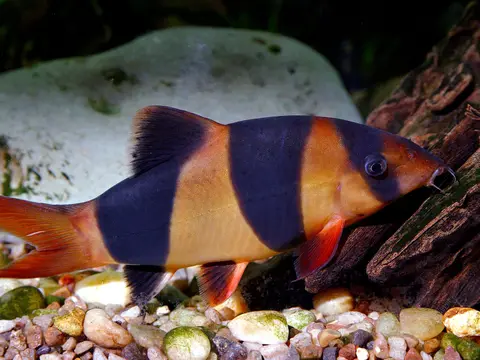 Clown loach Chromobotia macracanthus 132 gal (500 L) · 77–86 °F (25–30 °C)
 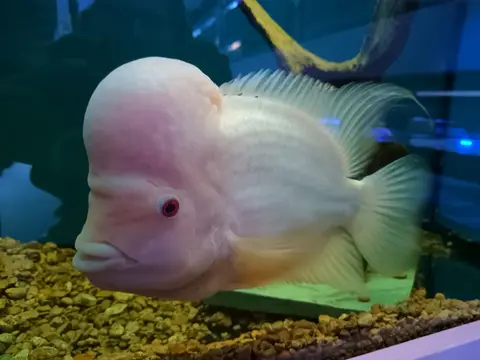 Blood parrot cichlid Amphilophus hybrid 53 gal (200 L) · 75–82 °F (24–28 °C)
 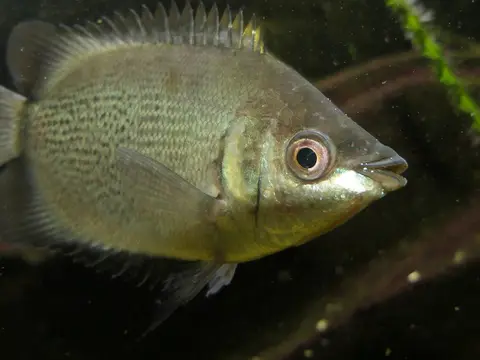 Kissing gourami Helostoma temminckii 79 gal (300 L) · 72–82 °F (22–28 °C)
 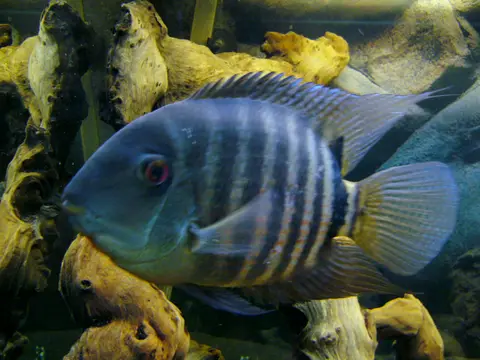 Severum Heros severus 79 gal (300 L) · 75–84 °F (24–29 °C)
 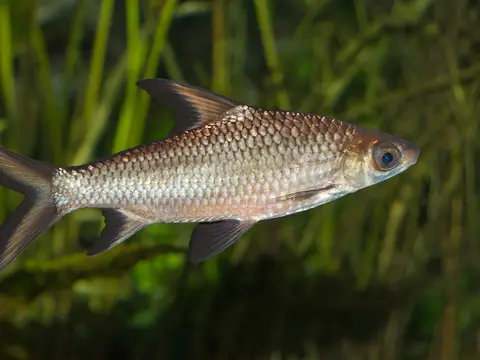 Bala shark Balantiocheilos melanopterus 264 gal (1000 L) · 72–82 °F (22–28 °C)
 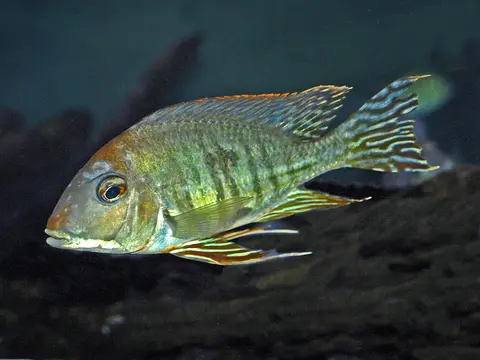 Geophagus altifrons Geophagus altifrons 159 gal (600 L) · 79–86 °F (26–30 °C)
 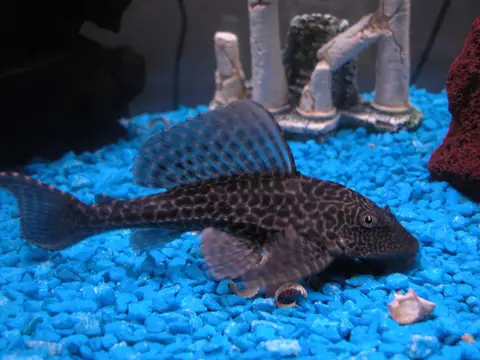 Common pleco Pterygoplichthys pardalis 132 gal (500 L) · 72–82 °F (22–28 °C)
 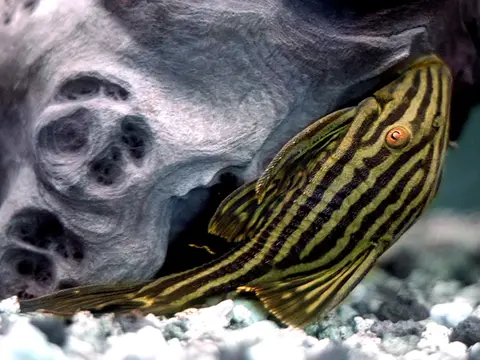 Royal pleco Panaque nigrolineatus 106 gal (400 L) · 72–82 °F (22–28 °C)
 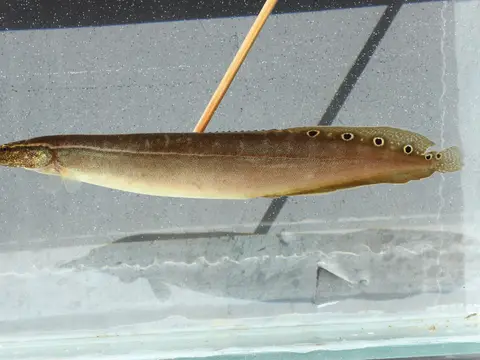 Peacock eel Macrognathus siamensis 53 gal (200 L) · 73–82 °F (23–28 °C)
 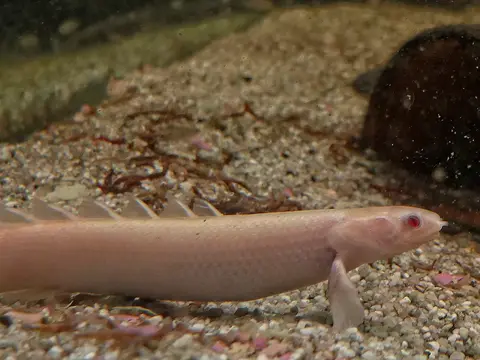 Senegal bichir Polypterus senegalus 79 gal (300 L) · 75–82 °F (24–28 °C)
 Check the compatibility of your whole tank →
What not to keep it with
Popular species you shouldn’t house with the Black ghost knifefish, and why.
- Bristlenose pleco: one may eat the other due to size
- Cherry barb: one may eat the other due to size
- Tiger barb: one may eat the other due to size
- Betta fish: one may eat the other due to size
- Bronze cory: one may eat the other due to size
- Panda cory: one may eat the other due to size
- Zebra danio: one may eat the other due to size
- Discus: incompatible temperatures, one may eat the other due to size
Recommended equipment
What you need to keep the Black ghost knifefish healthy, checked against Amazon stock.


Frequently asked questions
How many liters does a Black ghost knifefish need?
At least about 500 liters. More space always helps keep the water stable.
What water temperature does the Black ghost knifefish need?
Between 23 and 28 °C, with a pH of 6 to 7.5.
What fish can live with the Black ghost knifefish?
Based on water, size and temperament, it fits with species such as Clown loach, Blood parrot cichlid, Kissing gourami, Severum and Bala shark. Use our compatibility calculator to check your whole tank.
Can the Black ghost knifefish be kept with shrimp?
Not recommended: because of its size or instinct, it will eat shrimp.