If you buy through our links, Amazon pays us a small commission at no extra cost to you. That’s how we keep the site running. How we choose.
Contents
Our top 3 picks
Stock checked on October 8, 2026

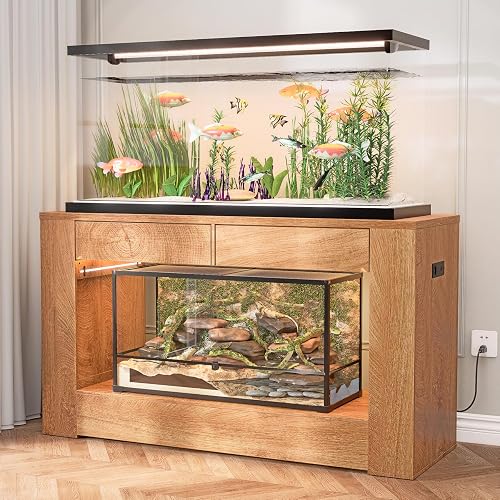
large aquariums (55 gallons and up) comparison, in stock
Tetra 55 Gallon Glass Aquarium, Rectangular Fish Tank

LANDEN Aquarium 120P 72 Gallon Ultra Clear Glass Rimless Fish Tank
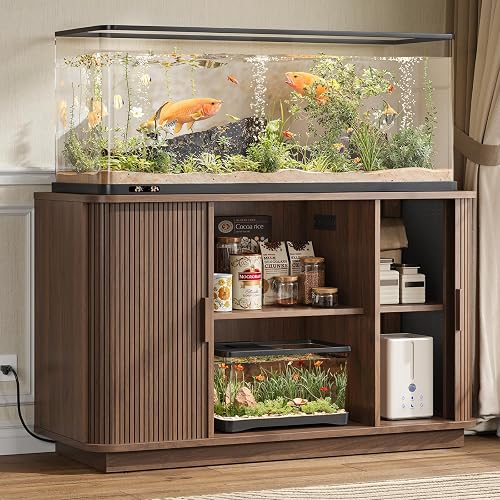
ONBRILL 55-75 Gallon Fish Tank Stand with Power Outlet,Fluted Sliding Door
Tetra LED 55 Gallon Complete Fish Tank Kit for Freshwater Fish

Bestier 55-75 Gal Fish Tank Stand Cabinet with Power Outlet & LED, Black
48" Aquarium Stand for 55–75/90 Gallon,Heavy Duty Fish Tank Stand

Tetra LED 55 Gallon Complete Fish Tank Kit for Freshwater Fish

VOWNER Farmhouse 55-75 Gallon Fish Tank Stand with Power Outlet, Grey
AcuarioSano rating: combines the average rating and the number of buyer reviews on Amazon. No brand pays to be featured.
First things first: the weight on your floor
A 55-gallon (208 L) aquarium is not just another piece of furniture. Water alone weighs about 8.3 lb per gallon (1 kg per liter), and once you add the glass, gravel, rock and the stand itself, the usual rule of thumb is around 10 lb per gallon all in. A set-up 55 gallon lands at roughly 600-650 lb (270-300 kg), and a 125 gallon goes past 1,400 lb (630 kg), all on a footprint of a few square feet.
On a concrete slab or a modern floor, a well-placed 55-75 gallon rarely causes trouble, but that load is far above the live load a typical residential floor is designed for (about 40 lb/sq ft, roughly 200 kg/m²). So do it right: put it against a load-bearing wall or in a corner, ideally running across the floor joists rather than parallel between two of them, not in the middle of a large room. In older homes with wooden framing, or before going past about 75-100 gallons on an upper floor, ask a contractor. And once it's full, it doesn't move: if you ever need to relocate it, follow our guide to moving an aquarium.
Warning: never put a large tank on a dresser, a table or a TV stand. They aren't built for hundreds of pounds sitting on the rim of the glass; over time they sag, the tank twists, and the glass or silicone seams can fail.
Common sizes and what they mean
| Size | Typical footprint | Approx. weight set up | Filtration | Good for |
|---|---|---|---|---|
| 55 gal (208 L) | 48 × 13 × 21 in | 600-650 lb (270-300 kg) | 1 large canister | angelfish, big community, small mbuna |
| 75 gal (284 L) | 48 × 18 × 21 in | about 850 lb (385 kg) | 1 large or 2 mid-size canisters | Malawi cichlids, discus, mid-size cichlids |
| 125 gal (473 L) | 72 × 18 × 21 in | about 1,400 lb (630 kg) | 2 canisters or a sump | oscars, large cichlids, big schools |
| 180 gal (680 L) | 72 × 24 × 25 in | about 2,000 lb (900 kg) | 2 canisters or a sump | large cichlid groups; advanced keepers |
Weights include water, glass, substrate, decor and stand and are only estimates: always check the manufacturer's specs.
Stand, leveling and tank-and-cabinet combos
Above about 40-55 gallons a dedicated stand is a must. The best option is the manufacturer's own cabinet for that tank: Fluval, Aqueon, Marineland, Juwel and others sell large tanks as combos with a cabinet that matches the base exactly and is rated for the weight. If you buy one separately, see our roundup of aquarium stands: load rating, exact footprint and moisture-resistant materials.
Before filling, check with a level that the stand is flat in both directions and doesn't rock. Rimless tanks usually need a foam mat underneath; framed tanks sit directly on the stand, as the maker specifies. Follow the order in our guide to setting up an aquarium step by step and fill in stages, rechecking level and seams.
Filtration, heating and lighting
- Filter: aim for a real turnover of 3-5 times the tank volume per hour. For 55-75 gallons, one large canister filter (Fluval, Eheim, Oase, Marineland) does the job; from about 100 gallons, two canisters or a freshwater sump. For cichlids, go to the high end.
- Heater: at roughly 2-4 watts per gallon (0.5-1 W per liter), a 55 gallon needs about 150-200 W and a 100 gallon around 300 W to hold 75-80 °F (24-27 °C). Better two heaters at half the wattage each: heat spreads evenly and a single failure does less damage.
- Light: on tanks longer than 4 ft (120 cm), one short fixture leaves dim corners. Use a full-length LED or two bars, on a 6-8 hour timer.
- Maintenance: a 20-30 % change means 10-25 gallons every week; a faucet-connected siphon hose saves a lot of bucket trips.
Tip: a big tank is more stable than a small one, because feeding or temperature mistakes get diluted in more water. That's why a well-equipped 55 gallon is more forgiving than a nano. What does go up is the running cost: estimate power, food and water conditioner with our guide to what an aquarium costs to run.
Which fish they make sense for
From 55 gallons up you can keep species that won't fit in a 20 or 30 gallon: groups of angelfish (they need at least 20 in, about 50 cm, of height), Malawi cichlid communities with fish like the yellow lab, big schools of tetras or barbs, and bottom dwellers in proper groups. The oscar reaches about 12 in (30 cm) and is very messy: for one adult, think 100-125 gallons, not 55.
Common mistakes
- Setting it on furniture not built for aquariums, or on a floor nobody checked.
- Sticking with the small filter that came in the kit and never upgrading as the stocking grows.
- Stocking it all at once because "there's plenty of room": the 4-6 week cycling period still applies.
- Placing it far from an outlet and a faucet, or where a leak would ruin hardwood floors.
- Choosing fish that outgrow the tank, like a common pleco or an oscar in a 55 gallon.
We compare spec sheets, verified reviews and real-world use criteria, but we don't physically test the products.
Frequently asked questions
How much does a full 55-gallon tank weigh?
Roughly 600-650 lb (270-300 kg) once you count the water (about 460 lb), glass, substrate, decor and stand. That's why it needs a dedicated stand and a solid floor, ideally against a load-bearing wall.
Does a large aquarium need a special stand?
Yes. From about 40-55 gallons up, use the manufacturer's stand or one built for aquariums, with a load rating above the total weight and the same footprint as the tank. A dresser or TV stand won't do.
Is a large tank a good idea for a beginner?
It can be: more water means water quality changes more slowly and mistakes are more forgiving. In exchange it costs more, weighs a lot and needs 10-25 gallon water changes every week. If you have the room and budget, a 55 gallon is easier to keep stable than a nano.
What filter does a 75-gallon tank need?
A real flow of about 225-375 gallons per hour (850-1400 L/h), which is 3-5 times the volume. One large canister or two mid-size ones usually cover it; with cichlids or big fish, stay at the high end of that range.
You may also like
 Gear reviewAquarium stands
 Gear reviewCanister filters
 Gear reviewAquarium heaters
- GuideHow to Move a Fish Tank Without Losing Fish or Your Cycle
- GuideHow to Set Up a Fish Tank Step by Step: From Stand to First Fish
- GuideHow Much Does an Aquarium Cost? Setup Budget and Real Monthly Costs
- GuideFirst Aquarium for Beginners: Tank Size, Equipment and Easy Fish
- GuideHow to Set Up a Nano Tank: Equipment, Stocking and Maintenance