If you buy through our links, Amazon pays us a small commission at no extra cost to you. That’s how we keep the site running. How we choose.
Contents
Overview
The blood parrot cichlid does not exist in the wild. It is a man-made hybrid developed in Taiwan in the late 1980s, most likely from Central American cichlids such as Amphilophus citrinellus crossed with Vieja or Heros species; the exact recipe has never been published, so its scientific name is just a trade label.
Its round body and tiny, always-open "smiling" mouth are deformities locked in by selective breeding. The spine is compressed, it swims clumsily, and it struggles to eat and defend itself. Some fish are also sold dyed or tattooed, a cruel practice worth refusing to support. Even so, blood parrots are sociable, long-lived and full of personality. If you choose one, do it knowing exactly what it is.
Care and tank setup
It may look gentle, but it reaches about 8 inches (20 cm) and is bulky: plan on 55 gallons (200 liters) for one or two fish, and more for a group. It prefers stable, roughly neutral, well-oxygenated water and strong filtration, because it produces a lot of waste.
- Aquascape: sand or fine gravel, large caves and open swimming space. It digs and moves objects around.
- Plants: anubias, Java fern and floating plants; rooted plants often get pulled up.
- Tankmates: it is territorial yet a poor fighter because of its mouth. Pair it with medium-sized, calm fish such as large tetras, larger barbs or plecos, and avoid aggressive cichlids. Shrimp and small fish will be eaten.
- Common mistakes: buying dyed fish, keeping it in a 15-gallon tank, or mixing it with oscars or African cichlids.
A cycled tank, a heater and weekly 25-30% water changes are a must.
Feeding
Blood parrots are greedy omnivores, but the deformed mouth makes biting hard. Choose small, slow-sinking pellets and frozen foods such as brine shrimp or mysis that they can suck in. Dedicated blood parrot pellets with astaxanthin enhance the red color naturally. Feed two small meals a day and make sure it actually eats, since faster tankmates can easily outcompete it.
Breeding
Pairs do form, clean a flat stone and lay eggs that both parents defend fiercely. However, most males are sterile, so the eggs turn white and fungus over. Only occasionally is a spawn fertile. In practice this is not a fish to breed at home, and there is no good reason to try to produce more hybrids with built-in health problems.
Compatible tank mates
Species from our database that share water parameters, size and temperament with the Blood parrot cichlid. Calculated from the data in each profile.
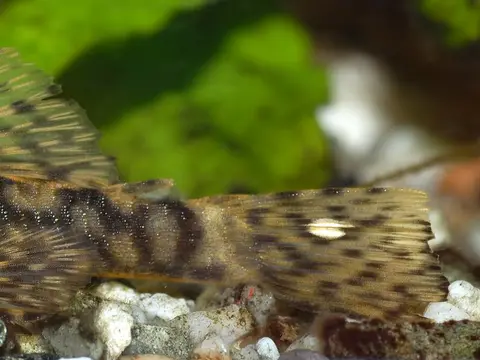 Bristlenose pleco Ancistrus sp. 26 gal (100 L) · 72–81 °F (22–27 °C)
 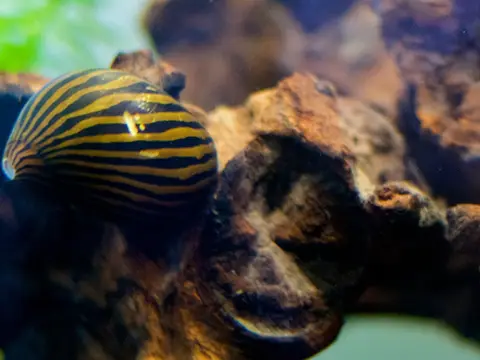 Nerite snail Neritina natalensis 5 gal (20 L) · 72–82 °F (22–28 °C)
 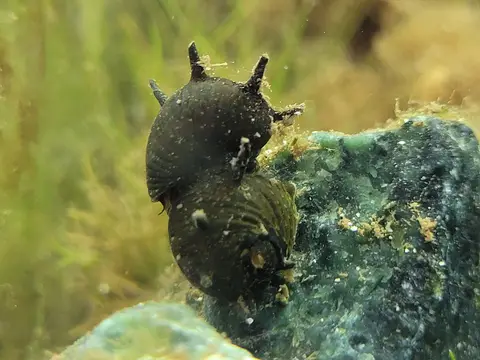 Horned nerite snail Clithon corona 5 gal (20 L) · 72–82 °F (22–28 °C)
 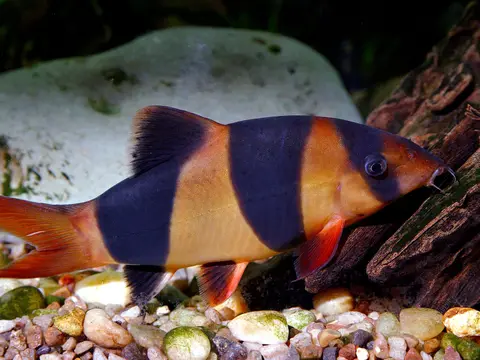 Clown loach Chromobotia macracanthus 132 gal (500 L) · 77–86 °F (25–30 °C)
 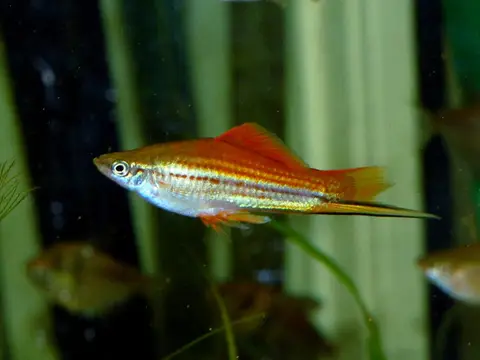 Swordtail Xiphophorus hellerii 32 gal (120 L) · 72–81 °F (22–27 °C)
 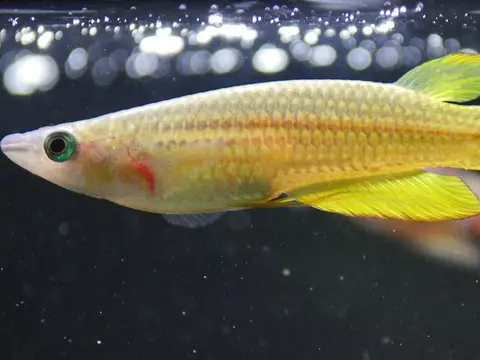 Golden wonder killifish (striped panchax) Aplocheilus lineatus 26 gal (100 L) · 72–81 °F (22–27 °C)
 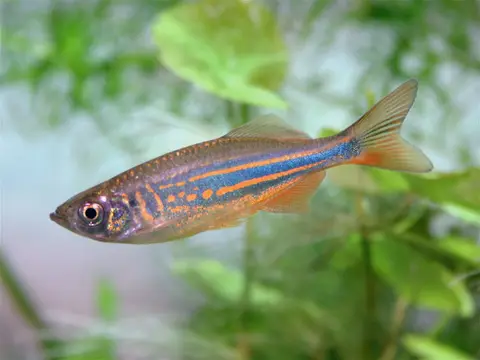 Giant danio Devario aequipinnatus 63 gal (240 L) · 68–79 °F (20–26 °C)
 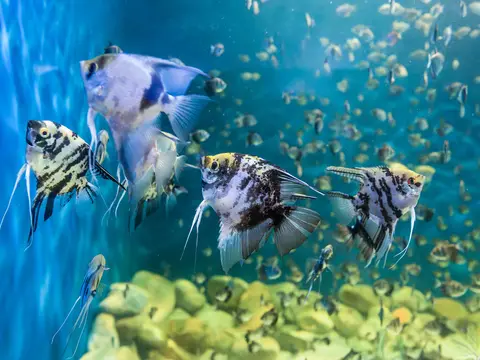 Angelfish Pterophyllum scalare 53 gal (200 L) · 75–84 °F (24–29 °C)
 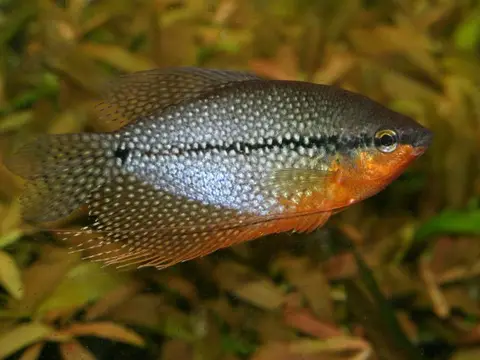 Pearl gourami Trichopodus leerii 32 gal (120 L) · 75–82 °F (24–28 °C)
 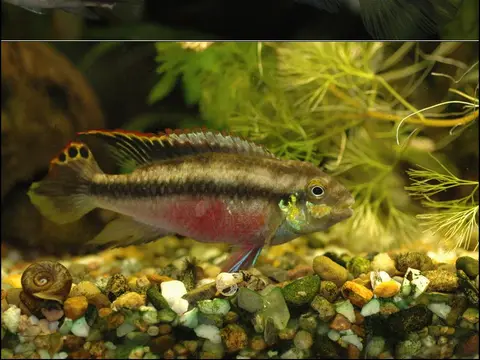 Kribensis Pelvicachromis pulcher 21 gal (80 L) · 75–82 °F (24–28 °C)
 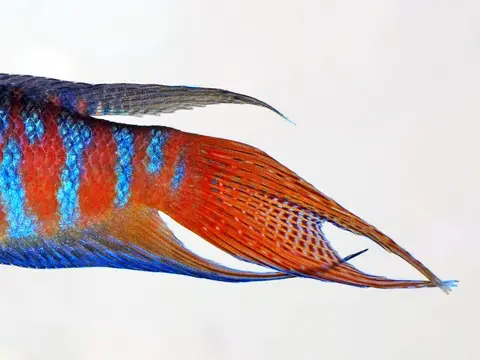 Paradise fish Macropodus opercularis 21 gal (80 L) · 61–79 °F (16–26 °C)
 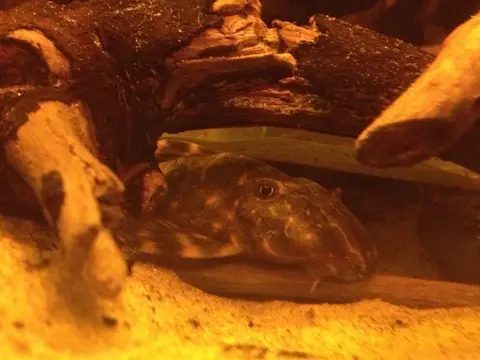 Clown pleco (L104) Panaqolus maccus 21 gal (80 L) · 75–82 °F (24–28 °C)
 Check the compatibility of your whole tank →
What not to keep it with
Popular species you shouldn’t house with the Blood parrot cichlid, and why.
- Cherry barb: one may eat the other due to size
- Tiger barb: one may eat the other due to size
- Betta fish: one may eat the other due to size
- Bronze cory: one may eat the other due to size
- Panda cory: incompatible temperatures, one may eat the other due to size
- Zebra danio: incompatible temperatures, one may eat the other due to size
- Guppy: one may eat the other due to size
- Dwarf gourami: one may eat the other due to size
Recommended equipment
What you need to keep the Blood parrot cichlid healthy, checked against Amazon stock.


Frequently asked questions
How many liters does a Blood parrot cichlid need?
At least about 200 liters. More space always helps keep the water stable.
What water temperature does the Blood parrot cichlid need?
Between 24 and 28 °C, with a pH of 6.5 to 7.8.
What fish can live with the Blood parrot cichlid?
Based on water, size and temperament, it fits with species such as Bristlenose pleco, Nerite snail, Horned nerite snail, Clown loach and Swordtail. Use our compatibility calculator to check your whole tank.
Can the Blood parrot cichlid be kept with shrimp?
Not recommended: because of its size or instinct, it will eat shrimp.