If you buy through our links, Amazon pays us a small commission at no extra cost to you. That’s how we keep the site running. How we choose.
Contents
Overview
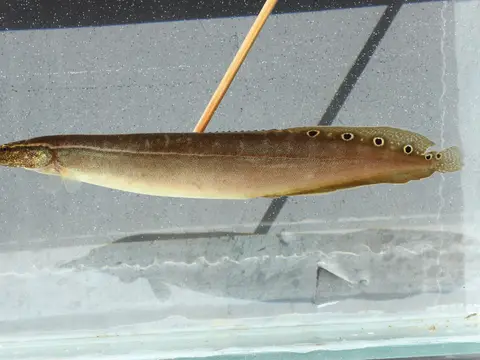
The peacock eel is not a true eel but a spiny eel from Southeast Asia. It has a long brown body with a pale stripe along the side, a pointed, mobile snout like a tiny trunk, and a row of black eyespots ringed in cream along the base of the dorsal fin, which gives it its name. Small spines run along its back.
It lives in slow rivers, canals and floodplains of Thailand, Cambodia and the Mekong basin. It spends much of the day buried in sand with only its head poking out, then comes out to hunt at dusk. It is curious and often learns to recognize its keeper, but it reaches about 10 inches (25 cm) and eats small fish, which you need to plan around.
Care and tank setup
Plan on a 55-gallon (200-liter) tank with a good footprint, roughly 4 ft (120 cm) long. Substrate is the key: several inches of soft, fine sand. Gravel scratches its skin and stops it burrowing, a common cause of infections.
- A lid with no gaps: it escapes through surprisingly small tubes and openings.
- Driftwood, caves and sturdy plants that are well rooted or tied to decor.
- Moderate light and clean, stable water at 73-82°F (23-28°C) in a cycled tank.
- Its skin has no visible protective scales, so it reacts poorly to some medications; use reduced doses.
Tankmates: peaceful, medium-sized fish too big to swallow, such as gouramis, medium barbs, larger rasboras or calm loaches. Neon tetras, small guppies and shrimp will be eaten. Several peacock eels usually get along in larger tanks, though they may squabble over the best hiding spots.
Feeding
It is a carnivore that feeds mostly in the evening. Offer bloodworms, chopped earthworms, brine shrimp and mysis, live or frozen; some learn to take sinking pellets, but few show interest in flakes. Place food near where it burrows at lights-out so faster fish do not grab it all. Watch its body condition closely during the first weeks.
Breeding
Aquarium breeding is rare and hardly documented among hobbyists. In the wild it depends on flood cycles, with eggs laid among vegetation. Fish in the trade are wild-caught or farmed in Asia. The realistic goal at home is keeping it healthy for years: with the right sand and diet it easily lives beyond a decade.
Compatible tank mates
Species from our database that share water parameters, size and temperament with the Peacock eel. Calculated from the data in each profile.
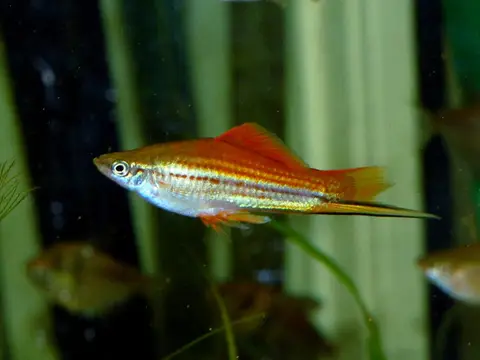 Swordtail Xiphophorus hellerii 32 gal (120 L) · 72–81 °F (22–27 °C)
 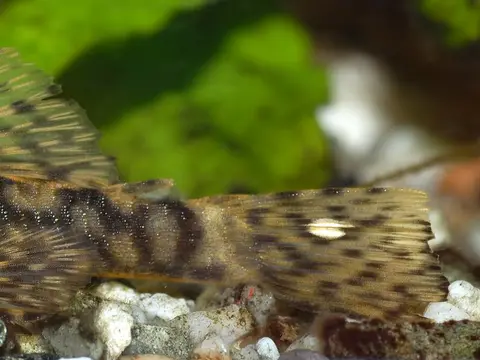 Bristlenose pleco Ancistrus sp. 26 gal (100 L) · 72–81 °F (22–27 °C)
 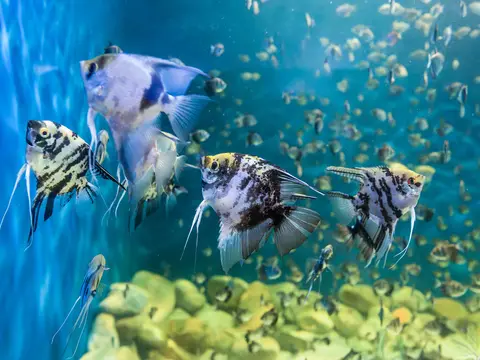 Angelfish Pterophyllum scalare 53 gal (200 L) · 75–84 °F (24–29 °C)
 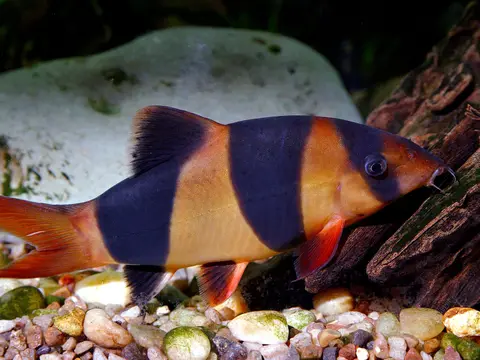 Clown loach Chromobotia macracanthus 132 gal (500 L) · 77–86 °F (25–30 °C)
 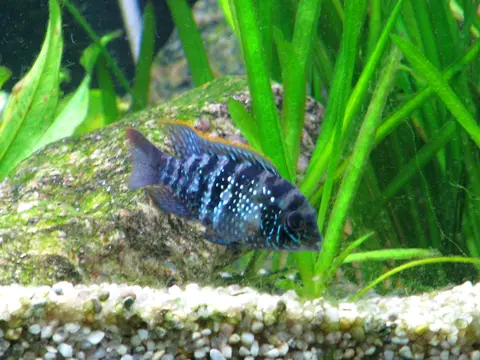 Blue acara Andinoacara pulcher 53 gal (200 L) · 72–82 °F (22–28 °C)
 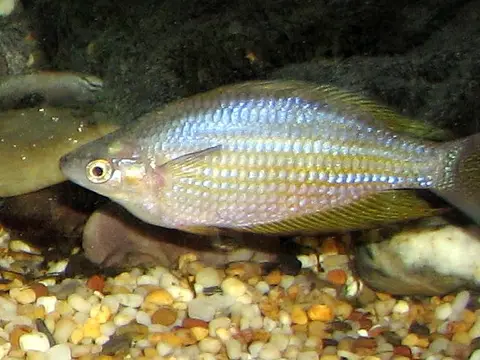 Eastern rainbowfish (splendid rainbowfish) Melanotaenia splendida 53 gal (200 L) · 72–82 °F (22–28 °C)
 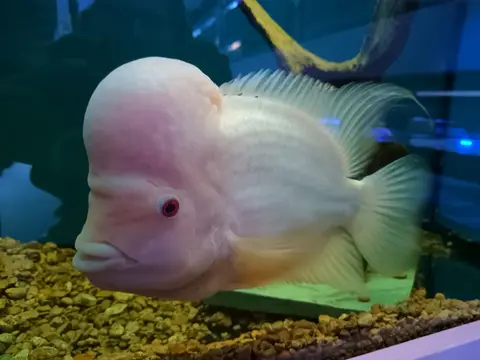 Blood parrot cichlid Amphilophus hybrid 53 gal (200 L) · 75–82 °F (24–28 °C)
 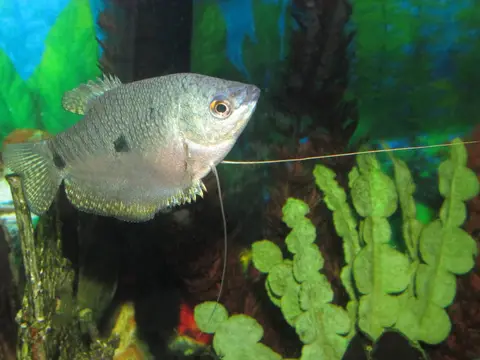 Blue gourami Trichopodus trichopterus 32 gal (120 L) · 72–82 °F (22–28 °C)
 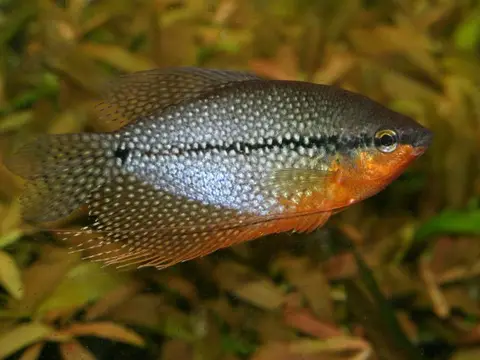 Pearl gourami Trichopodus leerii 32 gal (120 L) · 75–82 °F (24–28 °C)
 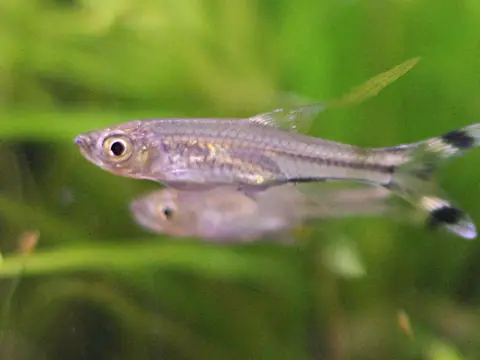 Scissortail rasbora Rasbora trilineata 40 gal (150 L) · 72–79 °F (22–26 °C)
 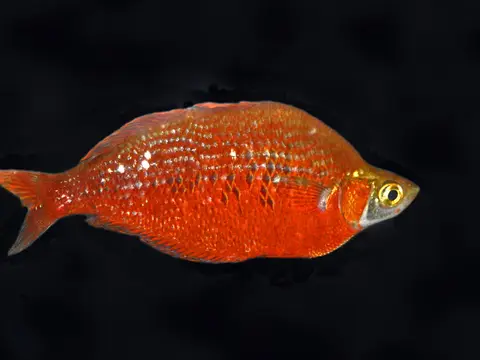 Red rainbowfish Glossolepis incisus 66 gal (250 L) · 72–79 °F (22–26 °C)
 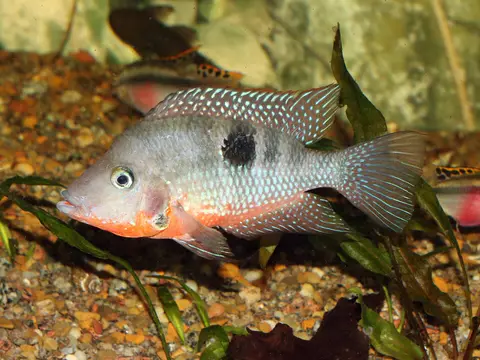 Firemouth cichlid Thorichthys meeki 53 gal (200 L) · 75–84 °F (24–29 °C)
 Check the compatibility of your whole tank →
What not to keep it with
Popular species you shouldn’t house with the Peacock eel, and why.
- Cherry barb: one may eat the other due to size
- Tiger barb: one may eat the other due to size
- Betta fish: one may eat the other due to size
- Bronze cory: one may eat the other due to size
- Panda cory: one may eat the other due to size
- Zebra danio: one may eat the other due to size
- Guppy: one may eat the other due to size
- Dwarf gourami: one may eat the other due to size
Recommended equipment
What you need to keep the Peacock eel healthy, checked against Amazon stock.


Frequently asked questions
How many liters does a Peacock eel need?
At least about 200 liters. More space always helps keep the water stable.
What water temperature does the Peacock eel need?
Between 23 and 28 °C, with a pH of 6 to 7.5.
What fish can live with the Peacock eel?
Based on water, size and temperament, it fits with species such as Swordtail, Bristlenose pleco, Angelfish, Clown loach and Blue acara. Use our compatibility calculator to check your whole tank.
Can the Peacock eel be kept with shrimp?
Not recommended: because of its size or instinct, it will eat shrimp.