If you buy through our links, Amazon pays us a small commission at no extra cost to you. That’s how we keep the site running. How we choose.
Contents
Overview
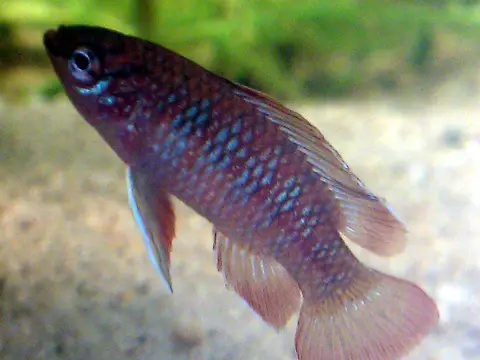
The scarlet badis (Dario dario) is one of the smallest and most colorful fish you can keep, barely reaching 0.8 inches (2 cm). Males show bright red vertical bars over a bluish body and fins edged in white and electric blue, while females are plain gray and understated.
It comes from clear, shallow, heavily vegetated streams in West Bengal and Assam, India. Despite its size, it behaves like a miniature cichlid: males display, defend a tiny territory and inspect every leaf for prey. It is a perfect choice for a planted nano tank set up just for them, but not for careless beginners, because feeding is its weak spot.
Care and tank setup
One male with several females, or a few males with plenty of females, does well in a 10-gallon (40-liter) tank or larger, preferably long rather than tall. With multiple males, plant more densely so each has its own corner and rivalries stay at the display stage.
- Dense planting, mosses, leaf litter and some driftwood; moderate light.
- Very gentle flow: a sponge filter is ideal.
- Neutral to slightly alkaline water; it handles cooler temperatures well, around 64-79°F (18-26°C).
- A mature tank with microfauna, which provides extra snacks.
Tankmates: best kept alone or with tiny, calm species such as chili rasboras, other microrasboras or shrimp. With fast, greedy fish it will go hungry and hide. Adult shrimp are safe, though it will pick off some shrimplets.
Feeding
It is a very picky micro-predator: many individuals refuse flakes and pellets. Offer baby brine shrimp, daphnia, grindal worms, cyclops or small bloodworms, live or frozen, daily and in small amounts. Check that it is really eating, because a scarlet badis with a sunken belly weakens within days. Some eventually accept fine dry food, but never as the staple.
Breeding
It breeds fairly easily in a well-planted species tank. The male intensifies his color and leads the female to a patch of moss or fine-leaved plants, where she lays a handful of eggs. There is no parental care and adults may eat the eggs. To raise fry, move the moss with eggs to a separate container and feed infusoria, then baby brine shrimp.
Compatible tank mates
Species from our database that share water parameters, size and temperament with the Scarlet badis. Calculated from the data in each profile.
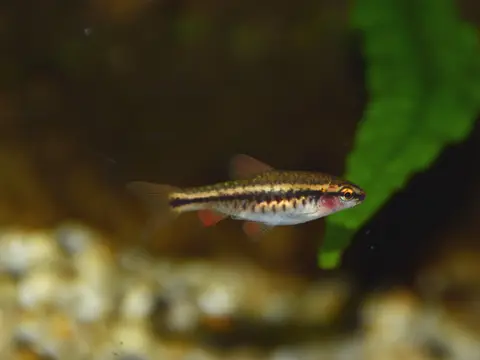 Cherry barb Puntius titteya 16 gal (60 L) · 73–81 °F (23–27 °C)
 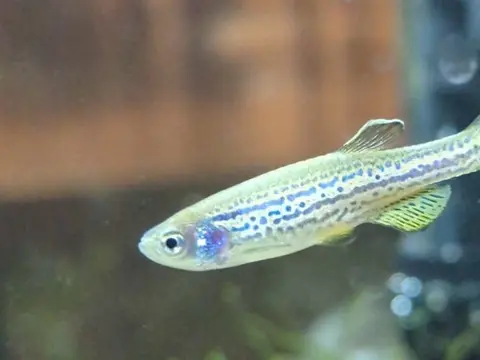 Zebra danio Danio rerio 16 gal (60 L) · 64–77 °F (18–25 °C)
 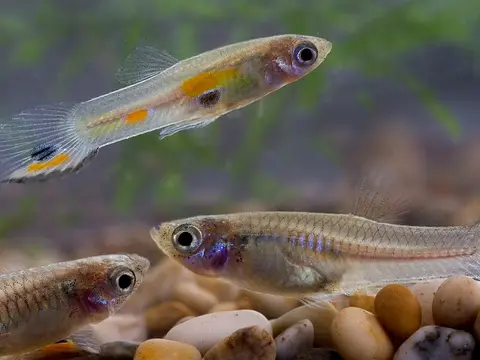 Guppy Poecilia reticulata 14 gal (54 L) · 72–82 °F (22–28 °C)
 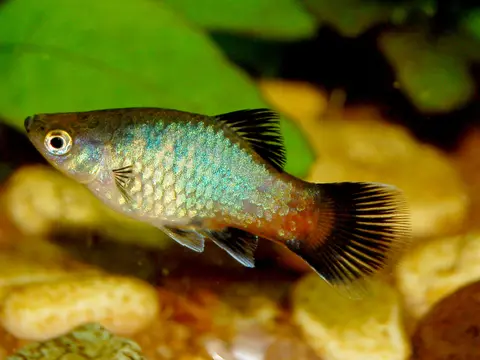 Platy Xiphophorus maculatus 16 gal (60 L) · 68–79 °F (20–26 °C)
 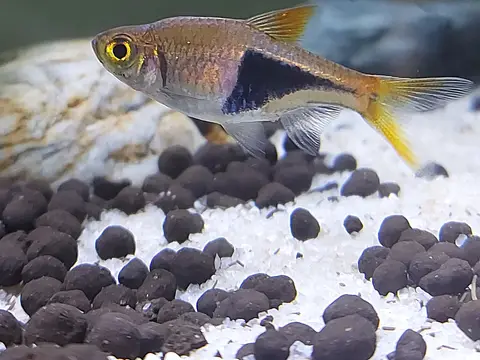 Harlequin rasbora Trigonostigma heteromorpha 16 gal (60 L) · 72–81 °F (22–27 °C)
 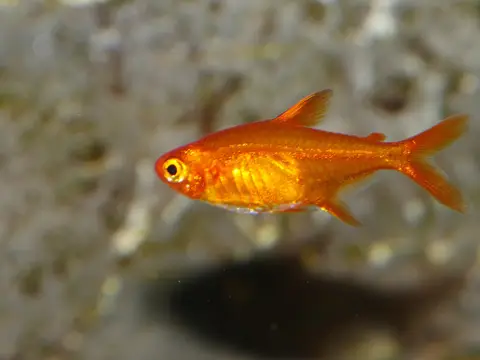 Ember tetra Hyphessobrycon amandae 11 gal (40 L) · 73–82 °F (23–28 °C)
 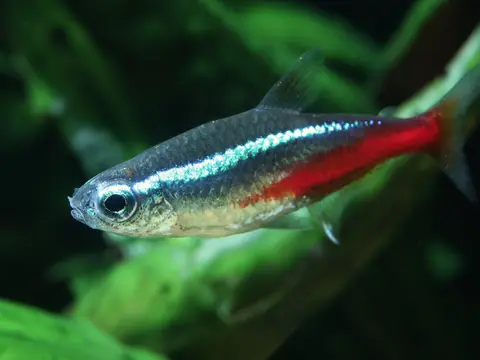 Neon tetra Paracheirodon innesi 16 gal (60 L) · 68–79 °F (20–26 °C)
 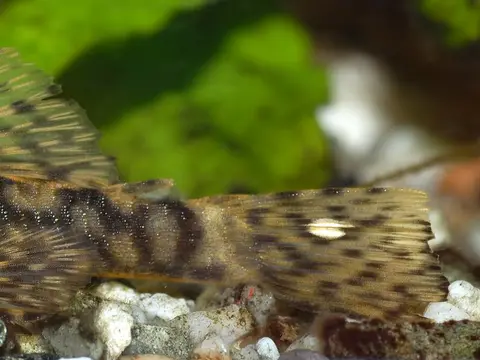 Bristlenose pleco Ancistrus sp. 26 gal (100 L) · 72–81 °F (22–27 °C)
 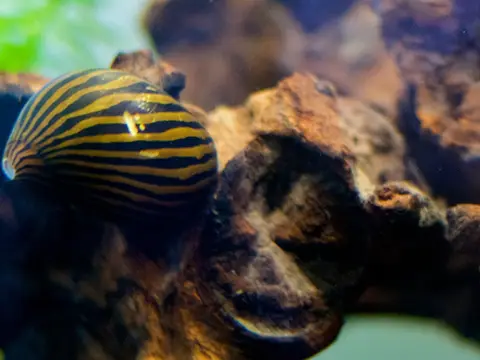 Nerite snail Neritina natalensis 5 gal (20 L) · 72–82 °F (22–28 °C)
 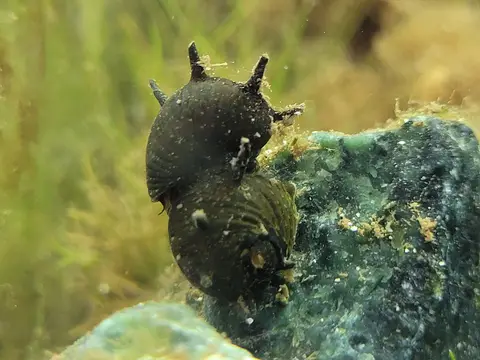 Horned nerite snail Clithon corona 5 gal (20 L) · 72–82 °F (22–28 °C)
 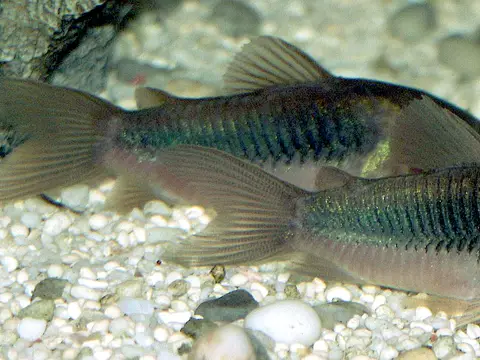 Bronze cory Corydoras aeneus 21 gal (80 L) · 72–81 °F (22–27 °C)
 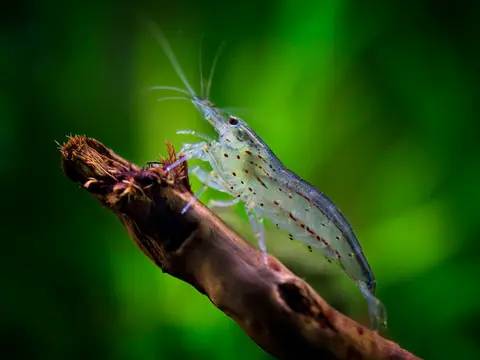 Amano shrimp Caridina multidentata 11 gal (40 L) · 64–82 °F (18–28 °C)
 Check the compatibility of your whole tank →
What not to keep it with
Popular species you shouldn’t house with the Scarlet badis, and why.
- Tiger barb: one may eat the other due to size
- Betta fish: one may eat the other due to size
- Common goldfish: one may eat the other due to size
- Discus: incompatible temperatures, one may eat the other due to size
- Angelfish: one may eat the other due to size
- Dwarf gourami: one may eat the other due to size
- Yellow lab cichlid: incompatible pH, one may eat the other due to size
- Clown loach: incompatible temperatures, one may eat the other due to size
Recommended equipment
What you need to keep the Scarlet badis healthy, checked against Amazon stock.



Frequently asked questions
How many liters does a Scarlet badis need?
At least about 40 liters for a group of at least 4 fish. More space always helps keep the water stable.
What water temperature does the Scarlet badis need?
Between 18 and 26 °C, with a pH of 6.5 to 7.5.
What fish can live with the Scarlet badis?
Based on water, size and temperament, it fits with species such as Cherry barb, Zebra danio, Guppy, Platy and Harlequin rasbora. Use our compatibility calculator to check your whole tank.
Can the Scarlet badis be kept with shrimp?
Yes: it usually won’t eat adult shrimp, though some shrimplets may get picked off. A tank with plenty of moss gives the babies cover.