If you buy through our links, Amazon pays us a small commission at no extra cost to you. That’s how we keep the site running. How we choose.
Contents
Overview
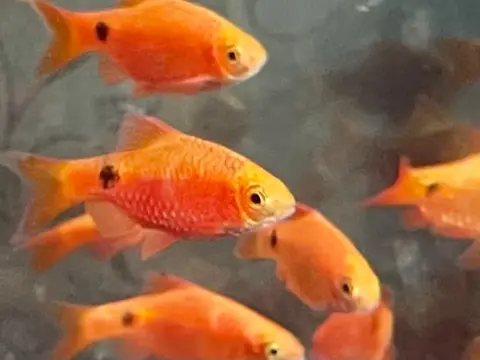
The rosy barb is an elongated, silvery barb with a black spot near the tail. In breeding condition and on a good diet, males flush a deep rosy red and their fins darken. Long-finned (veil) and more intensely colored captive strains are also available.
It comes from rivers and lakes in northern India, Nepal and Bangladesh, where the climate is subtropical, so it prefers cooler water than most tropical fish. It is one of the hardiest fish in the hobby, active and eye-catching. Keep in mind that it reaches about 4 inches (10 cm) and needs room: it is not a fish for small tanks, but it is a great choice for beginners with a roomy aquarium.
Care and tank setup
For a group of eight, plan on about 40 gallons (150 L) and at least 40 inches (100 cm) of length, since they are strong swimmers. Use a cycled tank with good filtration and oxygenation.
- Temperature: they thrive at cooler temperatures. Keeping them constantly at 81-82 °F (27-28 °C) shortens their lives; a heater set to 70-73 °F (21-23 °C) is plenty in most homes.
- Plants: they pick at and may eat soft plants. Choose tough species like anubias, java fern, vallisneria or cryptocorynes.
- Tank mates: active fish of similar size: danios, other barbs, larger tetras, loaches and plecos. In small groups they may nip fins, so avoid angelfish, bettas, fancy guppies and shrimp, which they may eat.
With eight or more, their behavior is far more balanced and you get to see the males' color displays. A lid is a good idea: they jump when startled.
Feeding
An omnivore with a big appetite for greens. Combine quality flakes and pellets with spirulina-rich food and blanched vegetables like peas or zucchini; it helps keep them off your plants. Several times a week, offer mosquito larvae, brine shrimp or daphnia. Split food into two small meals to avoid overfeeding.
Breeding
One of the easiest egg scatterers to breed. A well-conditioned pair in a breeding tank with fine-leaved plants or moss and mesh over the bottom usually spawns in the morning light, leaving hundreds of sticky eggs. The parents eat them, so remove the adults. Fry hatch in one to two days, grow quickly and take infusoria, followed by baby brine shrimp.
Compatible tank mates
Species from our database that share water parameters, size and temperament with the Rosy barb. Calculated from the data in each profile.
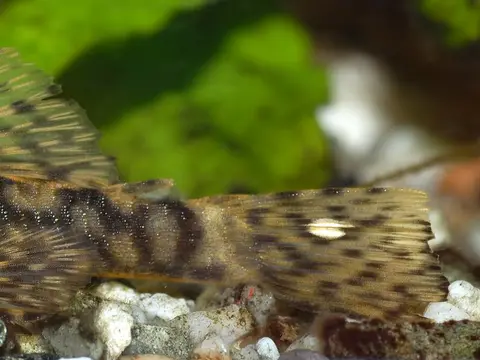 Bristlenose pleco Ancistrus sp. 26 gal (100 L) · 72–81 °F (22–27 °C)
 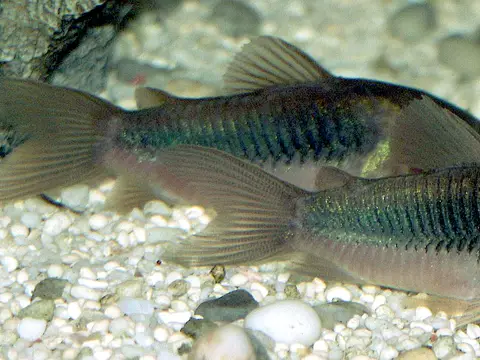 Bronze cory Corydoras aeneus 21 gal (80 L) · 72–81 °F (22–27 °C)
 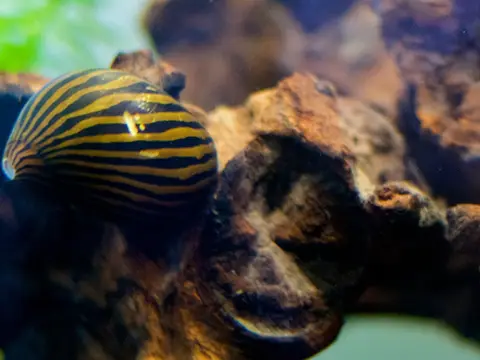 Nerite snail Neritina natalensis 5 gal (20 L) · 72–82 °F (22–28 °C)
 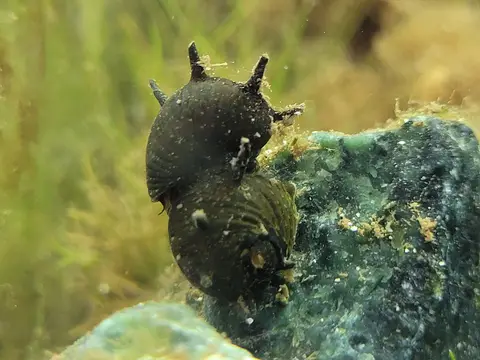 Horned nerite snail Clithon corona 5 gal (20 L) · 72–82 °F (22–28 °C)
 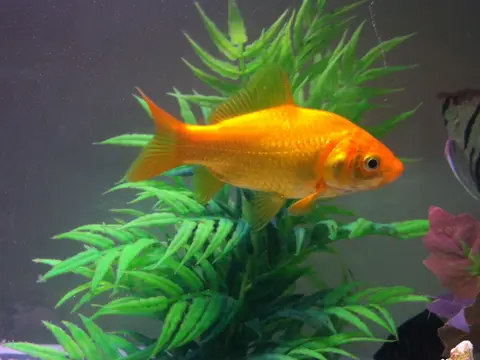 Common goldfish Carassius auratus 79 gal (300 L) · 50–75 °F (10–24 °C)
 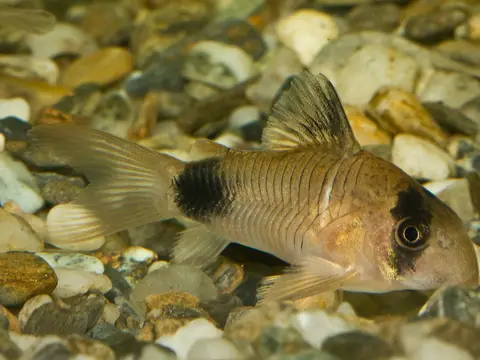 Panda cory Corydoras panda 16 gal (60 L) · 68–77 °F (20–25 °C)
 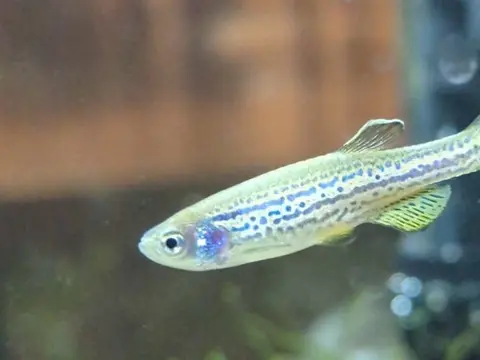 Zebra danio Danio rerio 16 gal (60 L) · 64–77 °F (18–25 °C)
 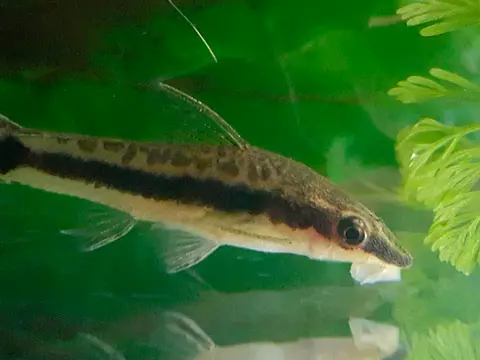 Otocinclus catfish Otocinclus vestitus 16 gal (60 L) · 70–79 °F (21–26 °C)
 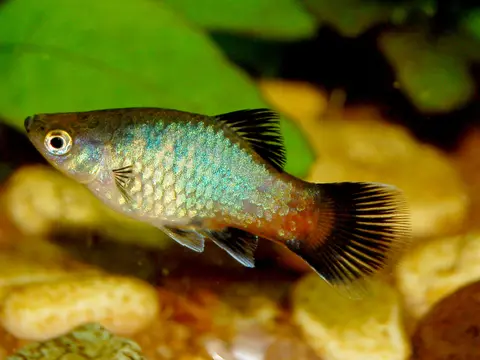 Platy Xiphophorus maculatus 16 gal (60 L) · 68–79 °F (20–26 °C)
 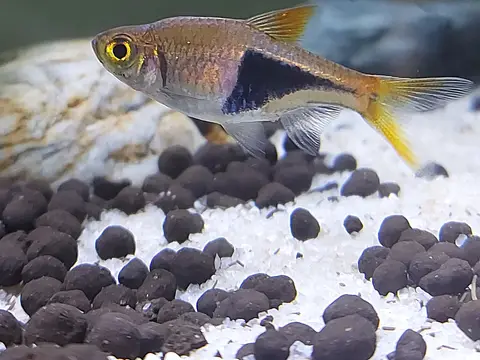 Harlequin rasbora Trigonostigma heteromorpha 16 gal (60 L) · 72–81 °F (22–27 °C)
 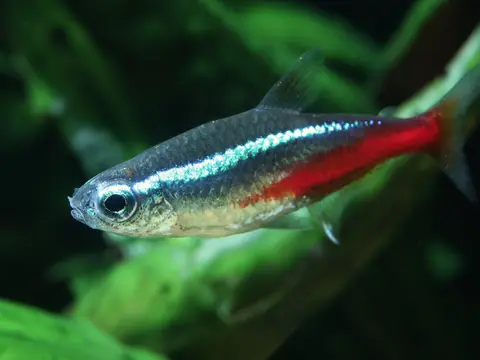 Neon tetra Paracheirodon innesi 16 gal (60 L) · 68–79 °F (20–26 °C)
 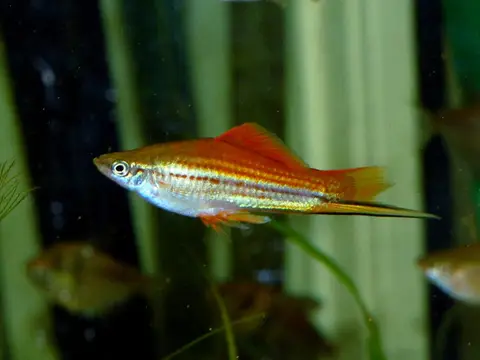 Swordtail Xiphophorus hellerii 32 gal (120 L) · 72–81 °F (22–27 °C)
 Check the compatibility of your whole tank →
What not to keep it with
Popular species you shouldn’t house with the Rosy barb, and why.
- Betta fish: incompatible temperatures, nips long fins
- Discus: incompatible temperatures
- Angelfish: incompatible temperatures, nips long fins
- Guppy: nips long fins
- Oranda goldfish: nips long fins
- Oscar: one may eat the other due to size, incompatible temperaments
- Ram cichlid: incompatible temperatures
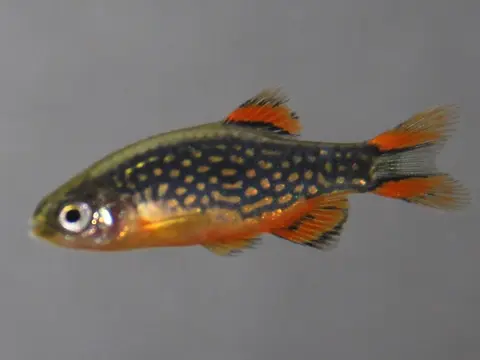
- Celestial pearl danio: one may eat the other due to size
Recommended equipment
What you need to keep the Rosy barb healthy, checked against Amazon stock.




Frequently asked questions
How many liters does a Rosy barb need?
At least about 150 liters for a group of at least 8 fish. More space always helps keep the water stable.
What water temperature does the Rosy barb need?
Between 18 and 25 °C, with a pH of 6 to 8.
What fish can live with the Rosy barb?
Based on water, size and temperament, it fits with species such as Bristlenose pleco, Bronze cory, Nerite snail, Horned nerite snail and Common goldfish. Use our compatibility calculator to check your whole tank.
Can the Rosy barb be kept with shrimp?
Not recommended: because of its size or instinct, it will eat shrimp.