If you buy through our links, Amazon pays us a small commission at no extra cost to you. That’s how we keep the site running. How we choose.
Contents
Overview
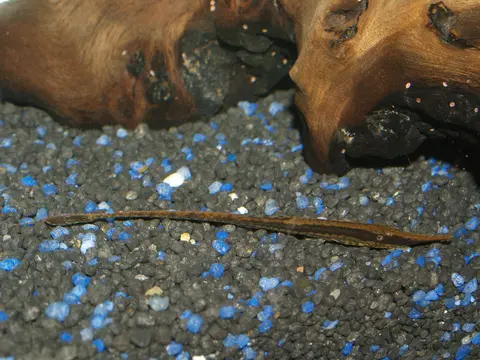
The twig catfish, or farlowella, is one of the oddest fish in the hobby: a very long, thin loricariid of about 6 in (15 cm), with a pointed, elongated snout and brown coloring that makes it look just like a dead twig. It comes from the Orinoco basin in Venezuela and Colombia, where it lives in slow water among branches, roots and leaf litter.
It spends hours motionless on wood, leaves or the glass and only moves slowly to graze algae. People love its bizarre look and total calm, but it is not for every tank: it is shy, a poor competitor for food and sensitive to poor water quality. It is ideal for planted tanks and very peaceful communities.
Care and tank setup
One fish or a pair needs a mature, stable tank of about 26 gallons (100 L) with good length. Water quality is its biggest demand: clean, well-oxygenated water with low nitrates, so keep up with regular water changes.
- Lots of plants, thin driftwood and branches to rest on and blend in.
- Dried leaves (catappa, oak) that grow biofilm and release tannins.
- Gentle flow and moderate light with shaded areas.
Choose slow, peaceful tankmates: small tetras, rasboras, corydoras, otos and shrimp. Fast or greedy fish will steal its food, while barbs or restless cichlids stress it. A common mistake is adding it to a new tank with no algae; many arrive weak and need plenty of food from day one.
Feeding
Twig catfish graze mostly on algae and biofilm. Supplement daily with spirulina wafers and blanched zucchini or cucumber placed near its favorite resting spot. It also takes small frozen foods. Check that its belly is not sunken, which is the best sign that it is getting enough to eat.
Breeding
Breeding at home is possible. The pair lays eggs on a smooth vertical surface such as the glass or a piece of wood, often in a spot with some current, and the male guards and cleans them until they hatch about a week later. The fry need plenty of fine algae, biofilm and finely mashed vegetables and are delicate at first.
Compatible tank mates
Species from our database that share water parameters, size and temperament with the Twig catfish. Calculated from the data in each profile.
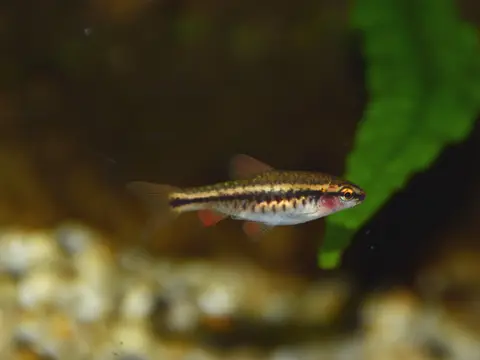 Cherry barb Puntius titteya 16 gal (60 L) · 73–81 °F (23–27 °C)
 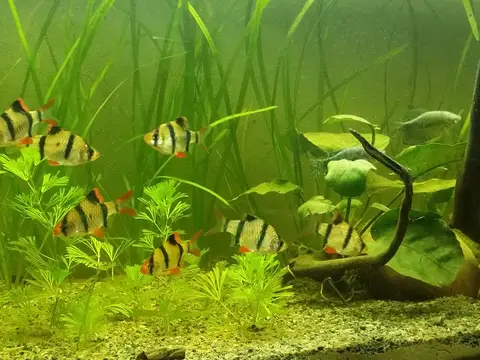 Tiger barb Puntigrus tetrazona 26 gal (100 L) · 72–79 °F (22–26 °C)
 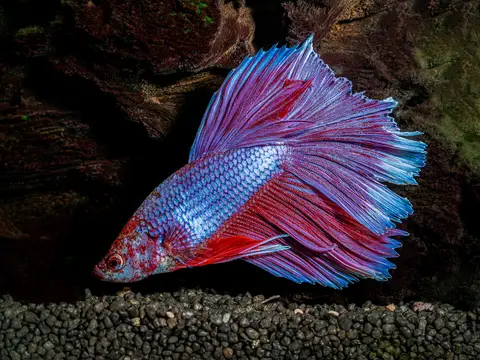 Betta fish Betta splendens 7 gal (25 L) · 75–82 °F (24–28 °C)
 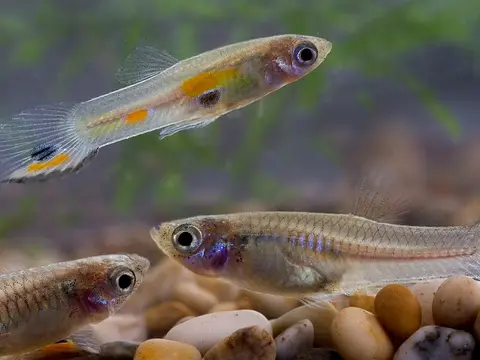 Guppy Poecilia reticulata 14 gal (54 L) · 72–82 °F (22–28 °C)
 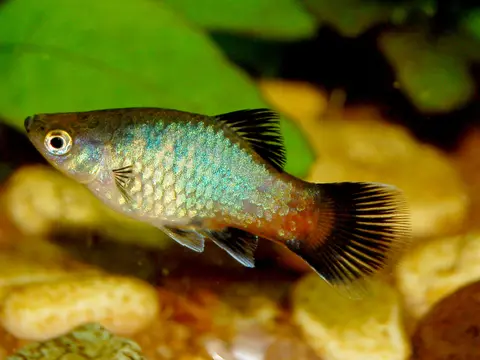 Platy Xiphophorus maculatus 16 gal (60 L) · 68–79 °F (20–26 °C)
 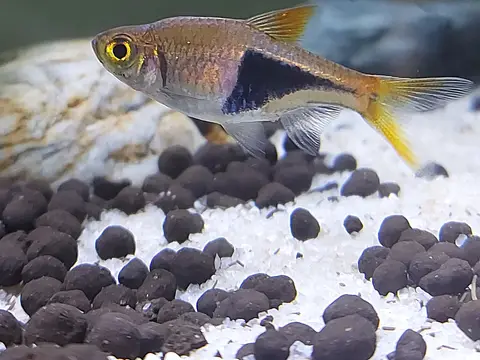 Harlequin rasbora Trigonostigma heteromorpha 16 gal (60 L) · 72–81 °F (22–27 °C)
 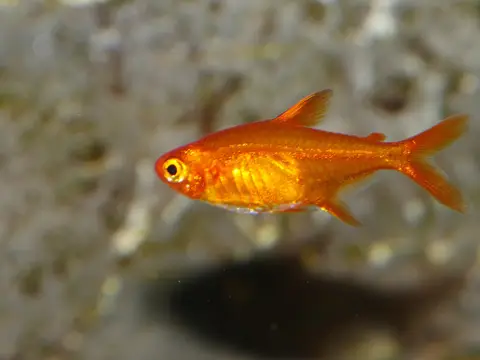 Ember tetra Hyphessobrycon amandae 11 gal (40 L) · 73–82 °F (23–28 °C)
 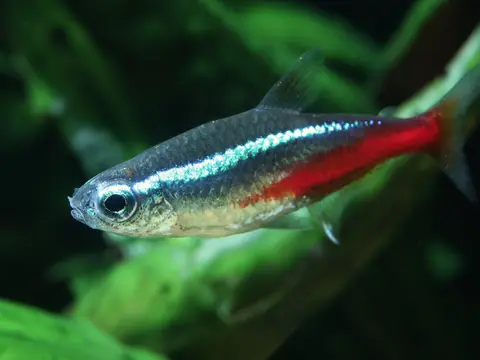 Neon tetra Paracheirodon innesi 16 gal (60 L) · 68–79 °F (20–26 °C)
 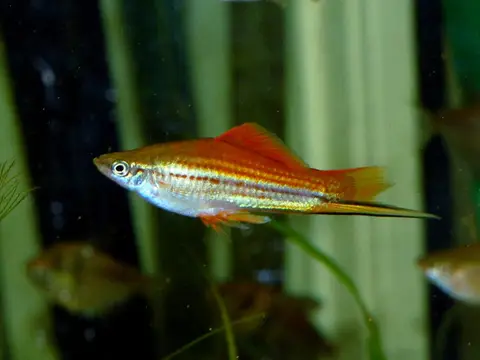 Swordtail Xiphophorus hellerii 32 gal (120 L) · 72–81 °F (22–27 °C)
 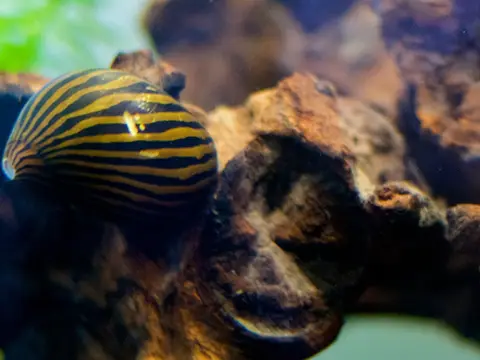 Nerite snail Neritina natalensis 5 gal (20 L) · 72–82 °F (22–28 °C)
 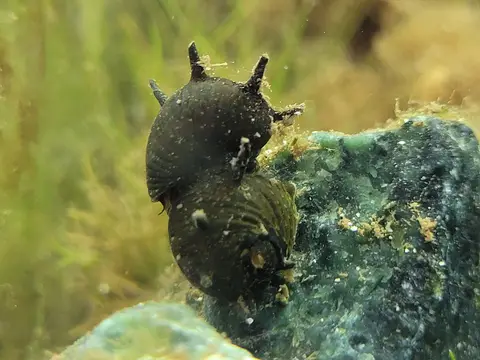 Horned nerite snail Clithon corona 5 gal (20 L) · 72–82 °F (22–28 °C)
 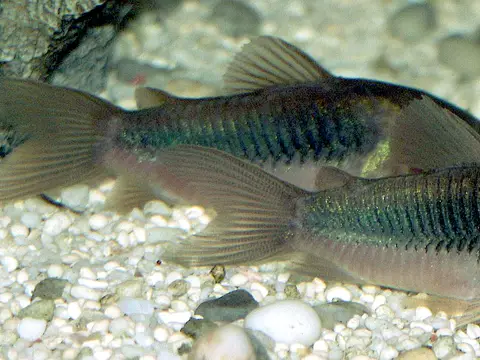 Bronze cory Corydoras aeneus 21 gal (80 L) · 72–81 °F (22–27 °C)
 Check the compatibility of your whole tank →
What not to keep it with
Popular species you shouldn’t house with the Twig catfish, and why.
Recommended equipment
What you need to keep the Twig catfish healthy, checked against Amazon stock.



Frequently asked questions
How many liters does a Twig catfish need?
At least about 100 liters. More space always helps keep the water stable.
What water temperature does the Twig catfish need?
Between 24 and 27 °C, with a pH of 6 to 7.5.
What fish can live with the Twig catfish?
Based on water, size and temperament, it fits with species such as Cherry barb, Tiger barb, Betta fish, Guppy and Platy. Use our compatibility calculator to check your whole tank.
Can the Twig catfish be kept with shrimp?
Yes: it usually won’t eat adult shrimp, though some shrimplets may get picked off. A tank with plenty of moss gives the babies cover.
You may also like
Plecos and suckermouth catfish → Freshwater fish → Complete aquarium guide →