If you buy through our links, Amazon pays us a small commission at no extra cost to you. That’s how we keep the site running. How we choose.
Contents
Overview
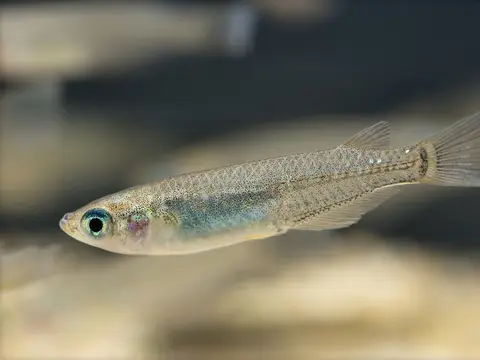
The medaka, or Japanese ricefish, is a small surface-dwelling fish native to Japan, Korea, China and Taiwan, where it lives in rice paddies, ditches and slow-moving ponds. It grows to about 1.4 inches (3.5 cm) and has a straight back, large eyes and a broad anal fin. The wild form is grayish, but Japanese breeders have created hundreds of varieties: orange (himedaka), white, blue, metallic-scaled and long-finned.
Medaka are hugely popular in Japan, where they are kept in ceramic bowls and patio tubs, and they are also a well-studied laboratory model. Hobbyists love their calm nature, their tolerance of changing temperatures and how easily they breed. They are perfect for unheated aquariums, shrimp tanks and well-planned outdoor containers.
Care and tank setup
A 10-gallon (40 L) tank is enough for a group of 6; choose one that is longer than it is tall, because medaka spend nearly all their time near the surface.
- Temperature: they handle cold water and seasonal swings but are most active at 64-77 °F (18-25 °C). Indoors they need no heater.
- Flow: gentle; a sponge filter or a filter turned down low.
- Decor: floating and fine-leaved plants where females can attach their eggs, with part of the surface left open for feeding.
- Lid: recommended, as they can jump.
Outdoors, keep them in tubs or mini ponds of 10 gallons (40 L) or more, with plants and partial shade; in summer stop the water from overheating in direct sun, and in winter make sure shallow containers cannot freeze solid. They get along with shrimp, snails, white clouds and other small peaceful fish, but not goldfish or larger species. Never release them into the wild.
Feeding
A surface-feeding omnivore. Medaka take fine flakes and floating micro pellets and love brine shrimp, daphnia and small mosquito larvae. In outdoor tubs they supplement their diet with small insects and algae. Feed small amounts twice a day in summer and cut back sharply when the water is cold.
Breeding
They breed very easily with more than 12-13 hours of light and mild water. The female carries a cluster of eggs beneath her belly for a few hours, then wipes them onto plants or floating roots. Adults eat eggs and fry, so move egg-laden plants to a separate container. Eggs hatch in about 10 days, and fry take powdered food and infusoria.
Compatible tank mates
Species from our database that share water parameters, size and temperament with the Medaka (Japanese ricefish). Calculated from the data in each profile.
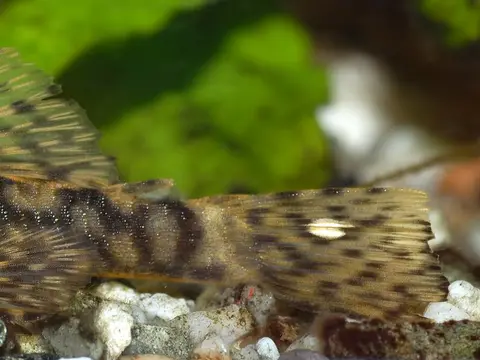 Bristlenose pleco Ancistrus sp. 26 gal (100 L) · 72–81 °F (22–27 °C)
 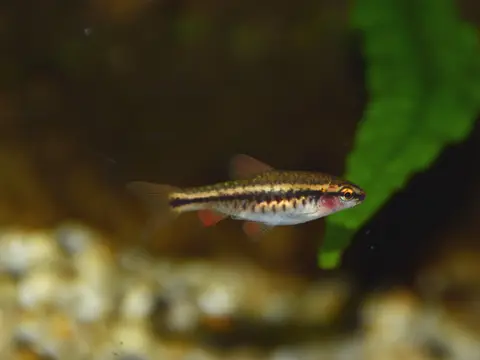 Cherry barb Puntius titteya 16 gal (60 L) · 73–81 °F (23–27 °C)
 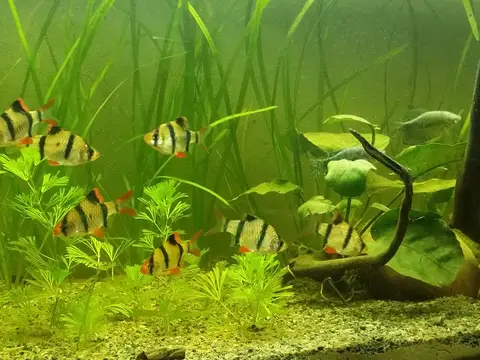 Tiger barb Puntigrus tetrazona 26 gal (100 L) · 72–79 °F (22–26 °C)
 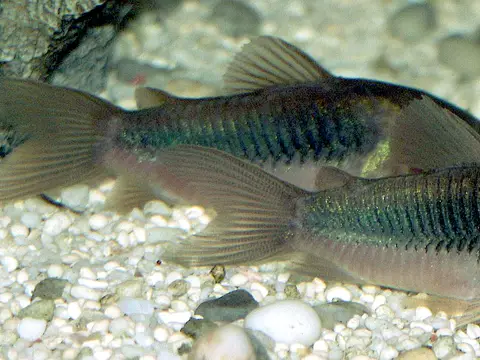 Bronze cory Corydoras aeneus 21 gal (80 L) · 72–81 °F (22–27 °C)
 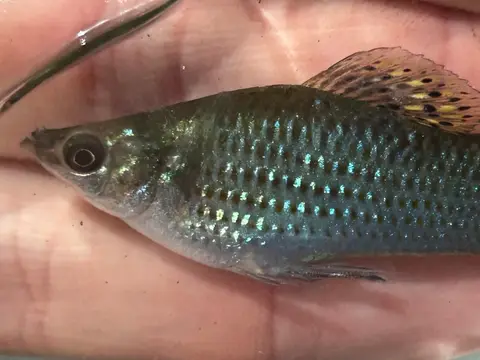 Molly Poecilia sphenops 26 gal (100 L) · 75–82 °F (24–28 °C)
 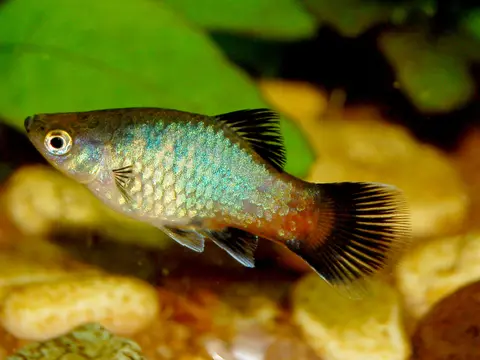 Platy Xiphophorus maculatus 16 gal (60 L) · 68–79 °F (20–26 °C)
 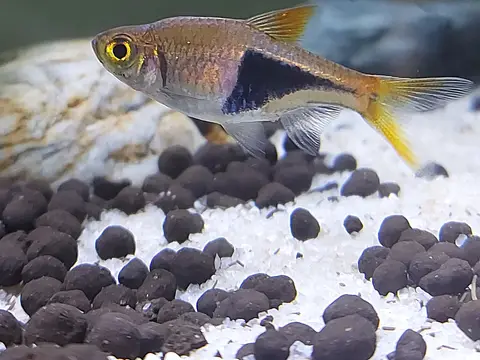 Harlequin rasbora Trigonostigma heteromorpha 16 gal (60 L) · 72–81 °F (22–27 °C)
 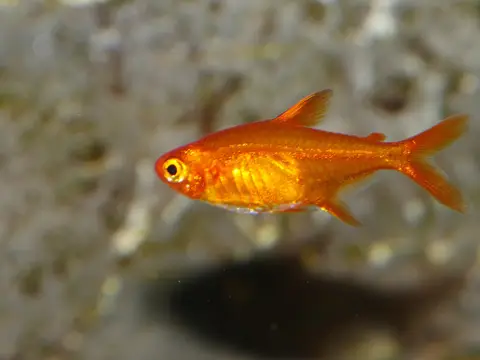 Ember tetra Hyphessobrycon amandae 11 gal (40 L) · 73–82 °F (23–28 °C)
 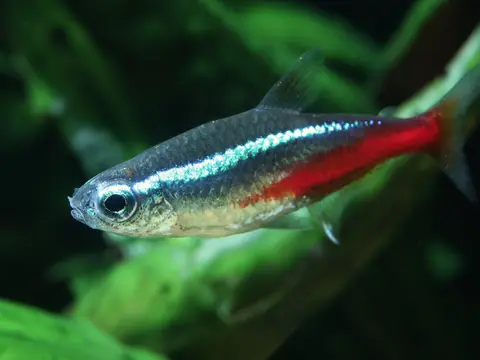 Neon tetra Paracheirodon innesi 16 gal (60 L) · 68–79 °F (20–26 °C)
 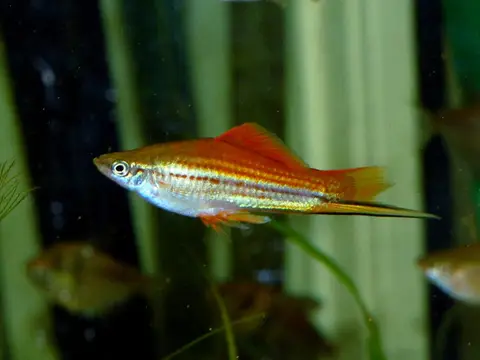 Swordtail Xiphophorus hellerii 32 gal (120 L) · 72–81 °F (22–27 °C)
 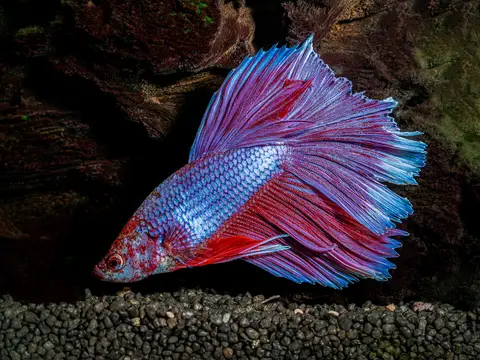 Betta fish Betta splendens 7 gal (25 L) · 75–82 °F (24–28 °C)
 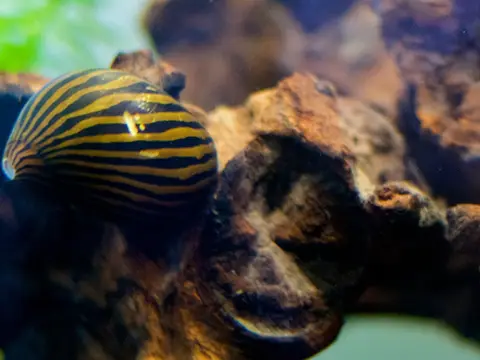 Nerite snail Neritina natalensis 5 gal (20 L) · 72–82 °F (22–28 °C)
 Check the compatibility of your whole tank →
What not to keep it with
Popular species you shouldn’t house with the Medaka (Japanese ricefish), and why.
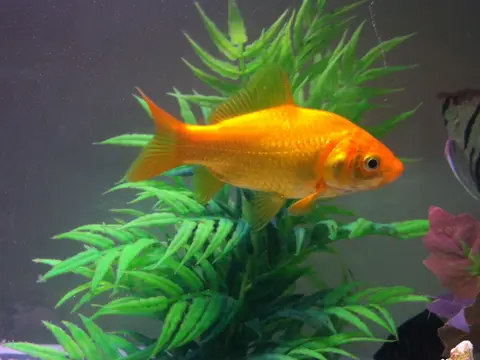
- Common goldfish: one may eat the other due to size
- Discus: incompatible temperatures, one may eat the other due to size
- Angelfish: one may eat the other due to size
- Clown loach: incompatible temperatures, one may eat the other due to size
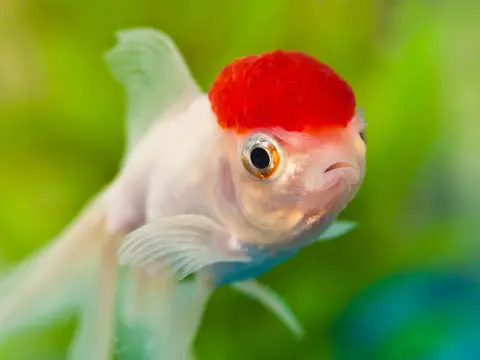
- Oranda goldfish: one may eat the other due to size
- Oscar: one may eat the other due to size, incompatible temperaments
Recommended equipment
What you need to keep the Medaka (Japanese ricefish) healthy, checked against Amazon stock.




Frequently asked questions
How many liters does a Medaka (Japanese ricefish) need?
At least about 40 liters for a group of at least 6 fish. More space always helps keep the water stable.
What water temperature does the Medaka (Japanese ricefish) need?
Between 10 and 26 °C: it’s a coldwater species that doesn’t need a heater in a normal home. pH 6.5 to 8.
What fish can live with the Medaka (Japanese ricefish)?
Based on water, size and temperament, it fits with species such as Bristlenose pleco, Cherry barb, Tiger barb, Bronze cory and Molly. Use our compatibility calculator to check your whole tank.
Can the Medaka (Japanese ricefish) be kept with shrimp?
Yes: it usually won’t eat adult shrimp, though some shrimplets may get picked off. A tank with plenty of moss gives the babies cover.
You may also like
Coldwater fish → Freshwater fish → Complete aquarium guide →