If you buy through our links, Amazon pays us a small commission at no extra cost to you. That’s how we keep the site running. How we choose.
Not every tank has a powerful light, and that is fine. This list is generated from our plant database and includes every plant whose light requirement is low: species that grow under basic stock lights, in deeper tanks or in shaded areas below floating plants.
Low-light plants usually grow slowly. That has advantages: less trimming, less fertilizer and fewer nutrient swings. The downside is that they take up fewer nutrients, so in a new tank it is wise to add a fast grower or some floating plants to keep algae in check.
- Anubias and Java fern: the classic low-light epiphytes.
- Cryptocoryne: rosette plants for the foreground and midground.
- Mosses: Java moss and similar species for wood and rock.
Low light does not mean no light. Plants still need a regular photoperiod of 6-8 hours on a timer. Too much light with too few nutrients is what usually triggers algae; too little and plants slowly fade.
Low-light plants also work in tanks with fish that eat or uproot soft plants, since their tough leaves and attached rhizomes are rarely damaged. Combine them with driftwood and rocks for a natural, low-maintenance aquascape.
Low-light plants
| Species | Light | CO₂ | Temp. | Difficulty |
|---|---|---|---|---|
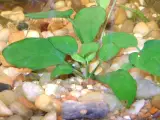 Anubias nana Anubias barteri var. nana | Low | Not needed | 72–82 °F (22–28 °C) | Easy |
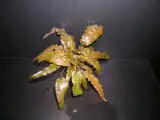 Cryptocoryne wendtii Cryptocoryne wendtii | Low | Not needed | 68–82 °F (20–28 °C) | Easy |
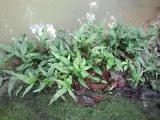 Java fern Microsorum pteropus | Low | Not needed | 68–82 °F (20–28 °C) | Easy |
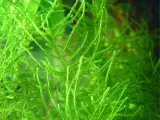 Java moss Taxiphyllum barbieri | Low | Not needed | 64–82 °F (18–28 °C) | Easy |
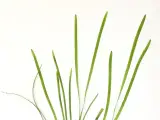 Vallisneria Vallisneria spiralis | Low | Not needed | 64–82 °F (18–28 °C) | Easy |
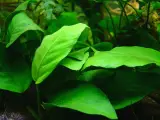 Anubias barteri Anubias barteri | Low | Not needed | 72–82 °F (22–28 °C) | Easy |
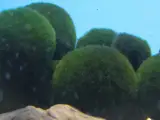 Marimo moss ball Aegagropila linnaei | Low | Not needed | 50–75 °F (10–24 °C) | Easy |
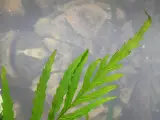 African water fern Bolbitis heudelotii | Low | Optional (helps) | 72–82 °F (22–28 °C) | Moderate |
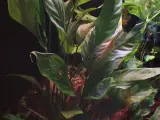 Bucephalandra Bucephalandra sp. | Low | Optional (helps) | 72–82 °F (22–28 °C) | Moderate |
 Hornwort (Ceratophyllum demersum) Ceratophyllum demersum | Low | Not needed | 50–82 °F (10–28 °C) | Easy |
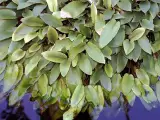 Cryptocoryne beckettii Cryptocoryne beckettii | Low | Not needed | 68–82 °F (20–28 °C) | Easy |
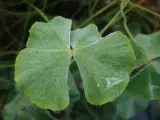 Marsilea hirsuta Marsilea hirsuta | Low | Optional (helps) | 64–82 °F (18–28 °C) | Easy |
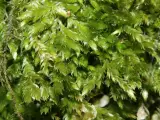 Flame moss Taxiphyllum sp. 'Flame' | Low | Optional (helps) | 64–82 °F (18–28 °C) | Easy |
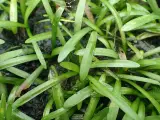 Dwarf sagittaria (Sagittaria subulata) Sagittaria subulata | Low | Not needed | 64–82 °F (18–28 °C) | Easy |
No species match those filters.
Frequently asked questions
Can aquarium plants grow without a special light?
Low-light plants such as Anubias, Java fern and Java moss grow under most basic aquarium LEDs. Room light or a window alone is usually not enough and can cause algae.
How many hours of light do low-light plants need?
About 6-8 hours a day, ideally on a timer. More hours do not make slow plants grow faster but can feed algae.
Do low-light plants need CO2?
No. They grow well without injected CO2, which is one reason they are popular in low-tech tanks.
You may also like
- ListEasy plants
 Gear reviewAquarium LED lights
- GuideHow Many Hours of Light Does an Aquarium Need? Photoperiod Guide
- GuidePlanted Tank for Beginners: Light, Substrate, Fertilizer and CO2
- GuideCO2 in a Planted Tank: When You Need It and How to Dial It In
 Gear reviewPlanted aquarium LED lights
 Gear reviewPlanted aquarium substrates
 Gear reviewAquarium plant fertilizers