If you buy through our links, Amazon pays us a small commission at no extra cost to you. That’s how we keep the site running. How we choose.
Contents
Overview
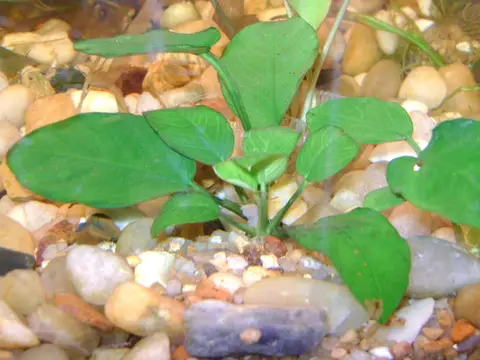
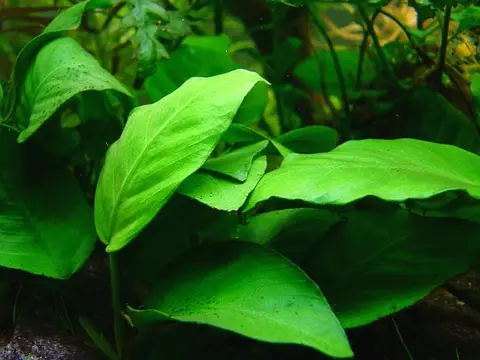
Anubias nana is the compact form of Anubias barteri, native to shady streams in West Africa, mainly Cameroon. It has small, oval, thick leaves in a glossy dark green that grow from a creeping rhizome, and it rarely gets taller than about 4 inches (10 cm).
It may be the hardest aquarium plant to kill. It tolerates low light, needs no CO2, adapts to a wide range of water and its leathery leaves are ignored by almost every fish, including many cichlids. That is why it is a favorite with beginners, in cichlid tanks and with anyone who wants driftwood and rocks covered in greenery that lasts for years.
Care and tank setup
The golden rule: never bury the rhizome. That thick horizontal stem the leaves and roots grow from will rot under gravel. Instead, tie it to driftwood or rock with cotton thread, fishing line or thin zip ties, or glue it with a drop of cyanoacrylate gel superglue. Within a few weeks the roots grip on their own. You can also wedge it between stones or bury only the roots, leaving the rhizome above the substrate.
- Light: low to medium. Under strong direct light the leaves get covered in green spot algae, so place it in the shade of other plants or hardscape.
- Flow: a little water movement helps keep the leaves clean.
- Tankmates: it works with almost anything, from shrimp to African cichlids. Only large, heavily herbivorous fish damage it.
The classic mistake is planting it straight from the pot into the substrate: remove the rock wool and tie it down.
Fertilizing and trimming
Because it grows so slowly, it needs very little fertilizer: a comprehensive liquid fertilizer at half dose is usually enough, and in well-stocked tanks sometimes not even that. Yellow or see-through leaves often point to a lack of iron or potassium. Pruning is simply cutting old, torn or algae-covered leaves off at the base. Wipe dirty leaves gently with a soft brush.
Propagation
It propagates by rhizome division. Once it has at least 6 to 8 leaves, cut the rhizome with clean scissors or a blade, leaving three or four leaves and some roots on each piece. Tie each piece down separately. It also produces side shoots now and then, which you can detach once they have their own roots. Be patient: each piece takes a few weeks to push new leaves.
Recommended equipment
What you need to keep the Anubias nana healthy, checked against Amazon stock.


Frequently asked questions
What light and CO₂ does Anubias nana need?
Light: low. CO₂: not needed. Growth: slow.
Is it a good plant for beginners?
Yes: it’s one of the easiest plants and forgives mistakes with light and fertilizing.
You may also like
 ProfileJava fern
 ProfileAfrican water fern
 ProfileAnubias barteri
- GuideHow to set up a coldwater aquarium: tank size, filter, plants, fish
- GuidePlanted Tank for Beginners: Light, Substrate, Fertilizer and CO2
- Gear reviewAquarium LED lights
- Gear reviewAquarium plant fertilizers
- GuideCO2 in a Planted Tank: When You Need It and How to Dial It In
Epiphyte plants → Aquarium plants → Complete aquarium guide →