If you buy through our links, Amazon pays us a small commission at no extra cost to you. That’s how we keep the site running. How we choose.
Contents
Overview
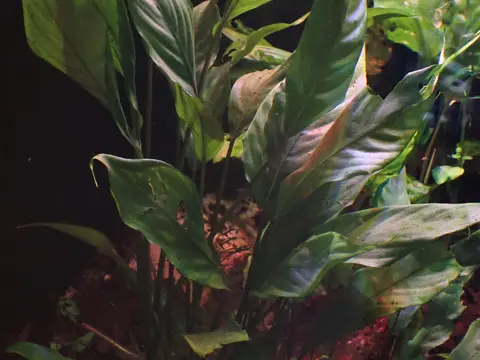
Bucephalandra, or "buce" to most hobbyists, is a genus of small epiphytic plants from the island of Borneo, where they grow on rocks in rainforest streams. The leaves are tough, about 1-2 inches (2-5 cm) long, in dark green, bronze, reddish or bluish tones, often with iridescent speckles that sparkle under the light.
Dozens of varieties are sold under trade names such as "Brownie", "Wavy Green" or "Kedagang", and today nearly all are tissue-cultured. Hobbyists love buce for its compact look, because it stays small for years and because, like anubias, it grows without CO2 and under modest light. It is ideal for nano tanks, shrimp tanks and for dressing rocks and driftwood in the foreground or midground.
Care and tank setup
The golden rule for every epiphyte applies: never bury the rhizome. Tie it on with fishing line or attach it with a dab of gel superglue (cyanoacrylate) to rock or driftwood; within a few weeks the roots will grip on their own.
- Light: low to moderate. Strong light on a slow grower means algae on the leaves.
- Flow: it likes moderate water movement that keeps the leaves clean.
- Water: stable, soft to medium, with no sudden temperature swings.
- Tankmates: safe with nearly all fish and shrimp; the tough leaves do not tempt plant eaters.
The classic problem is "buce melt": after purchase or a sudden change, it drops leaves all at once. Do not throw it out. If the rhizome is firm and green, it will sprout again. Choose cultivated plants over wild-collected ones.
Fertilizing and trimming
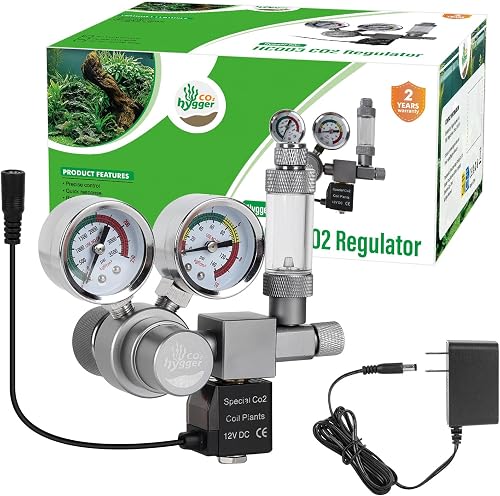
Buce needs very little. A low weekly dose of comprehensive liquid fertilizer is enough; CO2 speeds growth a bit and deepens the colors, but it is not required. Only trim old, damaged or algae-covered leaves, cutting them at the base. If the rhizomes start to tangle, you can rearrange them gently.
Propagation
Propagate it by dividing the rhizome: use clean scissors or a blade to cut a piece with at least three or four leaves and some roots, and attach it somewhere else. Healthy plants also put out side shoots you can separate. It is slow, so expect months, not weeks, before you get a dense clump. Some varieties even flower underwater with a small white or pink spathe.
Recommended equipment
What you need to keep the Bucephalandra healthy, checked against Amazon stock.



Frequently asked questions
What light and CO₂ does Bucephalandra need?
Light: low. CO₂: optional (helps). Growth: slow.
Is it a good plant for beginners?
It’s manageable if you have decent lighting and fertilize regularly.
You may also like
Epiphyte plants → Aquarium plants → Complete aquarium guide →