If you buy through our links, Amazon pays us a small commission at no extra cost to you. That’s how we keep the site running. How we choose.
Contents
Our top 3 picks
Stock checked on October 7, 2026

planted aquarium led lights comparison, in stock
Fluval Plant 3.0 LED Planted Aquarium Lighting, 32 Watts, 24-34 Inches
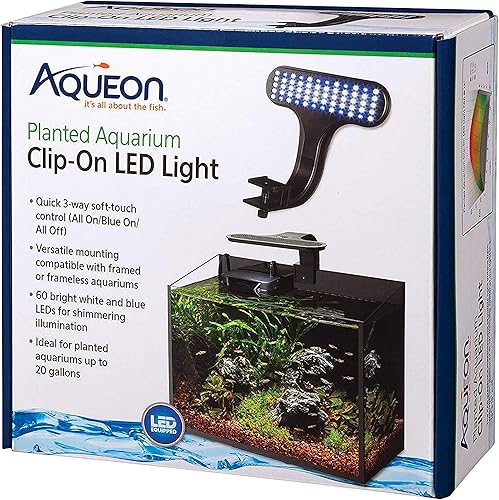
Aqueon Clip-On LED Aquarium Fish Tank Light for Planted Growing Plants for Up To 20 Gallon Aquariums
hygger Advanced LED Aquarium Light with Timer, 24/7 Lighting Cycle & DIY Mode, Full Spectrum Fish Tank Light for 36-42…
hygger Advanced LED Aquarium Light with Timer, 24/7 Lighting Cycle & DIY Mode, Full Spectrum Fish Tank Light for 30-36…
hygger Advanced LED Aquarium Light with Timer, 24/7 Lighting Cycle & DIY Mode, Full Spectrum Fish Tank Light for 24-30…
hygger Advanced LED Aquarium Light with Timer, 24/7 Lighting Cycle & DIY Mode, Full Spectrum Fish Tank Light for 18-24…
AQUANEAT LED Aquarium Light Full Spectrum for 30 Inch to 38 Inch Fish Tank Light Fresh Water
AQUANEAT LED Aquarium Light Full Spectrum for 36 Inch to 44 Inch Fish Tank Light Fresh Water
AcuarioSano rating: combines the average rating and the number of buyer reviews on Amazon. No brand pays to be featured.
Why light is the key to a planted tank
Plants use light for photosynthesis, and the amount of light sets how fast they grow. That growth in turn demands CO2 and nutrients. Give lots of light with too little CO2 or fertilizer and the plants can't use it, but algae can. That's why lighting in a planted tank can't be chosen in isolation: it goes hand in hand with your CO2 system and your dosing. A sensible rule is to start with moderate light and only turn it up once everything else is balanced.
PAR: the number that actually matters
Watts and lumens say little about the light your plants receive. The useful measure is PAR (photosynthetically active radiation), expressed in µmol/m²/s and measured at substrate level. PAR drops sharply with depth: the same fixture that delivers high light in a 12-inch-tall tank may only give medium light in a 20-inch-tall one. Reputable makers such as Chihiros, Twinstar, Fluval, Week Aqua and ADA publish PAR charts by depth; if a light gives no data at all, be skeptical about it handling demanding plants.
| Light level | PAR at substrate (approx.) | CO2 | Typical plants |
|---|---|---|---|
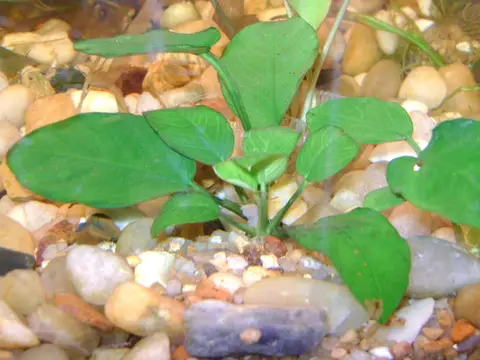
| Low | 15-30 | Not needed | Anubias nana, Java fern, mosses, cryptocorynes |
| Medium | 30-50 | Recommended | Rotala rotundifolia, Ludwigia repens, Staurogyne repens |
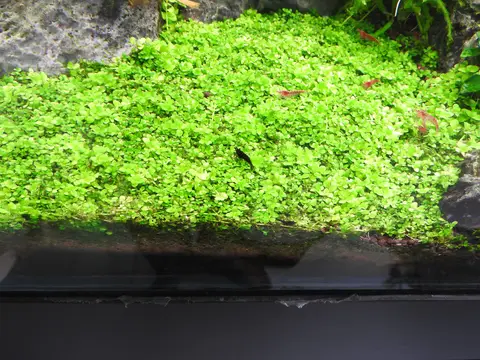
| High | 50-80+ | Essential | Monte Carlo, dwarf baby tears, Alternanthera reineckii |
What to look for in a planted tank light
Full spectrum
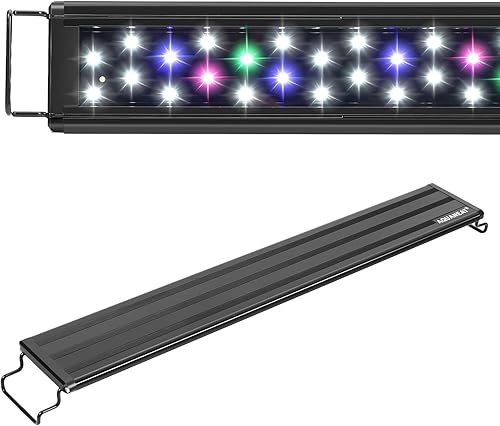
Plants mostly use red and blue light, but a broad spectrum with white, red, green and blue (RGB or WRGB fixtures) gives healthy growth and natural colors. Models with a separate red channel help red plants like Alternanthera show deeper color.
Dimming
Dimming is a must for planted tanks: it lets you start at 50-60% during cycling and the first weeks, then ramp up slowly as plants root in. It also makes it easy to respond to an algae outbreak without changing anything else.
App control and scheduling
App or remote control lets you program gradual sunrise and sunset, a midday siesta, or tune each color channel. It isn't essential, but it makes holding a steady photoperiod of 6-8 hours at full intensity much easier.
Coverage and tank height
The light should span the full length of the tank and, for carpeting plants, spread light evenly across the front. In tall tanks (over 18-20 inches / 45-50 cm), you'll need more output or a hanging fixture with good optics.
Tip: if you're new to planted tanks, go for medium light and easy plants. It's far more rewarding than high light without CO2 experience, and you can turn intensity up later if the fixture dims.
Warning: lights made for saltwater or reef tanks have a very blue-heavy spectrum that doesn't suit freshwater plants and encourages algae. Always confirm the model is meant for freshwater or planted tanks.
Common mistakes
- Running high light without CO2 or fertilizer and ending up with an algae farm.
- Leaving lights on 10-12 hours thinking plants will grow faster.
- Buying by wattage without checking PAR at your tank's depth.
- Starting at 100% intensity in a brand-new tank.
- Mixing high-light and low-light plants without shading the latter.
If you already have algae, read our guides to aquarium algae and lighting hours before swapping fixtures.
We compare spec sheets, verified reviews and real-world use criteria, but we don't physically test the products.
Frequently asked questions
How much PAR does a planted tank need?
It depends on the plants: roughly 15 to 30 for low-light plants, 30 to 50 for medium light and over 50 for demanding carpeting plants like Monte Carlo, always measured at substrate level.
Do I need CO2 with a strong light?
With high light, yes. Without CO2, plants can't use that much light and algae take over. With low or medium light you can skip CO2 by choosing the right plants.
What does WRGB mean on an LED light?
It combines white LEDs with red, green and blue ones. That gives a full spectrum, natural colors and the ability to tune each channel to bring out red or green plants.
How many hours of light does a planted tank need?
Between 6 and 8 hours at full intensity per day. Sunrise and sunset ramps don't count as full light, but avoid stretching the total much beyond 9 to 10 hours.