If you buy through our links, Amazon pays us a small commission at no extra cost to you. That’s how we keep the site running. How we choose.
Contents
Overview
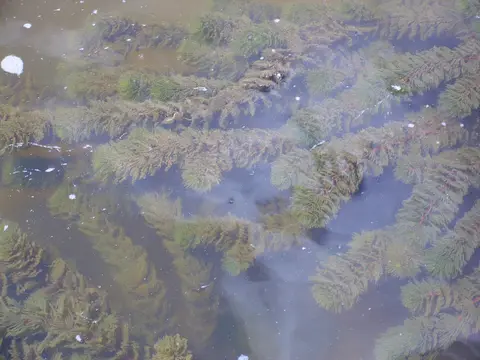
Hornwort (Ceratophyllum demersum), also called coontail, is a rootless aquatic plant found in still waters on almost every continent, including North America. Its long stems carry whorls of stiff, fine, forked leaves that look like a raccoon's tail or a bottle brush.
It may be the easiest aquarium plant there is: it grows in cold or tropical water, soft or hard, in low light and without CO2. It soaks up nitrate and phosphate quickly, which helps hold back algae in new tanks. It is also excellent for breeding tanks, shrimp setups and ponds. Even so, keep it contained and never dump it into local waterways.
Care and tank setup
It works in any tank from about 5 to 10 gallons (20-40 liters) up, as well as goldfish tanks and ponds. You can let it float freely, where it forms a tangle that fry love, or anchor stems to the bottom with a rock or plant weight. Do not bury it in the substrate: with no roots, the buried part simply rots.
- Light: low to medium. More light just means even faster growth.
- Temperature: very wide range; in very warm tanks above 82 °F (28 °C) it weakens.
- Water: prefers moderately hard to hard water.
Goldfish and some herbivores eat it, which is not always a bad thing. Common mistakes: panicking when it sheds needles after a sudden change in conditions (it usually bounces back within days) and leaving a big mass of dropped needles to rot on the bottom. It is often said to release algae-inhibiting compounds, but its main effect is simply outcompeting algae for nutrients.
Fertilizing and trimming
It needs no fertilizer in a stocked tank because it feeds on the nutrients already in the water. In heavily planted tanks, a complete liquid fertilizer stops it from starving other plants. Maintenance is all about volume control: thin out or cut back stems every week or two so it does not block the light. Vacuum shed needles and put surplus in the trash or compost, never in a creek or pond.
Propagation
It spreads by fragmentation, which works like a natural cutting: any piece of stem with a few whorls becomes a new plant. Just cut long stems in half and leave both pieces in the tank. It also branches constantly. Within a few weeks, a couple of stems can fill a medium aquarium, so the challenge is not multiplying it but keeping it in check.
Recommended equipment
What you need to keep the Hornwort (Ceratophyllum demersum) healthy, checked against Amazon stock.

Frequently asked questions
What light and CO₂ does Hornwort (Ceratophyllum demersum) need?
Light: low. CO₂: not needed. Growth: fast.
Is it a good plant for beginners?
Yes: it’s one of the easiest plants and forgives mistakes with light and fertilizing.
You may also like
 ProfileAmazon sword (Echinodorus bleheri)
 ProfileVallisneria
- ProfileAponogeton ulvaceus
- GuideAmmonia, Nitrite and Nitrate in Aquariums: Safe Levels and Fixes
- ListEasy plants
- Gear reviewAquarium LED lights
- Gear reviewAquarium plant fertilizers
- GuidePlanted Tank for Beginners: Light, Substrate, Fertilizer and CO2
Background plants → Aquarium plants → Complete aquarium guide →