If you buy through our links, Amazon pays us a small commission at no extra cost to you. That’s how we keep the site running. How we choose.
Contents
Overview
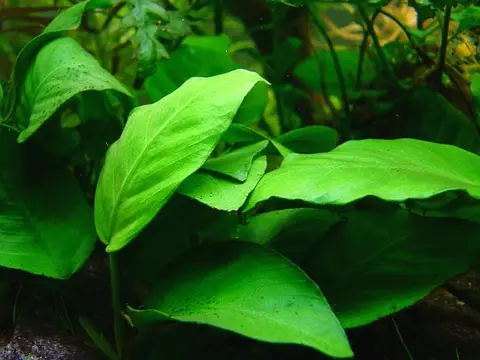
Anubias barteri is the parent species of the popular Anubias nana, but much bigger: its thick, dark green leaves, heart- or spear-shaped, sit on long stems and the plant easily reaches 10 to 12 inches (25 to 30 cm). It comes from riverbanks and streams in West Africa, where it grows partly submerged and in shade.
Hobbyists like it for its sturdy look, how little it asks for and the fact that almost no fish eats it. It is ideal for the midground and background of tanks of 30 gallons (110 l) or more, especially with cichlids, larger fish or low-light setups without CO2.
Care and tank setup
Like every anubias, it is an epiphyte: the rhizome must stay exposed, never buried. Tie it to driftwood or a large rock with cotton thread, fishing line or zip ties, or glue it with cyanoacrylate gel. Given its size, use a stable base that will not tip over as the plant grows. You can also plant the roots in the substrate as long as the rhizome sits on top.
- Light: low to medium. Under strong light its long-lived leaves collect algae.
- Placement: midground or background, also handy for hiding cables, filters or heaters.
- Tankmates: it stands up to American and African cichlids that uproot other plants, though big herbivores such as large plecos or silver dollars may chew it.
There are many trade varieties (var. barteri, angustifolia, caladiifolia, 'Coffeefolia' and more) with narrower, wider or crinkled leaves, but they all share the same care. Avoid placing it directly under a powerful light.
Fertilizing and trimming
It uses very little: a low weekly dose of comprehensive liquid fertilizer is enough. To speed it up a bit when it is planted in substrate, push a root tab near the roots. Pruning means removing old or algae-covered leaves by cutting them off at the base of the stem. If the rhizome gets too long, you can divide it to keep the plant compact.
Propagation
It propagates by rhizome division: cut off a section with at least three or four leaves and a few roots and tie it somewhere else. Mature plants also send out side shoots that can be separated. In aquariums it may even flower with a small white spathe once well established, but growing it from seed has no practical interest at home.
Recommended equipment
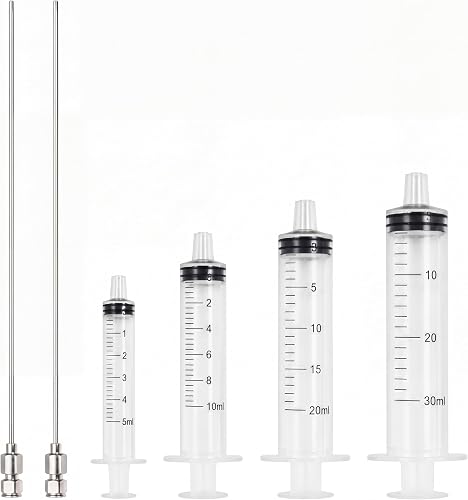
What you need to keep the Anubias barteri healthy, checked against Amazon stock.


Frequently asked questions
What light and CO₂ does Anubias barteri need?
Light: low. CO₂: not needed. Growth: slow.
Is it a good plant for beginners?
Yes: it’s one of the easiest plants and forgives mistakes with light and fertilizing.
You may also like
Epiphyte plants → Aquarium plants → Complete aquarium guide →