If you buy through our links, Amazon pays us a small commission at no extra cost to you. That’s how we keep the site running. How we choose.
Contents
Overview
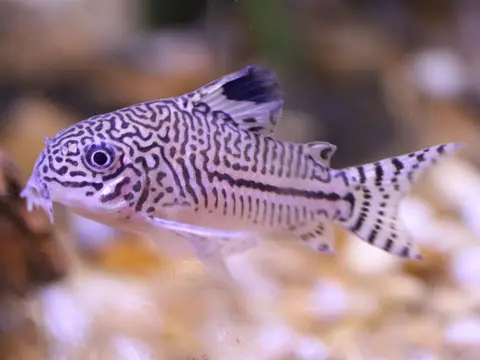
The three-stripe cory has a beautiful pattern: its silvery body is covered in a reticulated web of black lines and dots, with a dark stripe along the flank and a black blotch on the dorsal fin. It grows to around 2.2 inches (5-6 cm).
It comes from the upper Amazon basin in Peru, Colombia and Ecuador. Stores often sell it as the "julii cory," but true Corydoras julii is much rarer and has spots rather than lines on its head. For most hobbyists the difference hardly matters: the three-stripe is hardy, peaceful, usually captive-bred and perfect for any calm community tank.
Care and tank setup
A group of six or more needs roughly an 18-gallon (70-litre) tank with a long footprint. Choose fine sand or very smooth gravel: these fish spend all day sifting with their barbels, and sharp gravel wears them away. A cycled tank, filter and heater, good oxygenation and weekly water changes are essential.
- Aquascape: open sand, driftwood, plants and shade. They are more active under moderate lighting.
- Group: the bigger the group, the more natural the behavior; they will mix with other corys of similar needs but feel safest with their own kind.
- Tankmates: tetras, rasboras, livebearers, angelfish, dwarf cichlids and shrimp.
A frequent mistake is dosing salt or harsh treatments without considering the corys, which are very sensitive to certain medications.
Feeding
An omnivore, it accepts nearly anything that reaches the bottom. Use sinking wafers or pellets as the staple and add frozen bloodworms, brine shrimp or daphnia several times a week. If it shares the tank with fast eaters, feed after lights-out, when it forages most actively.
Breeding
It breeds without much trouble in a well-kept tank. A protein-fed group with more males than females often spawns after a cooler water change, using the classic cory T-position. Eggs are stuck to the glass or plants and are best moved to a separate container. The fry take baby brine shrimp and fine foods.
Compatible tank mates
Species from our database that share water parameters, size and temperament with the Three-stripe cory. Calculated from the data in each profile.
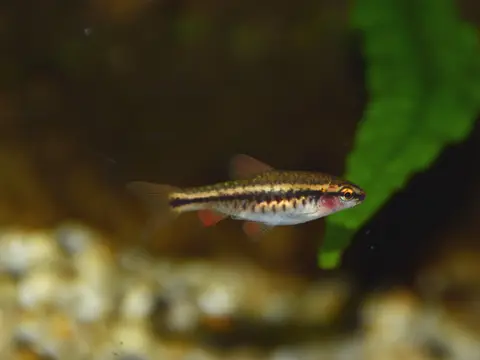 Cherry barb Puntius titteya 16 gal (60 L) · 73–81 °F (23–27 °C)
 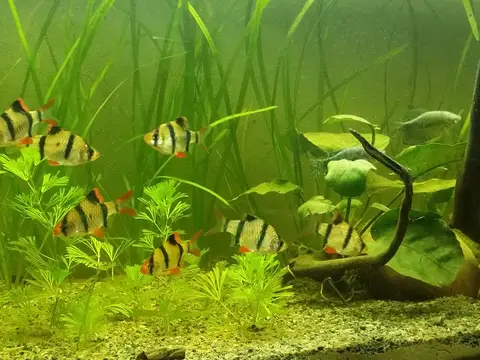 Tiger barb Puntigrus tetrazona 26 gal (100 L) · 72–79 °F (22–26 °C)
 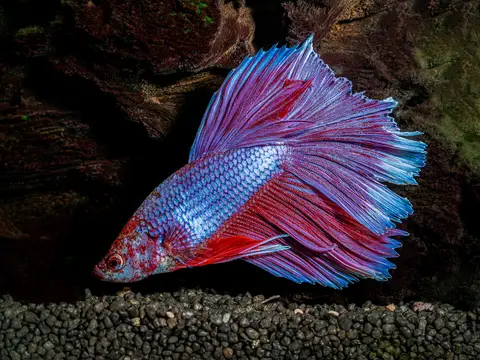 Betta fish Betta splendens 7 gal (25 L) · 75–82 °F (24–28 °C)
 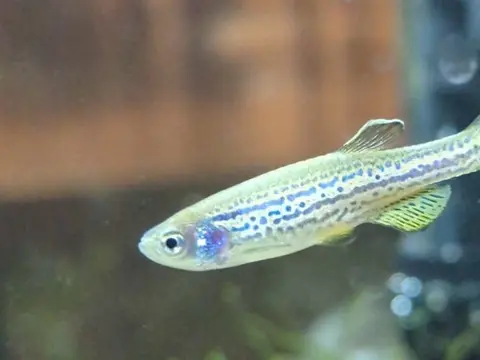 Zebra danio Danio rerio 16 gal (60 L) · 64–77 °F (18–25 °C)
 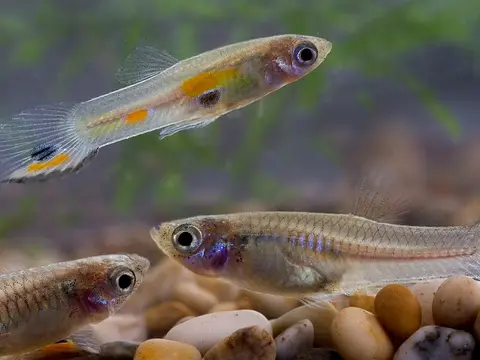 Guppy Poecilia reticulata 14 gal (54 L) · 72–82 °F (22–28 °C)
 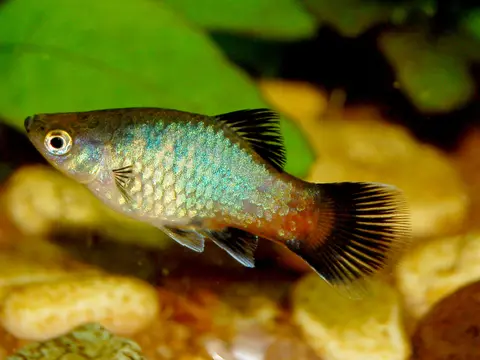 Platy Xiphophorus maculatus 16 gal (60 L) · 68–79 °F (20–26 °C)
 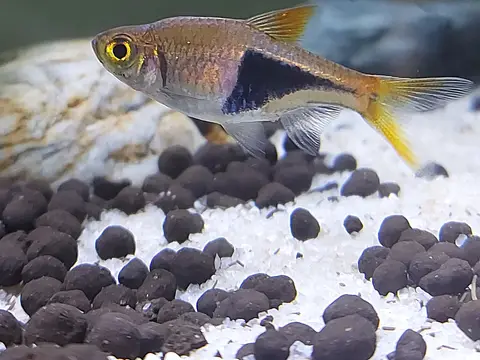 Harlequin rasbora Trigonostigma heteromorpha 16 gal (60 L) · 72–81 °F (22–27 °C)
 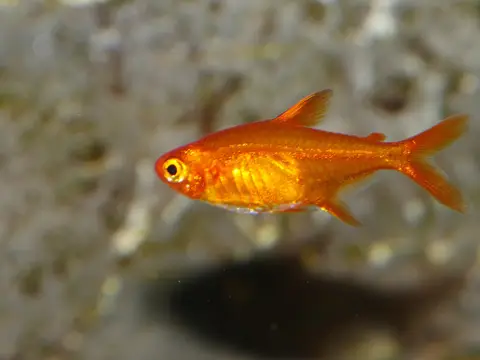 Ember tetra Hyphessobrycon amandae 11 gal (40 L) · 73–82 °F (23–28 °C)
 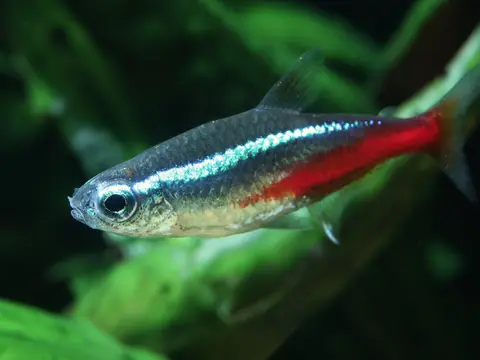 Neon tetra Paracheirodon innesi 16 gal (60 L) · 68–79 °F (20–26 °C)
 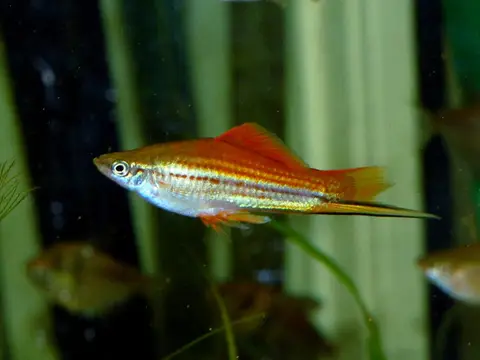 Swordtail Xiphophorus hellerii 32 gal (120 L) · 72–81 °F (22–27 °C)
 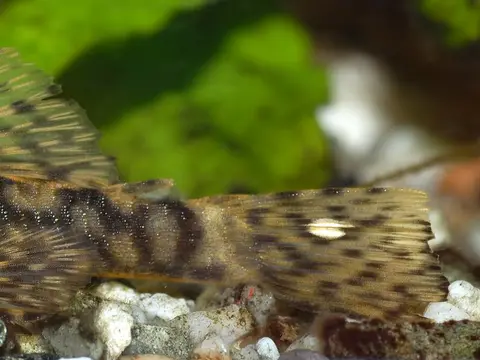 Bristlenose pleco Ancistrus sp. 26 gal (100 L) · 72–81 °F (22–27 °C)
 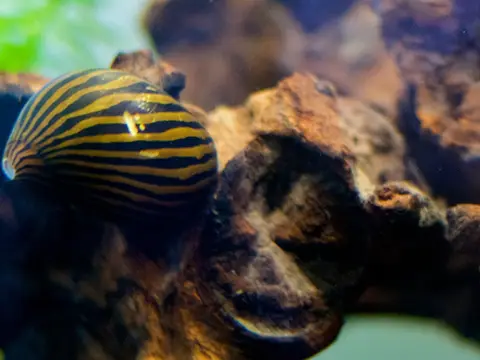 Nerite snail Neritina natalensis 5 gal (20 L) · 72–82 °F (22–28 °C)
 Check the compatibility of your whole tank →
What not to keep it with
Popular species you shouldn’t house with the Three-stripe cory, and why.
- Discus: incompatible temperatures
- Clown loach: incompatible temperatures, one may eat the other due to size
- Oscar: one may eat the other due to size, incompatible temperaments
Recommended equipment
What you need to keep the Three-stripe cory healthy, checked against Amazon stock.


Frequently asked questions
How many liters does a Three-stripe cory need?
At least about 70 liters for a group of at least 6 fish. More space always helps keep the water stable.
What water temperature does the Three-stripe cory need?
Between 22 and 26 °C, with a pH of 6 to 7.5.
What fish can live with the Three-stripe cory?
Based on water, size and temperament, it fits with species such as Cherry barb, Tiger barb, Betta fish, Zebra danio and Guppy. Use our compatibility calculator to check your whole tank.
Can the Three-stripe cory be kept with shrimp?
Yes: it usually won’t eat adult shrimp, though some shrimplets may get picked off. A tank with plenty of moss gives the babies cover.