If you buy through our links, Amazon pays us a small commission at no extra cost to you. That’s how we keep the site running. How we choose.
Contents
Aquarium water can be crystal clear and still be toxic. Fish are immersed in it around the clock, so their health depends on things you can't see: ammonia, nitrite, nitrate, pH, hardness and temperature, among others. This guide explains what each parameter means, the ideal ranges for a tropical freshwater tank, how to test them and what makes them go up or down.
The essentials: ammonia and nitrite always at 0; nitrate below 25-40 ppm; temperature steady at 75-80 °F (24-27 °C) for most tropical fish; and above all, stability. A pH that is slightly off but constant is better than a perfect one that keeps swinging.
Ideal ranges at a glance
These ranges suit a typical tropical community tank. Some species have different needs, noted in the last column and on each fish profile.
| Parameter | Ideal value | Notes |
|---|---|---|
| Ammonia (NH3/NH4) | 0 ppm | Any reading means there is a problem |
| Nitrite (NO2) | 0 ppm | Highly toxic even at low levels |
| Nitrate (NO3) | < 25-40 ppm | < 20 ppm for shrimp and sensitive species |
| pH | 6.5-7.5 | 6-7 for soft-water fish; 7.8-8.5 for Lake Malawi and Tanganyika cichlids |
| KH (carbonate hardness) | 3-8 dKH (54-143 ppm) | Below 2-3 dKH, pH becomes unstable |
| GH (general hardness) | 6-12 dGH (107-214 ppm) | 4-8 dGH for soft water; 12-20 for livebearers and African cichlids |
| Temperature | 75-80 °F (24-27 °C) | Coldwater fish (goldfish, medaka) at room temperature |
| TDS (total dissolved solids) | 150-350 ppm | Most useful in shrimp tanks |
Ammonia, nitrite and nitrate: the nitrogen cycle
These three compounds are the stages of the nitrogen cycle. Fish excrete ammonia through their gills, and uneaten food and organic waste release it as they break down. In a cycled tank, one group of filter bacteria converts ammonia into nitrite and another converts nitrite into nitrate. That is why a new tank needs 4 to 6 weeks of cycling before you add fish.
Ammonia
It burns gills and skin. Its toxicity rises with pH and temperature: above pH 7, more of it exists as free ammonia (NH3), the most dangerous form. Overstocking, overfeeding, a dead fish you haven't spotted or an over-cleaned filter all push it up.
Nitrite
It stops blood from carrying oxygen, which is why poisoned fish gasp at the surface even with good aeration. It shows up during cycling and whenever something damages the bacteria colonies, such as medication or rinsing filter media under the tap.
Nitrate
It is the end product and builds up slowly. Only water changes and, partly, fast-growing plants bring it down. Long-term high levels shorten fish lifespans and fuel algae. Our guide to nitrite and nitrate covers it in depth.
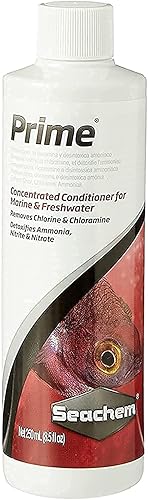
If you detect ammonia or nitrite: do a 30-50% water change that same day with conditioned, temperature-matched water, stop feeding for 24-48 hours and find the cause. A conditioner that binds ammonia helps as an emergency measure, but it doesn't replace the water change.
pH, KH and GH: acidity and hardness
pH
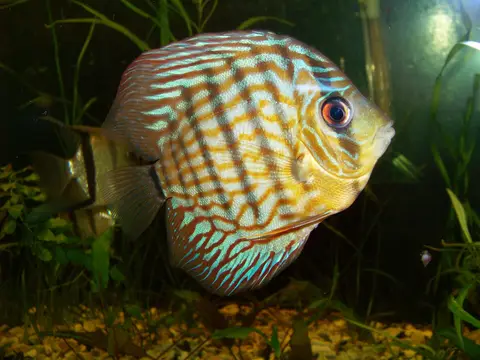
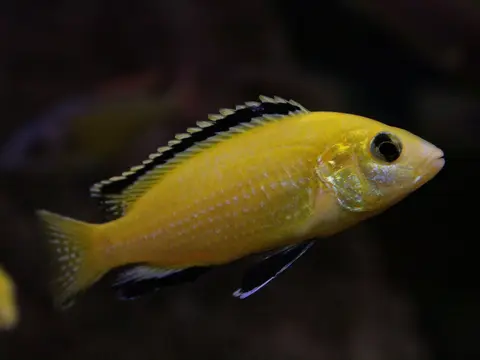
It measures how acidic or alkaline the water is on a 0-14 scale, where 7 is neutral. Each step is a tenfold change, so going from 7 to 6 is a much bigger shift than it looks. Most store-bought fish adapt well to pH 6.5-7.5. Soft-water species such as discus prefer 6-7, while African cichlids such as the yellow lab need 7.8-8.5. If you have to adjust it, do it slowly, as we explain in how to raise or lower aquarium pH.
KH (carbonate hardness)
This is the water's ability to buffer pH changes. With KH at 3-8 dKH, pH stays stable; below 2-3 dKH it can crash suddenly, especially in tanks with a heavy organic load or injected CO2. Regular water changes replenish the KH that gets used up. In the US, test kits often read in ppm or drops: 1 dKH is about 17.9 ppm.
GH (general hardness)
It tells you how much calcium and magnesium is dissolved. It affects fish osmoregulation, shrimp and snail molting and plant health. Livebearers (guppies, mollies, platies) like hard water; tetras, rasboras and discus prefer soft water.
Temperature and TDS
Temperature drives fish metabolism, dissolved oxygen and ammonia toxicity. For most tropical species, the range is 75-80 °F (24-27 °C). More important than the exact number is that it doesn't swing more than 2-3 °F (1-2 °C) during the day. A thermostatic heater (rule of thumb: about 4 watts per gallon, or 1 W per liter) and an accurate thermometer are essential. There is more in our guide to aquarium temperature.
TDS (total dissolved solids) measures everything dissolved in the water in ppm: minerals, salts, nitrate, organics. It tells you how much, not what, but it is very handy for keeping shrimp tanks consistent and for checking that your RO water is clean. If TDS climbs a lot between water changes, substances are building up and you should change more water.
How to test your water
There are three types of test, each with pros and cons:
- Test strips: quick and convenient, they read several parameters at once. They are less accurate and degrade quickly once the bottle is opened. Fine for spot checks.
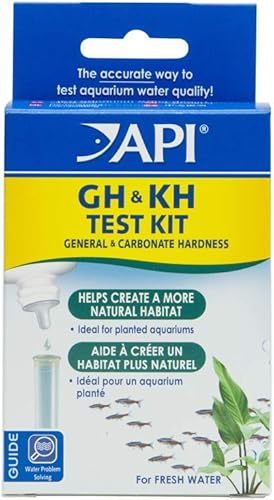
- Liquid test kits (drops): more accurate and cheaper per test. Master kits from brands such as API, Tetra, JBL or Sera cover ammonia, nitrite, nitrate, pH, KH and GH. This is the recommended option.
- Digital meters: for pH, TDS and temperature. Very handy, but pH pens need regular calibration.
You can compare options in our roundup of aquarium test kits. To get reliable results:
- Take the sample from mid-water, away from the filter outlet, and before your weekly water change.
- Rinse the test tube with tank water and follow the instructions exactly: number of drops, order and waiting time.
- Shake the reagents that call for it (the nitrate bottle usually does, vigorously).
- Read the color in daylight against a white background.
- Write the results down with the date. Trends tell you more than a single reading.
In a new tank, test ammonia, nitrite and nitrate every 2-3 days while cycling. In an established tank, once a week or every two weeks is enough, plus any time your fish seem off.
Common water parameter mistakes
- Chasing a specific pH with chemicals: it causes swings that stress fish more than a slightly off pH ever would.
- Using expired tests: reagents have an expiration date and give false readings past it.
- Testing only pH: pH tells you nothing about ammonia or nitrite, which are what kill fish.
- Testing right after a water change: you will get better numbers than the real ones.
- Choosing fish without checking your tap water: it is far easier to pick species suited to your water than to change it.
- Assuming clear water is healthy water: ammonia and nitrite are invisible.
What affects each parameter
- Ammonia rises: overfeeding, overstocking, dead fish or plants, an undersized or freshly cleaned filter.
- Nitrate rises: too few water changes, heavy feeding, few or no plants.
- pH drops: low KH, driftwood and leaves (tannins), injected CO2, organic buildup.
- pH and hardness rise: limestone rocks, shells, crushed coral, hard tap water.
- TDS rises: topping off without water changes, fertilizers and additives, shrimp mineral salts.
Knowing your parameters lets you get ahead of problems instead of reacting once fish are already sick. And when something goes wrong, the first fix is almost always the same: a good water change.
Recommended gear for this guide

Frequently asked questions
Which water parameters matter most?
Ammonia, nitrite and nitrate, because they tell you whether the filter is working and whether the water is toxic. Next come temperature and pH. KH, GH and TDS matter for specific animals such as shrimp, African cichlids or soft-water fish.
How often should I test my aquarium water?
Every 2-3 days while cycling. In an established tank, once a week or every two weeks, before your water change. Also test any time fish look lethargic, gasp at the surface or stop eating.
Are aquarium test strips accurate?
They are fine for quick checks, but less accurate than liquid kits, especially for nitrite and nitrate, and they spoil when exposed to humidity. During cycling or when there is a problem, use a liquid test kit.
What pH do aquarium fish need?
Most store-bought fish adapt to a pH between 6.5 and 7.5. Soft-water fish such as discus, tetras or apistogrammas prefer 6 to 7, while Lake Malawi and Tanganyika cichlids need 7.8 to 8.5. Stability matters more than the exact number.
What is TDS and do I need to test it?
It is the total amount of dissolved solids in the water, measured in ppm. It isn't essential in a community tank, but it is very useful for shrimp tanks, when you use RO water, or to check that substances are not building up between water changes.
You may also like
- GuideAmmonia, Nitrite and Nitrate in Aquariums: Safe Levels and Fixes
- GuideHow to Raise or Lower Aquarium pH Safely (Plus KH and GH)
- GuideAquarium Cycling: The Nitrogen Cycle, Testing and When to Add Fish
 ProfileDiscus
 ProfileYellow lab cichlid
- GuideAquarium Temperature: Ideal Range, Heaters, Summer and Outages
- Gear reviewAquarium water test kits
- Gear reviewAquarium water conditioners
Water care & maintenance → See all guides → Complete aquarium guide →