If you buy through our links, Amazon pays us a small commission at no extra cost to you. That’s how we keep the site running. How we choose.
Contents
pH is one of the parameters beginners worry about most and, ironically, one that causes the most trouble when people try to fix it at all costs. Many fish die not because the pH is "wrong" but because of the swings caused by the chemicals used to change it. In this guide we explain what pH, KH and GH are, why stability matters more than chasing an exact number, and how to raise or lower pH naturally and safely when you really need to.
The key idea: most community aquarium fish do well at a pH between 6.5 and 7.8, as long as it's stable. Before changing anything, test KH as well: if it's between 3 and 8 dKH (about 54-143 ppm), pH will hold steady on its own. If you do adjust pH, do it gradually, never more than 0.2-0.3 units per day.
pH, KH and GH: what each one means
These three values are related, but they measure different things. Understanding them prevents most mistakes:
- pH: shows how acidic (below 7) or alkaline (above 7) the water is. The scale is logarithmic: pH 6 is ten times more acidic than pH 7. That's why a one-unit change is much more drastic than it looks.
- KH (carbonate hardness): measures dissolved carbonates and bicarbonates. It acts as a buffer that neutralizes acids and stops pH from dropping. With low KH (under 2-3 dKH), pH can crash overnight.
- GH (general hardness): measures calcium and magnesium. It affects fish health, plant growth and molting in shrimp and snails, but has little effect on pH.
In an aquarium, pH tends to drift down over time: nitrification, decaying organic matter and the CO2 produced by fish and plants all generate acids that use up KH. Regular water changes replenish it. If you inject CO2, pH will also drop by roughly one unit during the photoperiod; we cover that in our guide to CO2 in the aquarium. For the other values, see our guide to aquarium water parameters.
Stability before numbers
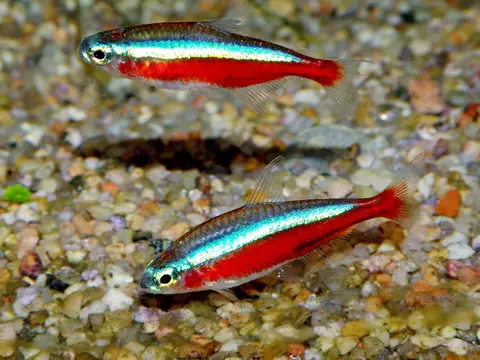
The fish sold in stores are almost always farm-bred, not wild-caught from the Rio Negro or Lake Malawi, and they're used to water quite different from their native habitat. A captive-bred cardinal tetra lives happily at pH 7 as long as that pH doesn't change. What really harms fish are swings: pushing pH up and down every few days stresses them far more than a value that's a little off the ideal.
So the right order is: first get to know your tap water (pH, KH and GH), then choose fish that suit it, and only then, if you want to keep very specific species, adjust the water with slow, natural methods. It's much easier to choose fish that match your water than to fight it every week.
How to lower pH naturally
Lowering pH only makes sense if you keep soft, acidic-water fish or shrimp and your tap water is hard. Here are the options, from gentlest to strongest:
- Driftwood: aquarium driftwood (mopani, mangrove, bogwood) releases tannins and humic acids that lower pH slightly and tint the water amber. The effect is mild and depends heavily on KH. Soak or boil it first so it sinks and leaches less color.
- Catappa leaves (Indian almond leaves): they add tannins with a mild antibacterial effect and recreate the "blackwater" of Amazonian and Asian streams. Use one medium leaf per 10-13 gallons (40-50 L) and replace it when it breaks down.
- Peat in the filter: aquarium peat in a mesh bag inside the filter softens the water and lowers pH gradually. Test every few days until you know how strong the effect is in your tank.
- RO water: the most effective and controllable method. Reverse osmosis water has almost zero pH buffering, KH and GH; mixing it with tap water at a fixed ratio (for example 50/50) gives you the same result every time. Never use pure RO without remineralizing it.
- Active substrates (aquasoil): they absorb carbonates and lower KH and pH for months. They're common in planted tanks and Caridina shrimp tanks.
How to raise pH naturally
Raising pH and hardness is mainly needed for African cichlids, livebearers, or when your water is very soft and pH keeps crashing:
- Crushed coral or aragonite: they dissolve slowly and release carbonates and calcium, raising KH, GH and pH. Use them as substrate or in a media bag inside the filter. It's the classic method for Lake Malawi cichlids such as the electric yellow cichlid.
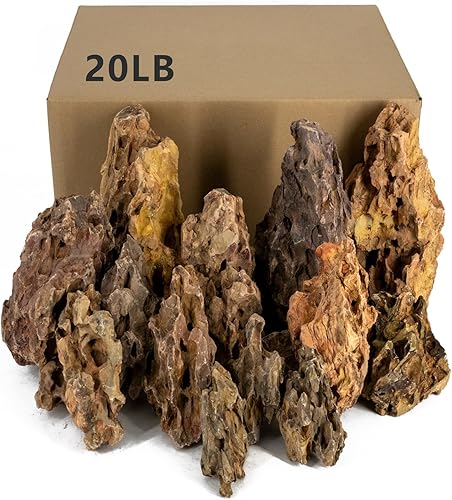
- Calcareous rocks: some aquarium rocks, such as limestone, Texas holey rock or certain seiryu-type stones, harden the water. Perfect for an African cichlid tank, but not for a soft-water setup. Do the vinegar test: if a few drops make it fizz, the rock is calcareous.
- More frequent water changes: if your tap water is harder than your tank water, simply changing water regularly restores KH and stabilizes pH.
- Remove what's lowering it: less driftwood, leaves or peat, and check whether your substrate is an aquasoil absorbing carbonates.
Avoid "pH Up" and "pH Down" chemicals. They change pH within minutes, which is already dangerous, and if KH stays the same the water drifts back to its old value within a day or two. The result is a pH roller coaster that stresses and can kill fish. If you need different water, change its composition (RO, coral, peat) instead of forcing the number.
Recommended pH, GH and KH by fish type
This table sums up rough ranges for the most common groups. They're broad: within them, stability is what counts.
| Tank type | Examples | pH | GH (dGH) | KH (dKH) |
|---|---|---|---|---|
| Soft-water Amazonian | Cardinal tetra, discus, Apistogramma | 5.5-7.0 | 1-8 | 0-4 |
| Tropical community | Tetras, rasboras, corydoras, barbs | 6.5-7.5 | 5-12 | 3-8 |
| Livebearers | Guppy, platy, molly, swordtail | 7.0-8.0 | 10-20 | 6-12 |
| Lake Malawi cichlids | Labidochromis, Aulonocara, Maylandia | 7.8-8.6 | 10-20 | 10-18 |
| Lake Tanganyika cichlids | Tropheus, Neolamprologus | 8.0-9.0 | 12-20 | 12-20 |
| Coldwater | Goldfish, White Cloud minnow | 7.0-8.0 | 8-18 | 5-12 |
| Neocaridina shrimp | Cherry shrimp, blue dream | 6.5-8.0 | 6-15 | 2-8 |
| Caridina shrimp | Crystal red | 5.8-6.8 | 4-6 | 0-1 |
One degree of hardness (dGH or dKH) equals about 17.9 ppm, so if your kit reads in ppm, divide by 17.9 to compare with the table.
How to test pH, KH and GH
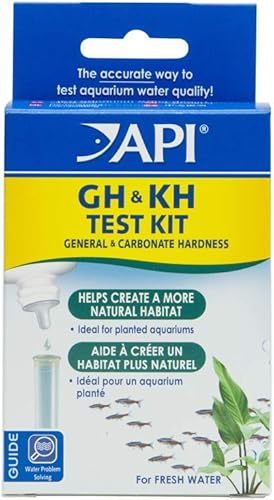
To keep pH under control you also need to test KH; without it, you won't know whether pH will hold. Liquid aquarium test kits from brands like API, JBL, Sera or Tetra are reliable and affordable; strips are fine for a quick check but less accurate. If you keep demanding species, a digital pH meter gives precise readings, although it needs regular calibration.
Always test at the same time of day, because pH changes over the course of the day (especially in planted or CO2-injected tanks), and write the results down. One reading tells you little; a few weeks of readings show you the trend.
Common mistakes
- Chasing an exact pH with chemicals and causing daily swings.
- Testing only pH without checking KH, which explains its stability.
- Changing pH suddenly by doing a water change with very different water.
- Using calcareous rocks or coral in a soft-water fish tank.
- Using pure RO water without remineralizing it: pH becomes unstable.
- Mixing African cichlids and soft-water Amazonian fish in the same tank.
- Blaming pH for deaths actually caused by ammonia or nitrite.
Get to know your water, choose fish that suit it and, if you need to adjust it, do so with slow, consistent methods. A stable pH, even if it isn't the "textbook" value, is the best guarantee of healthy fish.
Recommended gear for this guide

Frequently asked questions
What is the ideal pH for an aquarium?
For most community tanks, anywhere from 6.5 to 7.8 is perfectly fine as long as it stays stable. Soft-water Amazonian fish prefer 5.5-7, while African cichlids need 7.8-9 with hard water.
Why does the pH in my tank keep dropping?
Biological processes in the aquarium produce acids that use up KH. If KH is low or weeks go by without water changes, pH falls. Regular water changes and a KH of 3-8 dKH keep it stable.
Are pH Up and pH Down products safe?
We don't recommend them. They change pH very quickly and, if KH doesn't change, the value drifts back within a day or two, causing swings that stress fish. It's better to change the water itself with RO, peat, driftwood or crushed coral.
How much does driftwood lower pH?
It depends on your KH. In soft water it can lower pH by several tenths or more; in hard water the effect is small because carbonates neutralize the acids. It works as a supplement, not as the only method.
What is KH and why does it matter?
KH is carbonate hardness, the water's ability to neutralize acids. It buffers pH: with adequate KH, pH stays stable, and with very low KH it can crash suddenly.
You may also like
- GuideAquarium Water Parameters: Ideal Ranges and How to Test
- GuideAmmonia, Nitrite and Nitrate in Aquariums: Safe Levels and Fixes
- GuideAquarium Cycling: The Nitrogen Cycle, Testing and When to Add Fish
- GuideCO2 in a Planted Tank: When You Need It and How to Dial It In
 ProfileCardinal tetra
- Gear reviewAquarium driftwood
- Gear reviewAquarium water test kits
- Gear reviewAquarium rocks
Water care & maintenance → See all guides → Complete aquarium guide →