If you buy through our links, Amazon pays us a small commission at no extra cost to you. That’s how we keep the site running. How we choose.
Contents
Fish are cold-blooded: their body temperature is the temperature of the water. It drives their metabolism, appetite and immune system, and even how much oxygen is available to them. A tank kept at the right temperature, and above all a stable one, prevents a large share of health problems; one that swings several degrees every day is a breeding ground for stress and ich. In this guide we cover the ideal temperature for each type of tank, how to size a heater, why a thermometer is non-negotiable, and what to do in summer, in winter and when the power goes out.
The essentials: most tropical fish do well between 75 and 81 °F (24-27 °C). Use a thermostatic heater of roughly 4 watts per gallon (1 W per liter) and check the temperature daily with a separate thermometer. Stability matters more than the exact number: avoid swings of more than 2-4 °F (1-2 °C) in a day.
Ideal temperature by type of tank
There is no single temperature for every aquarium. Each species has a comfortable range, and in a community tank you need fish whose ranges overlap. These are the most useful benchmarks:
| Type of tank or species | Typical range | Heater needed? |
|---|---|---|
| Tropical community (tetras, rasboras, guppies, corydoras) | 75-81 °F (24-27 °C) | Yes, almost always |
| Betta, gouramis and most labyrinth fish | 77-82 °F (25-28 °C) | Yes |
| Discus and German blue rams | 82-86 °F (28-30 °C) | Yes, powerful and reliable |
| Neocaridina shrimp | 68-77 °F (20-25 °C) | Depends on the room |
| Coldwater: goldfish, White Cloud minnows, medaka | Room temperature (about 61-75 °F / 16-24 °C) | No |
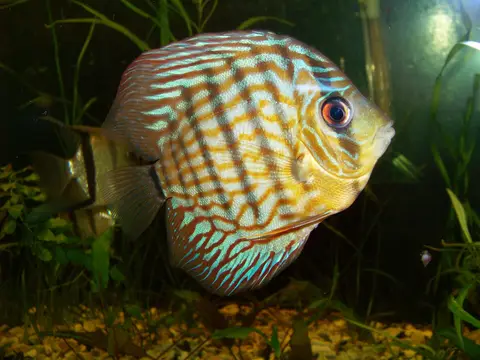
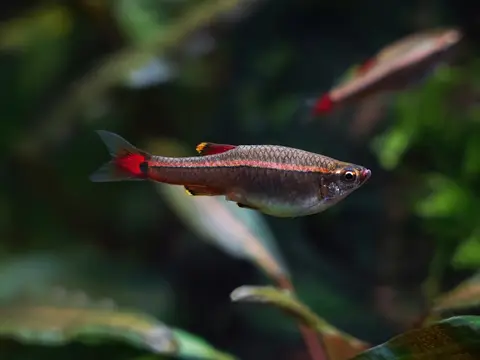
Discus are the classic example of a fish that needs warmer water and does not fit with species that prefer the cool end of the range. At the other extreme are coldwater fish such as the White Cloud Mountain minnow, which suffer when kept at tropical temperatures year-round. If they interest you, our guide to the coldwater aquarium explains how to keep them.
Within the range, warmer water speeds up metabolism: fish eat more, grow faster and also live somewhat shorter lives. Warm water also holds less dissolved oxygen. So there is no point in running the tank at the top of the range "just in case"; for a community tank, 77-79 °F (25-26 °C) is an excellent middle ground.
How to choose a heater
The rule of thumb is about 4 watts per gallon (1 W per liter). Go up to about 5-6 W per gallon (1.5 W/L) if the tank is small or sits in a cold room, since nano tanks lose heat very quickly, and down to about 2 W per gallon (0.5 W/L) for large tanks in warm rooms. You can fine-tune the number with our heater calculator, which takes tank volume and room temperature into account.
| Tank size | Mild room (about 68 °F / 20 °C) | Cold room (below 64 °F / 18 °C) |
|---|---|---|
| 5-8 gallons (20-30 L) | 25-50 W | 50 W |
| 15 gallons (60 L) | 50-75 W | 100 W |
| 25-30 gallons (100 L) | 100 W | 150 W |
| 55 gallons (200 L) | 200 W (better 2 × 100 W) | 2 × 150 W |
| 75 gallons (300 L) and up | 2 × 150 W | 2 × 200 W |
In larger tanks, split the wattage between two heaters. If one fails in the off position, the other keeps the water warm; if one sticks on, it has less power to overheat the tank. Place the heater near the filter outlet or intake, where there is flow, so the heat spreads evenly, and mount it at the angle the manufacturer recommends. Brands such as Eheim, Fluval, Tetra, Aqueon or Hygger make submersible thermostatic heaters; our comparison of aquarium heaters shows the differences between models.
Safety: always unplug the heater before taking it out of the water or doing a water change that leaves it exposed, and wait 15-20 minutes after placing it before plugging it back in. A heater running out of water can crack or cause burns.
The thermometer: the forgotten essential
A heater's thermostat is not a thermometer. The dials on many models are off by 2-4 °F, and the only way to know the real temperature is to measure it separately. A digital thermometer with a probe or a glass thermometer inside the tank are the most reliable options; stick-on liquid crystal strips are only a rough guide and are affected by room temperature. Place it on the opposite side from the heater to confirm the heat reaches the whole tank, and glance at it every day when you feed. You will find options compared in our guide to aquarium thermometers.
What to do in summer and heat waves
Heat is more dangerous than cold. Above 86-88 °F (30-31 °C), many tropical fish gasp at the surface because the water holds too little oxygen, and shrimp are especially sensitive. These are the steps, from simplest to most complete:
- Close the blinds and switch off or shorten the light: fixtures give off heat too, and direct sun sends the temperature soaring.
- Open the lid: it helps evaporation and heat exchange (watch out for jumpers).
- Use a cooling fan: clip-on aquarium fans blowing across the surface lower the temperature by about 4-7 °F (2-4 °C) through evaporation. Top off the evaporated water with dechlorinated water.
- Boost oxygen: an air pump, or raising the filter outlet to break the surface, makes up for the lower oxygen levels.
- Feed less: less food means less oxygen consumption and less waste.
- Chillers: for valuable setups or very hot climates, an aquarium chiller is the only solution that guarantees the temperature.
Clip-on models for small and medium tanks are compared in our guide to aquarium cooling fans.
No ice: dropping ice cubes or bags of ice into the tank causes sudden drops that stress fish more than the heat itself, and ice made from tap water contains chlorine. If you need to cool the tank, do it gradually: no more than 2-4 °F (1-2 °C) per hour and about 4-5 °F (2-3 °C) per day.
Winter and power outages
In winter the heater works harder, especially at night when the home heating turns down. Make sure it has enough wattage, keep the lid on (most heat is lost through the surface), and keep the tank away from exterior doors, drafty windows and radiators or heating vents, which cause big swings. If you notice the temperature dropping overnight, step up the wattage or add a second heater.
A power outage of a few hours is rarely serious: a covered tank in a reasonably warm home loses heat slowly. For longer outages:
- Wrap the tank in blankets or foam boards to hold in heat.
- Do not feed while the filter is off.
- Run a battery-powered air pump to keep oxygen up.
- If the temperature falls a lot, float sealed bottles of hot (not boiling) water and replace them every few hours.
- When the power comes back, if a canister filter has been off for several hours, rinse its interior with tank water before restarting it so you do not flush stagnant water into the tank.
Common temperature mistakes
- Trusting the heater's dial without a thermometer.
- Using an undersized heater for the tank volume or a cold room.
- Placing the tank by a window or a radiator: the temperature swings all day.
- Adding water-change water that is much colder or warmer: match it within 2-4 °F (1-2 °C).
- Mixing coldwater and tropical fish in the same tank.
- Cranking the heat up suddenly to treat ich: if you raise it, do it slowly, as explained in our guide to ich (white spot disease).
Recommended gear for this guide


Frequently asked questions
What is the ideal temperature for a tropical aquarium?
Between 75 and 81 °F (24-27 °C) for most tropical fish, with 77-79 °F (25-26 °C) as a good middle ground for a community tank. Some species, such as discus, need 82-86 °F (28-30 °C), and coldwater fish do not need a heater.
What size heater do I need?
As a rule of thumb, about 4 watts per gallon (1 W per liter). For small tanks or cold rooms, go up to 5-6 watts per gallon; for large tanks in warm rooms, about 2 watts per gallon is enough. From around 55 gallons (200 liters), two heaters are better than one.
How do I cool down my aquarium in summer?
Open the lid, close the blinds, switch off or shorten the light, and set up a fan blowing across the water surface. Increase aeration and feed less. Avoid adding ice: sudden temperature changes are worse than a few extra degrees.
How much can the temperature change without harming fish?
Ideally no more than 2 to 4 °F (1-2 °C) in a day. Small, slow changes are well tolerated, while fast rises or drops of several degrees cause stress and make diseases such as ich more likely.
What should I do during a power outage?
For a short outage, cover the tank and do not feed. If it lasts longer, wrap the tank in blankets, run a battery air pump, and float sealed bottles of hot water if the temperature drops a lot. When power returns, check the filter before switching it back on.
You may also like
- GuideAquarium Without a Filter or Heater: Can You Do It Safely?
- GuideFirst Aquarium for Beginners: Tank Size, Equipment and Easy Fish
- GuideHow Much Does an Aquarium Cost? Setup Budget and Real Monthly Costs
 ProfileDiscus
 ProfileWhite cloud mountain minnow
- GuideHow to set up a coldwater aquarium: tank size, filter, plants, fish
- Gear reviewAquarium heaters
- Gear reviewAquarium thermometers
Heaters & temperature → See all guides → Complete aquarium guide →