If you buy through our links, Amazon pays us a small commission at no extra cost to you. That’s how we keep the site running. How we choose.
Contents
Our top 3 picks
Stock checked on October 7, 2026

aquarium water conditioners comparison, in stock
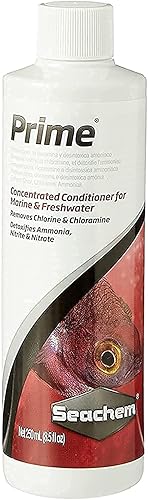
Seachem Prime - 250 ml/ 1.7 fl. oz.
API STRESS COAT Aquarium Water Conditioner 64-Ounce Bottle

API Stress Coat Aquarium Water Conditioner 16-Ounce Bottle
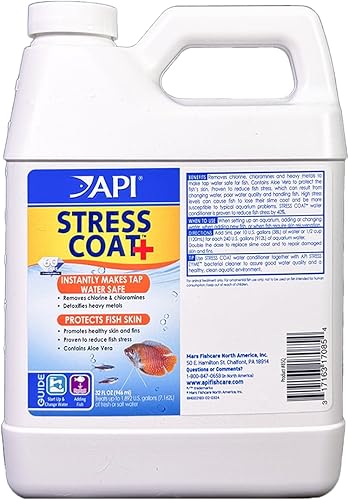
API STRESS COAT Aquarium Water Conditioner 32-Ounce Bottle

API STRESS COAT Aquarium Water Conditioner 8-Ounce Bottle
Tetra AquaSafe Plus 3.38 Ounces, Aquarium Water Conditioner And Dechlorinator

Tetra AquaSafe Plus Water Conditioner & Dechlorinator for Aquarium, 16.9 oz
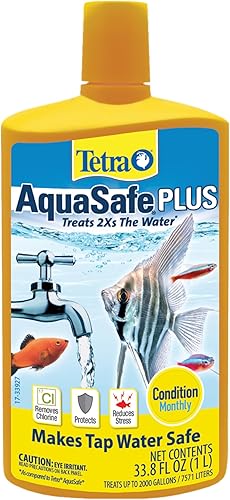
Tetra AquaSafe Plus Water Conditioner & Dechlorinator For Aquarium, 33.8 oz
AcuarioSano rating: combines the average rating and the number of buyer reviews on Amazon. No brand pays to be featured.
What a water conditioner does
Water utilities disinfect the supply with chlorine or chloramine (chlorine bound to ammonia). At tap-water levels they don't bother us, but for fish they are a direct irritant to gills and skin, and they also kill part of the nitrifying bacteria living in your filter. That's why every water change or top-off needs to be treated.
A dechlorinator does exactly that: it neutralizes chlorine and breaks down chloramine the moment you add it. Most formulas also bind heavy metals (copper, zinc, lead) that can leach from old plumbing, which matters if you keep shrimp or snails, both far more sensitive to copper than fish.
Chlorine vs chloramine: why it matters
Free chlorine gasses off if you let water sit for 24-48 hours with aeration, but chloramine doesn't: it's stable and only a conditioner removes it. Breaking it apart releases a small amount of ammonia. In a cycled tank the filter handles that easily; in a new or heavily stocked tank, choose a formula that also temporarily "locks" ammonia, as products like Seachem Prime or API Ammo Lock do.
Most US utilities publish which disinfectant they use in their annual water quality report, and many cities use chloramine. If you're not sure, assume chloramine: every modern conditioner handles it.
Types of water conditioner
| Type | What it does | Advantage | Best for |
|---|---|---|---|
| Basic dechlorinator | Chlorine, chloramine and metals | Cheap, covers the essentials | Stable community tanks |
| Concentrated (Prime-style) | The above plus temporary ammonia and nitrite binding | Tiny doses, lasts a long time | Large tanks, fish-in cycling, emergencies |
| With colloids or aloe | Supports the slime coat | Helpful after shipping or handling | New or stressed fish |
| With vitamins or iodine | Extra additives | More marketing than need | Optional |
| Combined with bacteria | Dechlorinator and bacteria in one bottle | Convenient at setup | New tanks; not a substitute for cycling |
Common brands include Seachem Prime, API Stress Coat and Tap Water Conditioner, Tetra AquaSafe, Fluval Water Conditioner and Fritz. All work when dosed correctly; the real differences are how many gallons each ounce treats and whether it binds ammonia.
How to dose without mistakes
- Dose for the volume of new water, not the whole tank (unless the label says otherwise or you're filling a tank from scratch).
- Add it to the bucket before pouring, or to the tank right before refilling if you use a hose or Python-style refill system.
- Use the cap or a syringe: with concentrates, "eyeballing it" usually means double the dose.
- Match the new water's temperature to the tank.
Tip: a 5 or 10 ml needle-free syringe makes an 8.5 oz (250 ml) bottle of concentrate last months on a 30-gallon (114 l) tank with weekly 20-30% changes, as covered in our guide to water changes.
Warning: a conditioner does not make an uncycled tank safe. Bound ammonia is still there and bacteria must process it: follow our aquarium cycling guide and check with a water test kit.
Common mistakes
- Skipping it on a "small" change: even 10% untreated water can harm gills and bacteria.
- Dosing for the full tank every time: usually not dangerous, but you waste product.
- Assuming aged water is chloramine-free: letting it sit only removes free chlorine.
- Thinking it replaces bacteria: neutralizing isn't cycling; that's what bottled nitrifying bacteria help with.
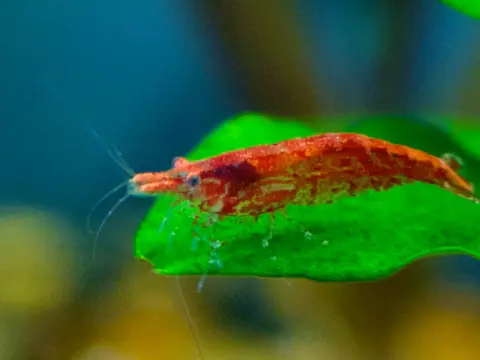
- Ignoring copper with invertebrates: if you keep cherry shrimp, always use a formula that binds heavy metals.
How to choose
For an ordinary community tank, a basic dechlorinator from a known brand is enough. If you have a large tank, do big water changes or are cycling with fish in, a concentrate that binds ammonia pays off in value. With shrimp, look for "heavy metals" or "invertebrate safe" on the label. We compare spec sheets, verified reviews and real-use criteria, but we don't physically test the products.
Frequently asked questions
Can I skip conditioner if I let tap water sit out?
Only if your utility uses free chlorine and you let the water sit 24-48 hours with aeration. If it uses chloramine, aging the water won't work and you need a conditioner. Since you rarely know for sure, the safe choice is to always use it.
What happens if I overdose?
Most conditioners tolerate a moderate overdose (double dose) well. Very large overdoses can lower dissolved oxygen, so add aeration if you went far over.
Does water conditioner remove ammonia?
Some bind it temporarily in a less toxic form for about 24-48 hours, but they don't remove it: your biological filter still has to process it.
Do I need conditioner with RO water?
Not with pure reverse osmosis water, since the membrane and prefilters already remove chlorine. If you blend RO with tap water, treat the tap portion.
You may also like
 Gear reviewAquarium water test kits
 Gear reviewAquarium bacteria starters
 Gear reviewAquarium gravel vacuums
- GuideAquarium Water Changes: How Much, How Often and How To
- GuideAquarium Cycling: The Nitrogen Cycle, Testing and When to Add Fish
 ProfileCherry shrimp
- GuideHow to Acclimate Fish: Floating, Drip Method and Quarantine
- GuideAquarium Water Parameters: Ideal Ranges and How to Test