If you buy through our links, Amazon pays us a small commission at no extra cost to you. That’s how we keep the site running. How we choose.
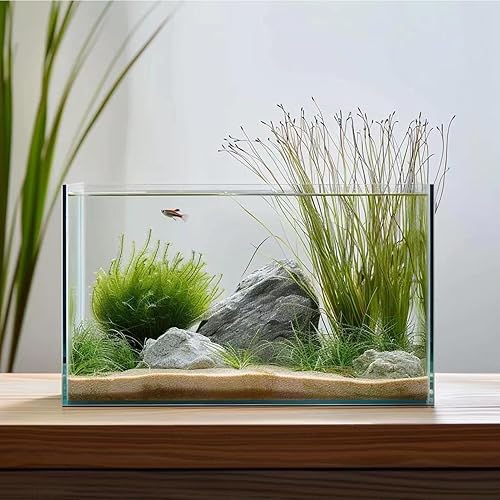
A nano aquarium is a small tank, roughly up to 8 gallons (30 L). This list is generated automatically from our database: it includes every fish and invertebrate whose minimum tank size is 30 litres or less.
Notice that the list is short on fish and long on shrimp and snails. That is deliberate. Many fish sold for small tanks are active swimmers that need far more room than their size suggests. We set our minimums for the species to show natural behavior, not just to survive.
Small tanks are beautiful, but they are less forgiving: temperature swings faster, waste builds up quickly and a dead snail can spike ammonia overnight. To keep a nano tank healthy:
- Cycle it fully and stock lightly; choose one species of fish rather than several.
- Use a gentle filter, a small adjustable heater and live plants.
- Change 20-30 % of the water weekly with conditioned water at the same temperature.
- Feed sparingly: overfeeding is the main nano killer.
Combinations that work well are a single betta with snails, a small school of chili rasboras with cherry shrimp, or a pure shrimp tank. Confirm any mix with the compatibility checker.
Nano tank fish
| Species | Min. liters | Size | Temp. | Difficulty |
|---|---|---|---|---|
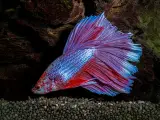 Betta fish Betta splendens | 7 gal (25 L) | 2.4 in (6 cm) | 75–82 °F (24–28 °C) | Easy |
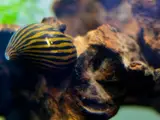 Nerite snail Neritina natalensis | 5 gal (20 L) | 1 in (2.5 cm) | 72–82 °F (22–28 °C) | Easy |
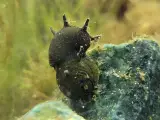 Horned nerite snail Clithon corona | 5 gal (20 L) | 0.6 in (1.5 cm) | 72–82 °F (22–28 °C) | Easy |
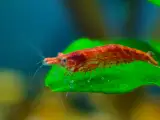 Cherry shrimp Neocaridina davidi | 5 gal (20 L) | 1.2 in (3 cm) | 64–81 °F (18–27 °C) | Easy |
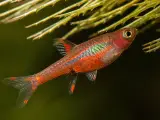 Chili rasbora Boraras brigittae | 8 gal (30 L) | 0.8 in (2 cm) | 72–82 °F (22–28 °C) | Moderate |
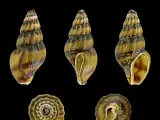 Assassin snail Anentome helena | 5 gal (20 L) | 1 in (2.5 cm) | 72–82 °F (22–28 °C) | Easy |
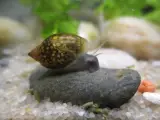 Bladder snail Physella acuta | 3 gal (10 L) | 0.4 in (1 cm) | 59–82 °F (15–28 °C) | Easy |
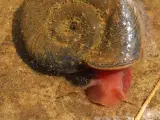 Ramshorn snail (great ramshorn) Planorbarius corneus | 5 gal (20 L) | 1.2 in (3 cm) | 59–77 °F (15–25 °C) | Easy |
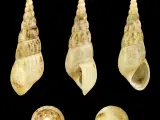 Malaysian trumpet snail Melanoides tuberculata | 5 gal (20 L) | 1.2 in (3 cm) | 68–86 °F (20–30 °C) | Easy |
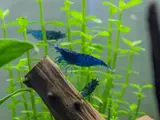 Blue dream shrimp Neocaridina davidi var. Blue Dream | 5 gal (20 L) | 1.2 in (3 cm) | 64–81 °F (18–27 °C) | Easy |
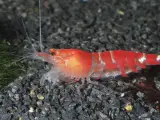 Crystal red shrimp Caridina cantonensis | 8 gal (30 L) | 1 in (2.5 cm) | 64–75 °F (18–24 °C) | Difficult |
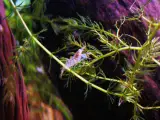 Tiger shrimp Caridina mariae | 7 gal (25 L) | 1.2 in (3 cm) | 64–77 °F (18–25 °C) | Moderate |
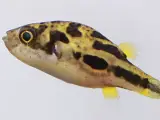 Pea puffer (dwarf puffer) Carinotetraodon travancoricus | 8 gal (30 L) | 1.2 in (3 cm) | 75–82 °F (24–28 °C) | Moderate |
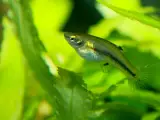 Least killifish Heterandria formosa | 8 gal (30 L) | 1 in (2.5 cm) | 68–79 °F (20–26 °C) | Easy |
No species match those filters.
Frequently asked questions
What is the smallest tank for a fish?
For most fish we recommend at least 8-10 gallons (30-40 L). A betta can live in 5 gallons (20 L) with a heater and filter, and shrimp can do well in similar volumes.
Can I keep neon tetras in a nano tank?
We do not recommend it. Neons are active schooling fish that need a group of 6-10 and more swimming length; 15-20 gallons (60-80 L) is a better minimum.
Are nano tanks harder to maintain?
They need less time per task but more consistency. Small volumes change temperature and water chemistry quickly, so regular testing and water changes matter even more.