If you buy through our links, Amazon pays us a small commission at no extra cost to you. That’s how we keep the site running. How we choose.
Contents
Overview
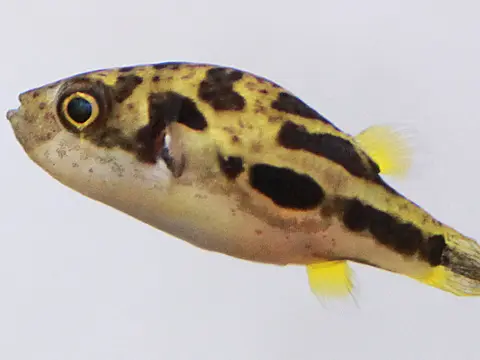
The pea puffer, or dwarf puffer, is one of the smallest pufferfish in the world, reaching only about 1 inch (2.5-3 cm). It comes from freshwater rivers and canals in southwestern India (Kerala and Karnataka) and, unlike many puffers sold in stores, it lives in true freshwater and needs no salt. Its body is greenish-yellow with dark blotches, and its independently moving eyes give it a lively, alert expression.
It is curious, intelligent and learns to recognize its keeper, but its size is deceiving: it is a territorial predator with plenty of attitude. Wild populations have declined because of collection for the aquarium trade, so choose captive-bred fish when you can. It is for hobbyists willing to set up a planted tank just for puffers.
Care and tank setup
One pea puffer can live in 8 gallons (30 L); a small group (one male with several females) needs 15-20 gallons (60-80 L) at least. The key rule is a species-only tank: it nips fins, harasses slow fish and eats shrimp and snails.
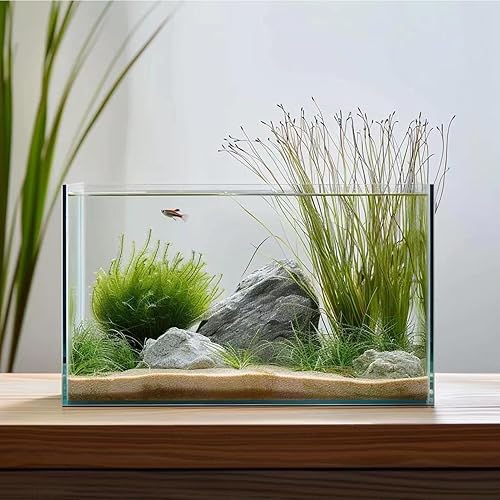
- Decor: densely planted with lots of visual barriers (tall plants, driftwood, moss) to break lines of sight and reduce aggression between puffers.
- Water: freshwater, no salt, clean and mature. It is sensitive to ammonia and nitrite, and its leftovers (snail shells, frozen food) foul the tank; change 25-30% weekly.
- Filter: efficient but with moderate flow.
Males have yellower bellies with a dark line down the middle and are the most aggressive. It is not shrimp-safe: it will eat them. Attempts with very fast surface fish sometimes work, but the risk is high and not recommended. Classic mistake: adding one to a community tank because it is tiny.
Feeding
A strict carnivore that rarely accepts flakes or pellets. Feed frozen or live mosquito larvae, brine shrimp, daphnia and bloodworms and, above all, small snails (pest species such as bladder or ramshorn snails), which help wear down its ever-growing teeth. Keep a separate snail culture so you always have a supply. Offer small portions once or twice a day.
Breeding
Pea puffers breed fairly readily in a well-fed, heavily planted tank. The male courts the female and leads her into moss or fine-leaved plants, where she lays a handful of eggs. Parents provide no care and may eat them. Move the egg-laden moss to a separate container: eggs hatch in about 5 days, and fry need infusoria followed by baby brine shrimp.
What not to keep it with
Popular species you shouldn’t house with the Pea puffer (dwarf puffer), and why.
- Bristlenose pleco: incompatible temperaments
- Cherry barb: incompatible temperaments
- Betta fish: incompatible temperaments, nips long fins
- Common goldfish: incompatible temperatures, one may eat the other due to size, incompatible temperaments
- Bronze cory: incompatible temperaments
- Panda cory: incompatible temperatures, incompatible temperaments
- Zebra danio: incompatible temperatures, incompatible temperaments
- Discus: incompatible temperatures, one may eat the other due to size, incompatible temperaments
Recommended equipment
What you need to keep the Pea puffer (dwarf puffer) healthy, checked against Amazon stock.


Frequently asked questions
How many liters does a Pea puffer (dwarf puffer) need?
At least about 30 liters. More space always helps keep the water stable.
What water temperature does the Pea puffer (dwarf puffer) need?
Between 24 and 28 °C, with a pH of 6.5 to 7.8.
What fish can live with the Pea puffer (dwarf puffer)?
This species is best kept alone or with very few carefully chosen tank mates.
Can the Pea puffer (dwarf puffer) be kept with shrimp?
Not recommended: because of its size or instinct, it will eat shrimp.