If you buy through our links, Amazon pays us a small commission at no extra cost to you. That’s how we keep the site running. How we choose.
Contents
Overview
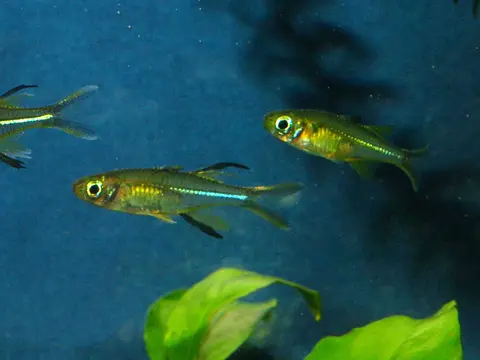
The forktail blue-eye (Pseudomugil furcatus) is a small relative of the rainbowfish that barely reaches 2 in (5 cm). It has a translucent yellowish body, a bright sky-blue ring around the eye and vivid yellow fins edged in black, with a forked tail. Males carry larger, more colorful dorsal and anal fins.
It comes from clear, well-vegetated streams in eastern Papua New Guinea. People love its color, the males' nonstop courtship as they flare their fins at females, and the fact that it's a peaceful fish ideal for small and mid-size planted tanks. Its weak point is a short lifespan, usually 2-3 years.
Care and tank setup
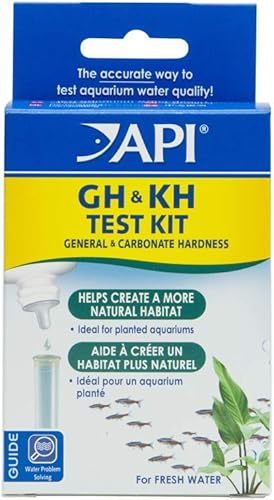
A group fits in a 15-gallon (60 L) tank with a 24 in (60 cm) front, though it looks better in 20-25 gallons. It prefers clean, stable water with a neutral to slightly alkaline pH and moderate hardness. It doesn't cope well with nitrate buildup or sudden swings, so stick to small, regular water changes.
- Keep 8 or more, with more females than males.
- Lots of plants, some floaters and open space near the top, where it spends most of its time.
- Gentle to moderate flow and a tight lid: it jumps.
It's very peaceful and a bit shy, so pair it with small, calm fish such as rasboras, dwarf tetras, pygmy corydoras, otocinclus or honey gouramis, plus shrimp. Avoid nervous barbs and large fish. A classic mistake is adding stressed store fish to a brand-new tank.
Feeding
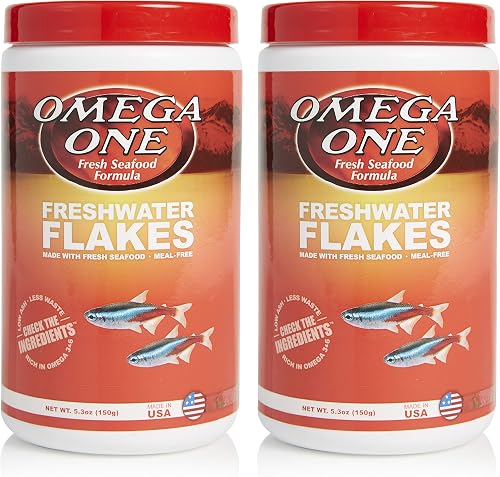
It feeds at the surface and in midwater. Offer small foods: quality micro-pellets or crushed flakes, plus frequent live or frozen brine shrimp, daphnia, cyclops or moina, which boost color and activity. Several small feedings a day work best. It rarely forages on the bottom, so anything that sinks goes to corydoras or shrimp.
Breeding
It breeds readily: males court every day and females lay a few large, sticky eggs on moss, floating-plant roots or a yarn mop. Adults eat them, so most keepers collect the mop and hatch the eggs separately. They hatch in 10-20 days, and fry take infusoria and liquid fry food right away, then baby brine shrimp soon after. Raising a few generations offsets its short life.
Compatible tank mates
Species from our database that share water parameters, size and temperament with the Forktail blue-eye. Calculated from the data in each profile.
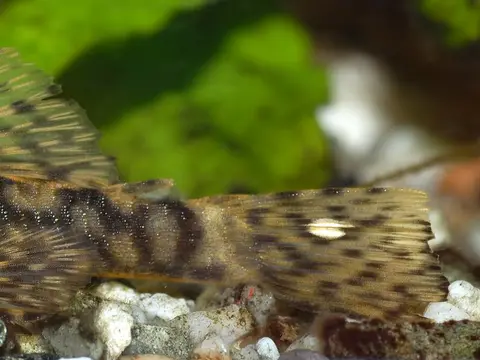 Bristlenose pleco Ancistrus sp. 26 gal (100 L) · 72–81 °F (22–27 °C)
 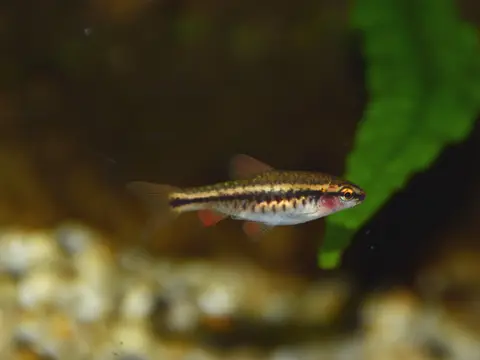 Cherry barb Puntius titteya 16 gal (60 L) · 73–81 °F (23–27 °C)
 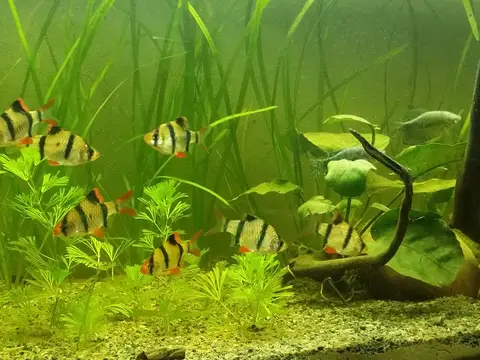 Tiger barb Puntigrus tetrazona 26 gal (100 L) · 72–79 °F (22–26 °C)
 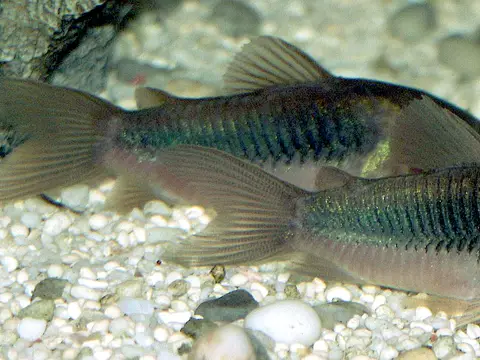 Bronze cory Corydoras aeneus 21 gal (80 L) · 72–81 °F (22–27 °C)
 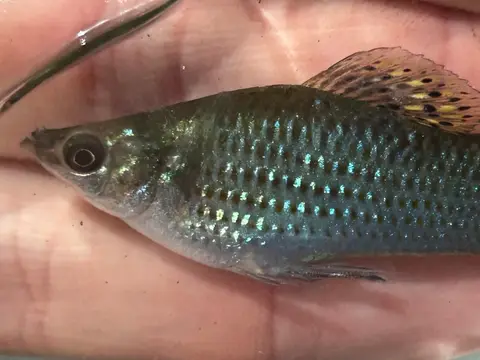 Molly Poecilia sphenops 26 gal (100 L) · 75–82 °F (24–28 °C)
 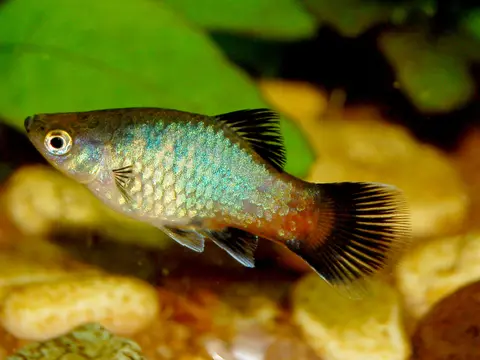 Platy Xiphophorus maculatus 16 gal (60 L) · 68–79 °F (20–26 °C)
 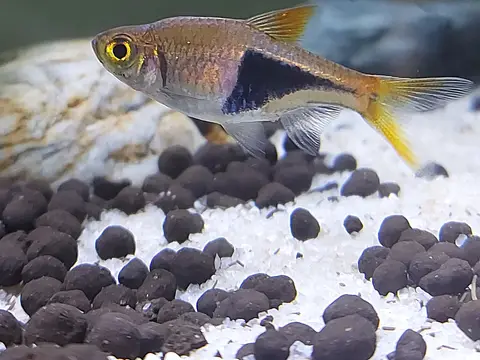 Harlequin rasbora Trigonostigma heteromorpha 16 gal (60 L) · 72–81 °F (22–27 °C)
 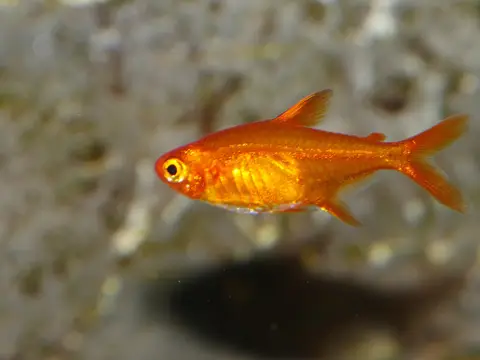 Ember tetra Hyphessobrycon amandae 11 gal (40 L) · 73–82 °F (23–28 °C)
 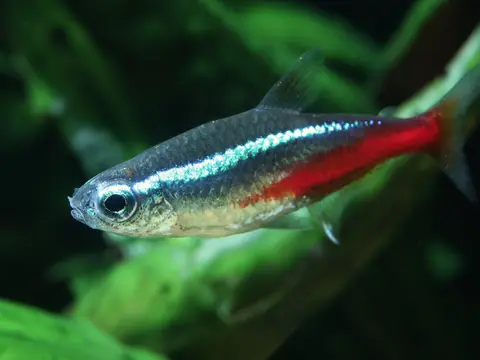 Neon tetra Paracheirodon innesi 16 gal (60 L) · 68–79 °F (20–26 °C)
 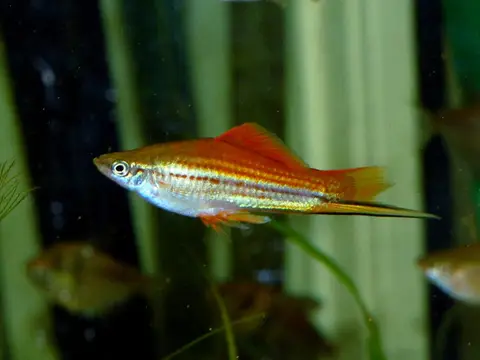 Swordtail Xiphophorus hellerii 32 gal (120 L) · 72–81 °F (22–27 °C)
 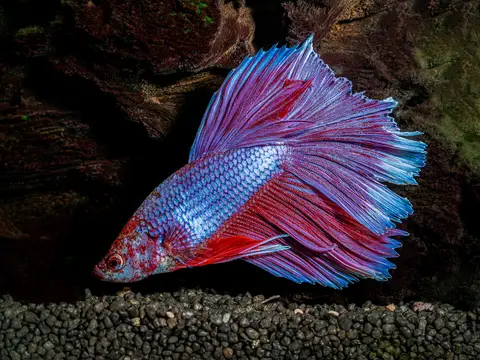 Betta fish Betta splendens 7 gal (25 L) · 75–82 °F (24–28 °C)
 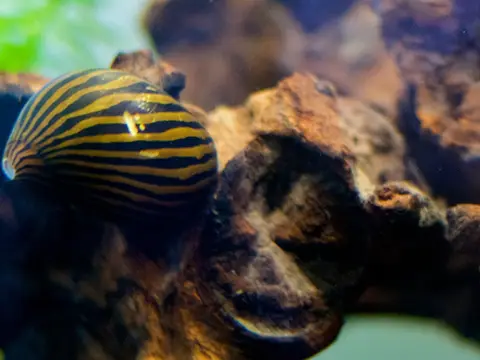 Nerite snail Neritina natalensis 5 gal (20 L) · 72–82 °F (22–28 °C)
 Check the compatibility of your whole tank →
What not to keep it with
Popular species you shouldn’t house with the Forktail blue-eye, and why.
- Common goldfish: incompatible temperatures, one may eat the other due to size
- Angelfish: one may eat the other due to size
- Clown loach: one may eat the other due to size
- Oscar: one may eat the other due to size, incompatible temperaments
Recommended equipment
What you need to keep the Forktail blue-eye healthy, checked against Amazon stock.


Frequently asked questions
How many liters does a Forktail blue-eye need?
At least about 60 liters for a group of at least 8 fish. More space always helps keep the water stable.
What water temperature does the Forktail blue-eye need?
Between 24 and 28 °C, with a pH of 7 to 8.
What fish can live with the Forktail blue-eye?
Based on water, size and temperament, it fits with species such as Bristlenose pleco, Cherry barb, Tiger barb, Bronze cory and Molly. Use our compatibility calculator to check your whole tank.
Can the Forktail blue-eye be kept with shrimp?
Yes: it usually won’t eat adult shrimp, though some shrimplets may get picked off. A tank with plenty of moss gives the babies cover.