If you buy through our links, Amazon pays us a small commission at no extra cost to you. That’s how we keep the site running. How we choose.
Contents
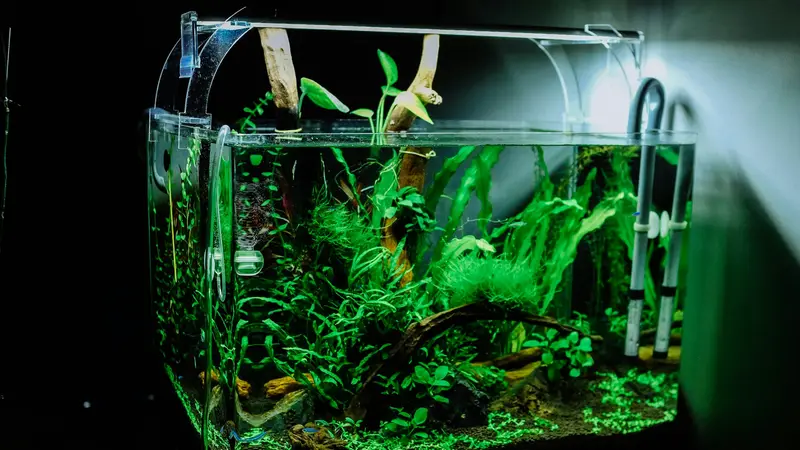
A well-planned first aquarium hooks you for life; a badly planned one ends up empty in the garage three months later. The difference is rarely money. It comes down to three decisions: tank size, patience during cycling and fish choice. This guide covers which tank to buy, which equipment is essential and what can wait, which species are genuinely easy and how to plan the first few weeks so everything goes smoothly.
If you only read this: pick a tank of 15 to 29 gallons (55-110 L), ideally a complete kit; cycle it for four to six weeks before adding fish; start with hardy species, a few at a time; and buy a liquid test kit on day one.
What size tank to choose
Starting small sounds sensible, but it's the other way around: the more water, the more stable the tank. In a small volume, a little extra food, a dead fish or a hot day can swing your water parameters within hours. In 20 or 29 gallons those same mistakes get diluted and give you time to react.
| Volume | For beginners | What it allows |
|---|---|---|
| Under 8 gallons (30 L), nano | Difficult: little room for error | Shrimp, a single betta, very small fish |
| 15-20 gallons (55-75 L) | A very good place to start | A school of tetras or guppies, corydoras, shrimp |
| 29-32 gallons (110-120 L) | The ideal choice if you have space | Several schools, more stability, plants |
| 55 gallons (200 L) or more | Doable, but pricier and heavier | Medium-sized fish, angelfish, big schools |
For most people a 15- to 20-gallon tank is the best balance of space, cost and stability. Our roundup of 15-gallon (60 L) aquariums goes through the most common models and what each kit includes. Pay attention to shape too: a long, low tank beats a tall, narrow one because it has more surface area for gas exchange and more swimming room. That's why the classic 20-gallon long is such a popular first tank.
No fishbowls. A bowl with no filter or heater isn't suitable for any fish, including goldfish and bettas. Goldfish need a large, well-filtered coldwater tank, and a betta needs at least a small tank with a gentle filter and a heater.
Budget: where to spend and where to save
We don't quote prices because they change daily, but here's how to split your money. Complete kits (tank, lid, LED light and filter, sometimes a heater too) from brands like Fluval, Aqueon, Tetra or Marineland usually cost less than buying the parts separately and guarantee everything fits together.
- Worth spending on: a good quiet filter, a reliable heater with a thermostat, a liquid test kit and a sturdy stand.
- Fine to save on: decor (a piece of driftwood and a few rocks are plenty), high-end lights (easy plants don't need them) and unnecessary gadgets.
- Ongoing costs: food, water conditioner, the occasional filter cartridge or sponge and electricity, which is modest for a 15-gallon tank and mostly comes from the heater in winter.
Essential equipment
- Tank with a lid: stops jumpers and evaporation.
- Filter: turning over 3 to 5 times the tank volume per hour. Runs day and night.
- Heater: about 4 W per gallon (~1 W/L) for tropical fish at 75-81 °F (24-27 °C).
- Thermometer: cheap and essential.
- LED light on a timer: 6 to 8 hours a day.
- Substrate: rinsed gravel or sand, or a plant substrate if you want lots of plants.
- Test kit: at least ammonia, nitrite, nitrate and pH.
- Water conditioner, a bucket used only for the aquarium, a gravel vacuum and a net.
We explain how to put it all together in the right order in how to set up a fish tank step by step.
Easy fish and plants to start with
A good beginner fish is hardy, peaceful, stays reasonably small and eats flake food. These species tick those boxes in a tropical tank of 15 gallons (60 L) or more:
| Species | Temperature | Minimum group | Notes |
|---|---|---|---|
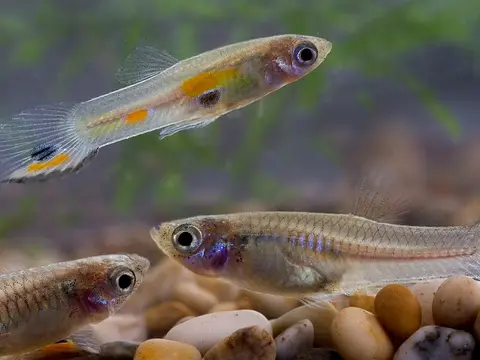
| Guppy | 72-82 °F (22-28 °C) | 3-5 (more females than males) | Breeds readily; expect fry |
| Platy | 68-79 °F (20-26 °C) | 3-5 | Very hardy and calm |
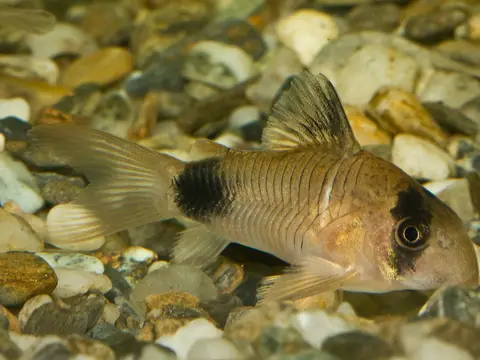
| Panda corydoras | 70-77 °F (21-25 °C) | 6 | Bottom dweller; needs sand or smooth fine gravel |
| Neon tetra | 70-79 °F (21-26 °C) | 10 | Best once the tank has been stable for a few weeks |
| Harlequin rasbora | 72-81 °F (22-27 °C) | 8-10 | Peaceful and eye-catching in a group |
| Cherry shrimp | 68-79 °F (20-26 °C) | 10 | For mature tanks; larger fish will eat them |
For plants, start with species that don't need CO2 or strong light: Java fern and Anubias are tied to wood or rock, while Cryptocoryne and Vallisneria go into the substrate. How many fish your tank can hold depends on each species' adult size and behavior; we cover that in how many fish can go in a tank.
At the start, avoid discus, oscars, bala sharks (they get huge), African cichlids and delicate species. And never buy a fish without knowing its adult size.
A plan for the first weeks
A tank's first month isn't about fish, it's about bacteria. This rough timeline helps you avoid rushing:
| When | What to do |
|---|---|
| Day 1 | Setup: substrate, hardscape, plants, conditioned water, filter and heater running |
| Weeks 1-4 | Cycling with an ammonia source; test every 2-3 days; light about 6 hours |
| Weeks 4-6 | Ammonia and nitrite at 0 for several days: big water change and first hardy fish |
| 2 weeks later | If readings stay good, add the second group of fish |
| From then on | 20-30% water change weekly, wipe the glass and give the filter a quick check once a month |
All the details, including a testing schedule, are in our guide to aquarium cycling. When the fish arrive, acclimate them by floating the bag for 15-20 minutes and feed what they finish in 2-3 minutes, once or twice a day. If you can, quarantine fish you add later for two to four weeks.
Classic beginner mistakes
- Adding fish the same day you set up the tank. It's the most common mistake and the one that kills the most fish.
- Choosing a tank that's too small because it seems easier.
- Impulse-buying fish without knowing their adult size, temperature needs or compatibility.
- Overfeeding: leftover food rots and sends ammonia up.
- Changing all the water or scrubbing the filter under the tap: you lose your bacteria colony.
- Leaving the light on 12 hours or more: guaranteed algae.
- Not owning a test kit and guessing what's wrong when a fish gets sick.
- Releasing fish or plants into ponds or creeks when you no longer want them: it's illegal and harmful. Rehome them or take them back to a store.
Recommended gear for this guide


Frequently asked questions
What size tank is best for a beginner?
Somewhere between 15 and 29 gallons. That's big enough for stable water parameters that forgive mistakes, yet small enough to fit in almost any home without making maintenance a chore. Nano tanks under 8 gallons are harder, not easier.
What are the easiest fish for a first aquarium?
Guppies, platies, panda corydoras, harlequin rasboras and, once the tank is stable, neon tetras. They're all peaceful, stay small and eat flake food. Pick one or two schooling species and respect the minimum group size for each.
How long do I have to wait before adding fish?
Four to six weeks, the time it takes to cycle the tank. It's ready when ammonia and nitrite read 0 for several days in a row and nitrate shows up. After that, add fish gradually in two or three batches.
Is a complete kit better than buying equipment separately?
For a first aquarium, a complete kit is usually the best option: it costs less, everything is compatible and it already comes with a filter and light sized for the tank. Just check whether it includes a heater and whether the filter is enough for the fish you have in mind.
How much maintenance does an aquarium need?
For a well set-up 15 to 29 gallon tank, about 30 to 45 minutes a week for a 20 to 30 percent water change and cleaning the glass, plus a few minutes a day to feed and check the temperature. The filter gets a check roughly once a month.
You may also like
- GuideHow Much Does an Aquarium Cost? Setup Budget and Real Monthly Costs
- GuideHow to Set Up a Fish Tank Step by Step: From Stand to First Fish
- GuideHow to Set Up a Nano Tank: Equipment, Stocking and Maintenance
- Gear review15 gallon aquariums
 ProfileGuppy
 ProfilePanda cory
- Gear reviewAquarium water test kits
- Gear reviewFish flakes and micro pellets