If you buy through our links, Amazon pays us a small commission at no extra cost to you. That’s how we keep the site running. How we choose.
Contents
Overview
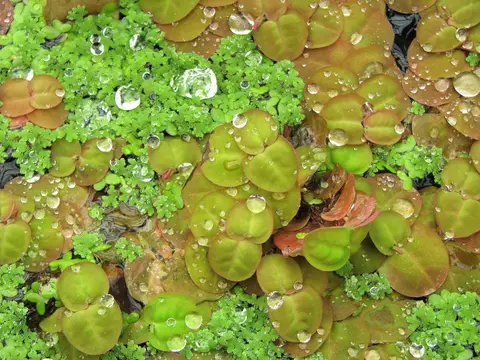
The red root floater (Phyllanthus fluitans) is a small floating plant from slow, quiet rivers in the Amazon basin. It forms chains of round, slightly cupped leaves about 0.4 inch (1 cm) across that turn red under good light and iron, as do its fine dangling roots.
It is one of the most decorative floaters: it adds color to the surface, casts soft shade, gives fry and surface fish cover, and soaks up nutrients that would otherwise feed algae. It grows at a moderate pace, far easier to manage than duckweed, though it is a bit more delicate. It is ideal for tanks with bettas, dwarf gouramis or blackwater tetras.
Care and tank setup
It works in tanks from about 8 gallons (30 liters) up, but success depends on the surface. It needs calm water; strong flow wets the tops of the leaves, sinks them and causes rot. It also dislikes condensation dripping from the lid, so leave some ventilation or a couple of inches of air.
- Light: medium to high. More light and iron give a much deeper red; in low light it stays green.
- Water: soft to moderately hard and stable.
- Surface: keep it to no more than half.
It suits peaceful fish; goldfish and herbivores will devour it. Typical mistakes: adding it to a tank where the filter outlet churns the surface, and not thinning it once it settles in. Never release it outdoors; throw extras in the trash or compost.
Fertilizing and trimming
Because it pulls nutrients straight from the water, liquid fertilizer is the key to color: dose a product with iron and micronutrients regularly. Pale or yellowish leaves usually signal low iron or nitrogen. Maintenance means removing older or damaged plants and thinning the excess every week or two. If an oily film forms on the surface, skim it off, since it hinders growth.
Propagation
It spreads by division: each rosette produces side shoots that gradually separate into new plants. All you need is stable, good conditions. Right after moving to a new tank it may stall for a few weeks; once adjusted, it grows steadily. Share spare chains with fellow hobbyists or dispose of them in the trash.
Recommended equipment
What you need to keep the Red root floater (Phyllanthus fluitans) healthy, checked against Amazon stock.

Frequently asked questions
What light and CO₂ does Red root floater (Phyllanthus fluitans) need?
Light: medium. CO₂: not needed. Growth: moderate.
Is it a good plant for beginners?
It’s manageable if you have decent lighting and fertilize regularly.
You may also like
 ProfileDuckweed (Lemna minor)
 ProfileRicciocarpus (purple-fringed riccia)
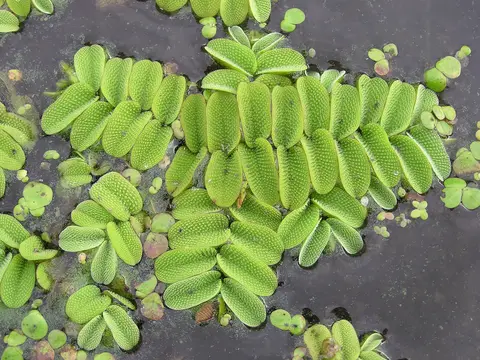 ProfileSalvinia (Salvinia natans)
- Gear reviewPlanted aquarium LED lights
- Gear reviewAquarium plant fertilizers
- GuidePlanted Tank for Beginners: Light, Substrate, Fertilizer and CO2
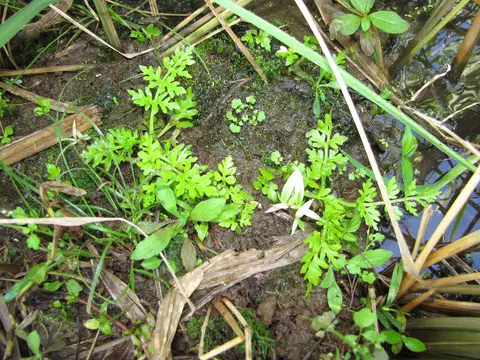 ProfileWater sprite
- GuideCO2 in a Planted Tank: When You Need It and How to Dial It In
Floating plants → Aquarium plants → Complete aquarium guide →