If you buy through our links, Amazon pays us a small commission at no extra cost to you. That’s how we keep the site running. How we choose.
Contents
Our top 3 picks
Stock checked on October 7, 2026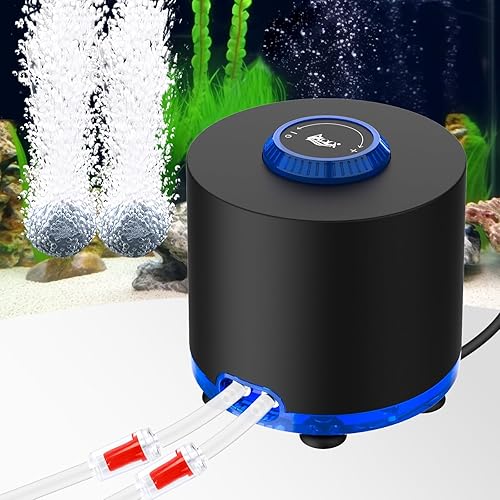


aquarium air pumps and air stones comparison, in stock
AQQA Aquarium Air Pump, 3W Powerful Dual Outlet Adjustable Oxygen Aerator
Pawfly 13 Feet Airline Tubing Standard Aquarium Air Pump Accessories with Air Stones, Check Valves, Suction Cups and…
Tetra Whisper Air Pump for Up to 10 Gallon Aquariums, Non-UL

Tetra Whisper Air Pump for Aquariums Up to 40 Gallons, Non-UL

Tetra Whisper Air Pump for Aquariums Up to 100 Gallons, Non-UL

Tetra Whisper Air Pump for Aquariums Up to 60 Gallons, Non-UL

Uniclife Aquarium Air Pump Dual Outlet Fish Tank Aerator with Accessories for 5-200 Gallon Tank
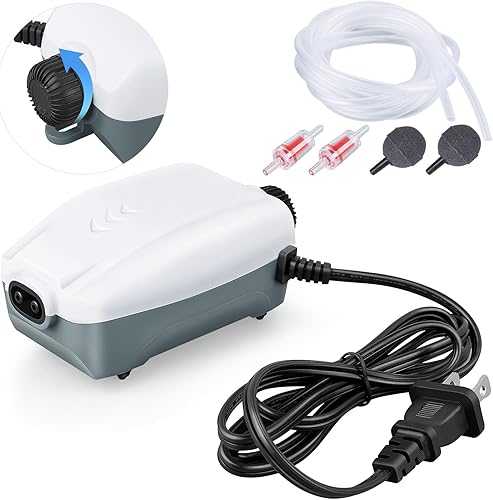
HITOP Dual Outlet Aquarium Electric Air Pump, Whisper Adjustable Fish Tank Aerator, Quiet Oxygen Pump with Accessories…
AcuarioSano rating: combines the average rating and the number of buyer reviews on Amazon. No brand pays to be featured.
Does your aquarium need an air pump?
Fish don't breathe the bubbles: oxygen enters the water at the surface. What an air pump does is ripple that surface and circulate the water, so gas exchange happens much faster. If your filter already breaks the surface well and the tank isn't overstocked, a tropical aquarium usually has plenty of oxygen without an air pump.
Still, there are times when you want one running, or at least sitting in a drawer:
- Heat waves: warm water holds less oxygen. Above 82-84 °F (28-29 °C), fish feel it fast.
- Medication: many treatments, and especially raising the temperature to fight ich, lower available oxygen.
- Heavily stocked tanks or big fish like goldfish and cichlids.
- Sponge filters: sponge filters are driven by an air pump.
- At night in planted tanks with CO2: with the lights off, plants consume oxygen.
Types of air pumps and diffusers
| Gear | What it's for | Pros | Cons | Best for |
|---|---|---|---|---|
| Small diaphragm pump (1 outlet) | one air stone or sponge filter | cheap, low power draw | budget models can buzz | tanks up to about 25 gallons (100 liters) |
| Diaphragm pump, 2-4 outlets | several stones or filters with valves | adjustable flow per outlet | louder if poorly placed | 25-80 gallons (100-300 liters) or multiple tanks |
| Battery or rechargeable USB pump | emergencies and power outages | runs without the grid | low output, limited runtime | backup, transporting fish |
| Air stone or bubble wand | breaking the air into bubbles | cheap, easy to replace | clogs over months | every tank |
| Disc or fine ceramic diffuser | finer, quieter bubbles | less splashing | needs more pressure | living-room tanks, nanos |
Brands like Tetra (Whisper), Aqueon, Eheim, Fluval, Hygger and Uniclife make pumps in every size. Check the output and the maximum depth: a tiny pump may struggle to push air down a tall tank.
Choosing a quiet pump
Noise is the number-one complaint. Most of it doesn't come from the bubbles but from diaphragm vibration transferred to the stand. A few fixes:
- Pick a pump with rubber feet and, ideally, flow control: a larger pump running gently is quieter than a small one at full blast.
- Set it on a sponge or mat, never directly on wood or glass.
- Hang it by its tubing instead of setting it down, or put it in a ventilated cabinet.
- Use a fine-bubble diffuser if splashing bothers you in a bedroom.
Tip: always keep a small spare air pump. In the middle of summer, with the water at 86 °F (30 °C), or while treating sick fish, being able to add aeration in five minutes makes all the difference. Pair it with a cooling fan to bring the temperature down.
Check valve and setup
If the pump sits below the waterline and the power goes out, water can siphon back down the tubing into the pump and toward the outlet. That's why a check valve on the airline, close to the tank and with the arrow pointing toward the stone, is a must. Alternatively, place the pump above the waterline, and always give the airline and power cord a drip loop.
Warning: in planted tanks with injected CO2, heavy aeration during the day drives off the CO2 you're paying for. If you run an air pump, put it on a timer so it only runs at night. More details in our guide to CO2 in the aquarium.
Common air pump mistakes
- Putting the pump on the floor with no check valve.
- Assuming more bubbles are always better: bettas and other calm-water fish get stressed by strong currents.
- Not replacing a clogged air stone, which strains the diaphragm.
- Using old, stiff airline tubing that cracks and leaks.
- Turning the air pump off during a treatment or heat wave, exactly when it's needed most.
If your home runs hot, also read our guide to aquarium temperature.
For this comparison we review spec sheets, verified reviews and real-world use criteria, but we don't physically test the products.
Frequently asked questions
Do I need an air pump in my aquarium?
Not always. If your filter moves the surface well and the tank isn't overstocked, oxygen is usually fine. An air pump is strongly recommended during heat waves, medication, in heavily stocked tanks and with sponge filters.
Can I leave the air pump on 24/7?
Yes, they're designed to run continuously. The exception is planted tanks with injected CO2, where it's better to run the pump only at night so it doesn't drive off the CO2.
What does a check valve do?
It stops water from siphoning back down the airline into the pump when it turns off or the power fails. It's essential whenever the pump sits below the waterline.
How can I make my air pump quieter?
Set it on a sponge or mat, hang it by the tubing or place it in a ventilated cabinet, and use a slightly larger pump turned down. A fine-bubble diffuser also reduces splashing.
You may also like
 Gear reviewSponge filters
 Gear reviewAquarium heaters
 Gear reviewAquarium cooling fans
- GuideIch (White Spot Disease) in Fish: Symptoms, Life Cycle, Treatment
- GuideCO2 in a Planted Tank: When You Need It and How to Dial It In
 ProfileBetta fish
- GuideAquarium Without a Filter or Heater: Can You Do It Safely?
- GuideAquarium Temperature: Ideal Range, Heaters, Summer and Outages